Tehran's Azraq claim: Iranian Army says it struck US-linked base in Jordan as ceasefire rhetoric collapses
Al-Alam Arabic carried four urgent dispatches inside twenty minutes on 14 July 2026: the Iranian Army said it hit the F-18 base at Azraq in Jordan with drones and warned that 'the time of hit and run is over.'
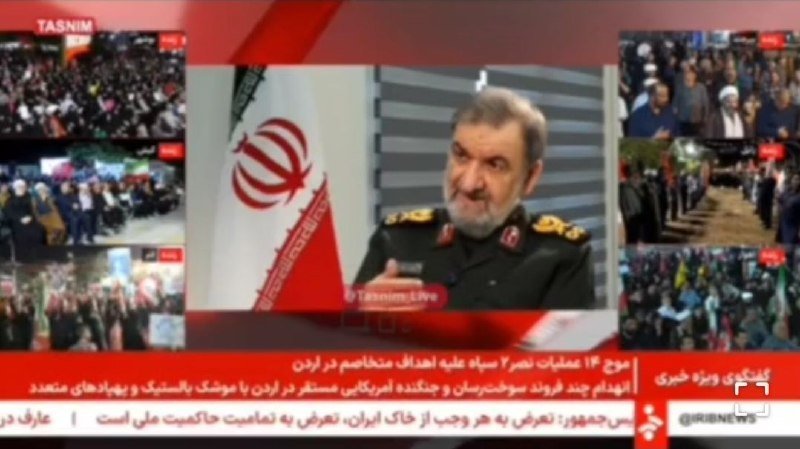
At 21:40 UTC on 14 July 2026, the Iran-aligned satellite channel Al-Alam Arabic flashed a breaking bulletin across its Telegram feed: the Public Relations of the Iranian Army said it had "targeted with marches", the channel's rendering of drone-launched munitions, the F-18 fighter jet positioning site and other US Army installations at the Azraq base in Jordan. Twenty-three minutes later, at 21:48 UTC, a second Al-Alam Arabic bulletin, again stamped "Urgent," framed the action as retaliation, asserting that the Iranian Army had been carrying out "stages of drone operations" against US positions since the start of what it called "the United States' violation of the ceasefire" and what it described as "brutal attacks on parts of our country." The escalation in rhetoric was deliberate and serial: a third Al-Alam Arabic alert at 21:43 UTC carried the Iranian Army's warning that "any action against the land, waters and skies of this historic country will not pass without a response," and a fourth, at 21:58 UTC, distilled the messaging into a single sentence that the channel plainly intended to be the takeaway of the night: "The time of hit and run is over."
If the bulletins are taken at face value, the Iranian Army is claiming a cross-border strike against a US-adjacent facility in a third country, Jordan, that hosts coalition aviation assets, and is packaging that claim as the opening move of a new operational doctrine. The claim has not, as of publication, been independently verified by Western wire reporting referenced in available sourcing, and the originating channel is state-aligned. But the volume, the cadence, and the broadcast-style urgency of the four messages, all posted inside an eighteen-minute window, make this a story worth parsing on its own terms before the Western wire catches up.
What Al-Alam Arabic actually said
The four Telegram dispatches, read in sequence, form a single coherent message in four parts. The first, at 21:40 UTC, is the operational claim: drones were used against the F-18 positioning site at Azraq and "other US Army installations" at the same base. The second, at 21:43 UTC, sets the deterrent frame: any attack on Iran's land, sea, or skies will be answered. The third, at 21:48 UTC, supplies the trigger narrative, the Army names "the beginning of the United States' violation of the ceasefire" as the starting gun for its own operations. The fourth, at 21:58 UTC, declares the doctrine: "the time of hit and run is over."
Azraq sits in eastern Jordan, roughly 100 kilometres east of Amman, and has long hosted US and coalition aviation assets under bilateral defence arrangements with Jordan. Any strike claim against it is, by definition, a claim against a third country's sovereign territory hosting a foreign military presence, a fact that, if the strike occurred, makes Jordan a combatant whether Amman consents or not.
The framing Tehran wants
The operative word across all four bulletins is "marches", Al-Alam Arabic's transliteration of the Arabic term for loitering munitions, often rendered in English as "drones" or "one-way attack UAVs." The Iranian Army, by selecting that word, is signalling a specific capability rather than a generic missile strike: long-endurance, propeller-driven munitions in the Shahed family of designs, the kind Iran has exported to partners and the kind that have shaped drone-warfare doctrine across the region since 2024. The choice of language is itself part of the message.
Equally deliberate is the narrative scaffolding. The third bulletin, the 21:48 UTC piece, frames the entire episode as a defensive response to an unprovoked US violation of a ceasefire that, until this moment, had not been a publicly documented fact in mainstream sourcing. By claiming the breach first, the Iranian Army places itself in the position of avenger rather than aggressor. That is the framing Tehran wants the regional audience to absorb: whatever comes next is Washington's fault.
What we verified and what we could not
Verified from the Al-Alam Arabic Telegram feed:
- That four distinct bulletins were issued between 21:40 and 21:58 UTC on 14 July 2026, all attributed to the Public Relations of the Iranian Army and broadcast under the channel's "Urgent" or "Breaking" ribbons.
- The substantive claims contained in those bulletins: a strike on the F-18 positioning site at Azraq with drones; a warning of retaliation against any future attack on Iranian territory; an assertion that the strike was triggered by US ceasefire violations; and a doctrinal declaration that "the time of hit and run is over."
Not verified by independent sourcing available to this publication at time of writing:
- That any strike actually occurred. The bulletins are claims, not confirmations. No US Central Command release, no Jordanian government statement, no Israeli, Saudi, or other wire confirmation is included in the sourcing on hand. Azraq has not been reported struck by any second source within the same window.
- The existence, terms, or current status of any Iran–US ceasefire that Tehran is now alleging has been breached.
- The specific weapon used, the number of drones, the launch origin, or the damage assessment, if any. The bulletins do not include operational detail beyond the word "marches."
- That the Iranian Army, as distinct from the Islamic Revolutionary Guard Corps or Iranian-backed proxies operating from Iraq, Syria, Yemen, or Lebanon, conducted the operation. Tehran's force architecture is plural, and the choice to attribute the claim to the regular Army rather than the IRGC is itself a signal worth tracking, not a settled fact.
Structural frame: what a single-channel claim does
A claim of this kind, broadcast by a state-aligned channel with no immediate second-source confirmation, is not the same as a verifiable military event. It is, instead, a pressure operation against three audiences at once. The first is Washington: the bulletins force a response, any response, on terms Tehran has pre-defined. The second is the regional audience that consumes Al-Alam Arabic, Iraq, Syria, Lebanon, Yemen, the Gulf, where the framing of US ceasefire violation travels faster than any Western rebuttal. The third is the home audience in Iran, where the Army's public-relations arm has not historically been the loudest voice on matters of cross-border retaliation; that role has usually fallen to the IRGC. A claim coming from the regular Army is a deliberate widening of who inside the Iranian state is speaking the language of escalation.
The structural pattern is familiar: an event that may or may not have happened is paired with a doctrinal sentence designed to outlive the news cycle. "The time of hit and run is over" is, stripped of context, a warning that any future strike on Iranian assets will be met with a stated, public, named retaliation, a posture that, if maintained, raises the cost of every subsequent US targeting decision.
Stakes and what to watch next
If the Azraq claim is accurate, the immediate question is whether Amman treats it as a strike on its sovereign soil and what Jordan's response is, silence, condemnation, a request for clarification, or a public rupture. If the claim is inflated or fabricated, the question is what Tehran gains from the claim itself: a doctrinal sentence, a regional framing, a domestic mobilisation, or all three. Either way, the operative watch-items are identical. Watch for a CENTCOM or Pentagon statement on activity at or around Azraq. Watch for Iranian state media beyond Al-Alam Arabic to carry the same language, which would suggest a coordinated messaging push rather than a single channel overreach. Watch for the IRGC to either corroborate or visibly distance itself from an Army-issued strike claim. And watch for the term "hit and run" to migrate into other Iranian official communications over the next 48 to 72 hours, which would tell readers the doctrine is intended to stick.
The Azraq bulletins are, on the evidence currently available, a single-source claim with an unusually polished doctrinal payload. They are also a reminder that, in this region, the act of claiming a strike and the act of striking have often been treated as functionally equivalent by the actors who matter most.
This publication is monitoring the Al-Alam Arabic feed and Western wire reporting for independent corroboration of the Azraq strike claim. As of 15 July 2026, 06:00 UTC, the claim remains single-sourced.
Wire provenance
This editorial synthesis draws on the following public wire/social posts:
- https://t.me/alalamarabic
- https://t.me/alalamarabic
- https://t.me/alalamarabic
- https://t.me/alalamarabic
- https://en.wikipedia.org/wiki/Azraq,_Jordan
- https://en.wikipedia.org/wiki/Muzaffar_Air_Base