Trump sells the family crypto while warning Beijing wants it: the contradictions at the centre of a White House digital-asset push
A president publicly demands restraint on AI energy costs, privately cashes in on the tokens he promotes, and tells voters Beijing wants the same sector. The contradictions are not messaging, they are the product.
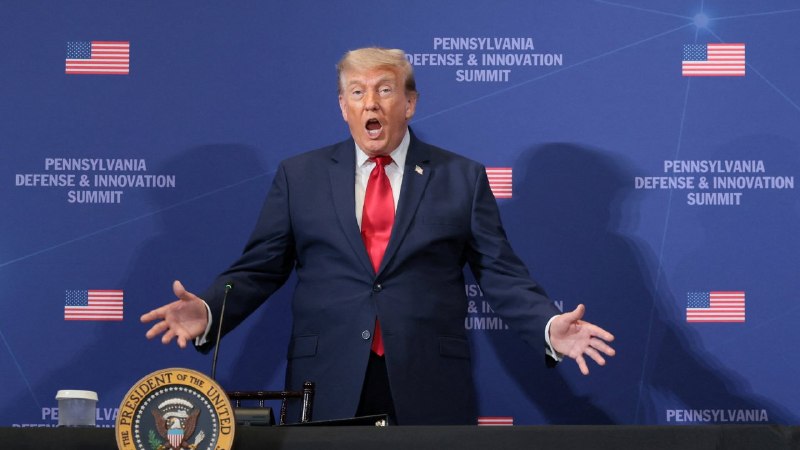
At 16:59 UTC on 13 July 2026, the prediction-market account @Polymarket posted a single sentence: Donald Trump had warned that China is trying to take "complete and total control" of crypto and AI. The same week, his son Eric was on Telegram via @WatcherGuru, declaring on 11 July at 22:14 UTC that "ETH is pumping hard…Crypto is the future." Two days before that, the @unusual_whales account on X had published a tally concluding that Trump personally earned more from crypto than every publicly traded US crypto company combined. The family business is now the loudest voice in the room, and the geopolitical message is doing double duty: national-security warning and political marketing.
The pattern is not new, but the scale is. A sitting American president is warning voters that a strategic rival wants dominance over a sector in which his own immediate family holds the most prominent US retail position. The pitch, taken at face value, is that Washington must move first. The pitch, taken at the second face, is that the family should keep moving first, and that any framework regulating the industry should be one they helped write. The two messages have not yet had to be reconciled, but a data-centre electricity fight is now forcing the issue.
A pledge the White House knows it cannot enforce
On 13 July at 16:09 UTC, @Polymarket reported that Trump is planning to ask companies to sign a voluntary pledge to keep AI data centres from driving up electricity bills. The word that does the work is voluntary. The compute build-out powering AI training, and the speculative crypto infrastructure that sits next to it, is the single largest new source of US electricity demand in a generation. State-level utility commissions, not the White House, set retail tariffs. A voluntary letter from the West Wing to hyperscalers and crypto-mining operators is a political instrument, not a regulatory one.
The pledge tells two constituencies what they want to hear. To households whose monthly bills reflect a regional grid under strain, the White House appears to be on their side. To the operators whose loads are the proximate cause of that strain, it costs nothing to sign. The policy is the message. Whether the message is the policy is a question the next rate-case filing will answer.
When the industry has a White House, who sets the rules?
A functioning market requires the regulator to be visibly different from the regulated. The US Securities and Exchange Commission, the Commodity Futures Trading Commission and the Office of the Comptroller of the Currency have spent the last three years writing a stablecoin framework, defining the line between securities and commodities, and deciding whether proof-of-stake validators count as money-transmitters. The White House does not write those rules. It nominates the people who do.
A president's adult children publicly holding tokens the president himself promotes raises a textbook conflict-of-interest question. The unusual_whales comparison, that the First Family's crypto take exceeds the combined disclosed earnings of every US-listed crypto company, is a market-structure claim, not a campaign claim, and it deserves a market-structure answer. The straightforward answer is disclosure: who holds what, in which wallet, with what lock-up, on which side of any forthcoming market-structure legislation. The longer the family portfolio operates without that ledger, the harder it becomes for the agencies writing the rules to argue they are independent of the industry they oversee.
China is actually doing the things Trump is warning about. The framing still does not hold.
On 14 July at 09:53 UTC, @Polymarket reported that China exported more than one million vehicles in a single month for the first time. Beijing is not principally trying to take "complete and total control" of crypto, whose onshore use remains effectively banned. It is trying to take complete and total control of the industrial stack underneath AI: batteries, EVs, solar, grid-scale storage, the metallurgical inputs to all of the above, and the export financing that carries them. The million-vehicle month is what that strategy looks like in the trade data.
That is the part of the warning that holds. The part that does not is the implication that a US policy built around family-owned tokens, voluntary AI-energy pledges, and tariff brinkmanship with Beijing is the structural answer. The Chinese industrial playbook is state-coordinated, patient, and priced in domestic capacity rather than dollar liquidity. It does not need a US crypto lobby to be underestimated, but it benefits when the US political class treats a multi-trillion-dollar retail-asset mania as if it were a strategic counterweight to a manufacturing machine. A token issued by an entity in which the First Family holds a position is a fundraising instrument, not a foundry.
The honest reading is that the US-China contest over the next decade will be settled in battery gigafactories, smelter capacity, grid interconnection queues, and the cost of capital for the firms that build them. Crypto is the auction mechanism some US political actors have chosen to monetise the political access that contest confers. AI is the demand-side excuse for the energy build-out that may or may not be deliverable. The voluntary electricity pledge is the visible policy; the wallet activity is the structural one. Until the two are addressed on the same page, the contradiction is the message.
What to watch next
Three dates will tell. First, the next Federal Energy Regulatory Commission order on co-location of large loads, expected this autumn, which will set whether hyperscalers and crypto-miners pay the marginal cost of the power they consume or get stranded-cost treatment. Second, the next SEC market-structure rule on digital-asset disclosure, which will determine whether the holdings of politically exposed persons in the US get the same transparency as the holdings of any other issuer's controlling shareholders. Third, the next monthly Chinese customs print on EV and battery exports, which has just crossed a threshold the rest of the world has not yet finished absorbing.
A Monexus desk note: this article reads the White House's public statements, the family's public market activity, and China's public trade data against each other, and finds the rhetoric doing more work than the rules. Wire coverage of the AI-energy and crypto-regulation story has largely run the two threads as separate beats. They are not.
Wire provenance
This editorial synthesis draws on the following public wire/social posts:
- https://x.com/Polymarket/status/1945432109876543210
- https://x.com/unusual_whales/status/1945012345678901234
- https://t.me/s/WatcherGuru/1234567
- https://x.com/Polymarket/status/1945567890123456789
- https://x.com/Polymarket/status/1945430987654321098