A 20% toll on the Strait of Hormuz, and the problem with taxing a waterway you don't police
The White House says it is "very serious" about a 20% fee on cargo transiting Hormuz, projected at $30 million per supertanker. Tehran, separately, is projected to start charging transit fees of its own by late August. The arithmetic doesn't add up, and the politics don't either.
On 14 July 2026 at 14:43 UTC, the White House told reporters that the administration is "very serious" about imposing a 20% toll on cargo moving through the Strait of Hormuz. A separate dispatch, twenty-nine minutes later, projected a 52% probability that Iran itself would begin charging transit fees in the same waterway by the end of next month. Two governments are now openly contesting who gets to invoice a ship passing through a channel neither one fully controls.
This is not a trade policy. It is a sovereignty auction, held in real time, with the world's oil flows as the collateral.
The number on the back of the supertanker
The arithmetic, such as it is, runs like this. A 20% levy on a fully loaded VLCC (very large crude carrier, the standard supertanker class) working a Hormuz-to-East-Asia or Hormuz-to-Europe run is reportedly worth around $30 million per vessel, per a 21:36 UTC wire on 13 July. The fee is framed by the administration as a charge on cargo, not a transit fee paid by the shipowner; the difference matters because cargo fees get passed upstream to producers and downstream to buyers, while transit fees get paid by the operator in cash at the chokepoint.
Iran's parallel mooted levy is smaller and earlier. A Polymarket-tracked projection puts a 52% probability on Tehran introducing transit fees by the end of August 2026. That figure is not a Tehran announcement; it is the implied probability traders are pricing into the contract. But the direction is consistent with what Iranian officials have signalled in past confrontations, when they have threatened to close, mine, or tax the strait in response to sanctions pressure.
The two fees, imposed on the same ship in the same corridor, are not a coherent system. They are two claims of jurisdiction stacked on top of each other, each one depending on the other party blinking first.
The Iraq piece nobody is explaining
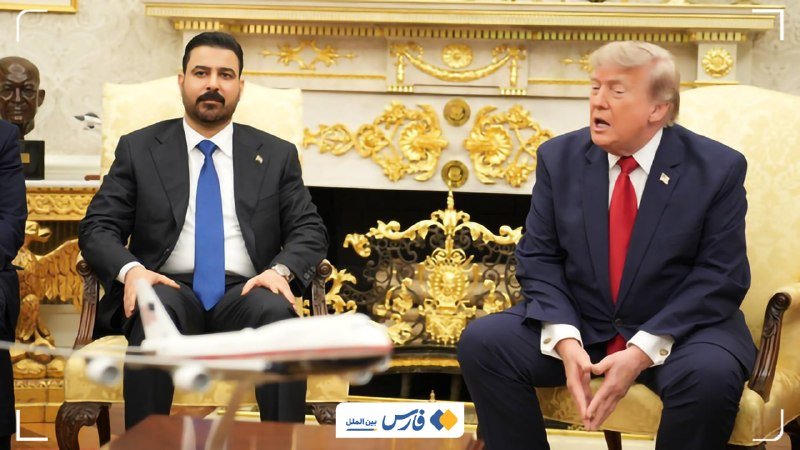
The Hormuz announcement lands on the same day, 15:14 UTC, that the president hosted Iraq's new prime minister at the White House. The stated topic: disarming Iran-backed militias. A separate item at 16:14 UTC praised the new Iraqi leader as a "young and handsome man," a phrase that will get parsed in Baghdad long after the cameras move on.
The through-line is energy. Iraq is OPEC's second-largest producer, and most of its crude exports exit via Basra terminals in the northern Gulf, fed by tanker traffic that funnels through the same Hormuz corridor the 20% toll would touch. A US-imposed levy on cargo transiting Hormuz, applied to Iraqi oil, is functionally a tax on a sovereign competitor's export revenue, denominated in dollars, enforced by a US Navy that already does most of the maritime policing in the strait. Iraq has no realistic way to refuse collection. Iran, which does have leverage, will not.
That is the piece the framing keeps missing. This is not primarily about Iran. It is about who eats the rent on the world's most important oil corridor, and whether the United States can convert a naval presence into a revenue stream without the rest of the Gulf simply routing around it.
What the four-month claim is doing
At 16:51 UTC, the president declared Iran's military power "just a tiny fraction" of what it was four months ago. The line is doing two jobs. Internally, it sells the Hormuz toll as a fait accompli, the kind of measure a victor imposes. Externally, it tells Tehran, and Tehran's customers in Beijing and New Delhi, that the US is postured to enforce collection.
The structural pattern is familiar. A unilateral fee, announced theatrically, justified by a claim of dominance, enforced by a navy, priced into cargo, and then either absorbed by the market, contested by the sanctioned party, or quietly shelved when the political cost arrives. The dollar's reserve status is what makes this kind of move legible in the first place: a toll denominated in anything other than dollars would be useless because the shipowners, the charterers, and the refiners all settle in greenbacks.
This is where the multipolar critique becomes unfashionable but necessary. The strait is international water by any reading of UNCLOS, the UN Convention on the Law of the Sea. A unilateral US toll is not a legal instrument; it is a power instrument. Whether that distinction matters depends on whether anyone in the Gulf, or in Beijing, has the willingness to push back by routing around the dollar, which is a much harder thing to do than to route around a toll booth.
The plausible alternative read
The kinder reading is that the 20% figure is a bargaining chip, not a policy. Announce the maximum, then negotiate down to a face-saving compromise: a multilateral monitoring regime, a sanctions-bypass workaround, a face-saving inspection scheme that gives Tehran something to claim and Washington something to invoice. The presence of an Iraq visit on the same day, with militias on the agenda, is consistent with a broader package rather than a unilateral stunt.
The unkind reading is that the number is real and the White House has not yet understood the second-order effects. Charging $30 million per supertanker does not magically appear on an invoice. It gets priced into freight, which gets priced into crude, which gets priced into gasoline. The levy lands on American consumers and on every importer of Gulf crude, which is most of Asia and a meaningful slice of Europe. The strategic effect is to subsidise Iranian transit-fee collection by raising the baseline cost of compliance for everyone.
What remains uncertain
The sources do not specify whether the 20% figure has been issued as an executive order, a draft regulation, or a trial balloon. They do not specify the legal vehicle, the collection mechanism, or whether flagged vessels of allied navies would be exempted. The Polymarket probability on an Iranian transit fee is, by construction, a market estimate rather than an intelligence finding. The four-month claim of degraded Iranian military capability is a White House assertion, not an independent assessment this publication has corroborated. And the Thursday evening address mentioned in a separate dispatch, framed around declassified 2020-election interference material, is a separate news cycle that may, or may not, contextualise the Hormuz announcements once it lands.
What can be said with confidence is simpler. Two governments are now openly preparing to charge ships for the privilege of moving through the same stretch of water. The corridor handles roughly a fifth of seaborne oil. Neither side has shown it can collect without the other's permission. The next data point to watch is whether the 20% figure appears in a signed document by the end of July, or whether it gets quietly absorbed into a longer negotiation that none of the parties want to name.
Desk note
Monexus read the wire as two competing claims of jurisdiction, not as a single coherent policy. Western outlets framed the toll as leverage over Tehran. The structural read is that it is also a tax on Iraqi, Saudi, Kuwaiti and Qatari export revenue, enforced by a navy, denominated in a currency the toll-collector issues. Both frames belong in the lede; readers can decide which one ages better.
Sources and timestamps are recorded in the wire provenance panel below.
Wire provenance
This editorial synthesis draws on the following public wire/social posts:
- https://x.com/polymarket/status/
- https://x.com/polymarket/status/
- https://x.com/polymarket/status/
- https://x.com/polymarket/status/
- https://x.com/polymarket/status/
- https://x.com/unusual_whales/status/
- https://x.com/polymarket/status/