Ruto's reelection is becoming a construction site
With the 2027 vote roughly fourteen months away, the president is doubling down on roads, housing and a new National Infrastructure Fund, betting that concrete buys more loyalty than the pulpit did in 2022.
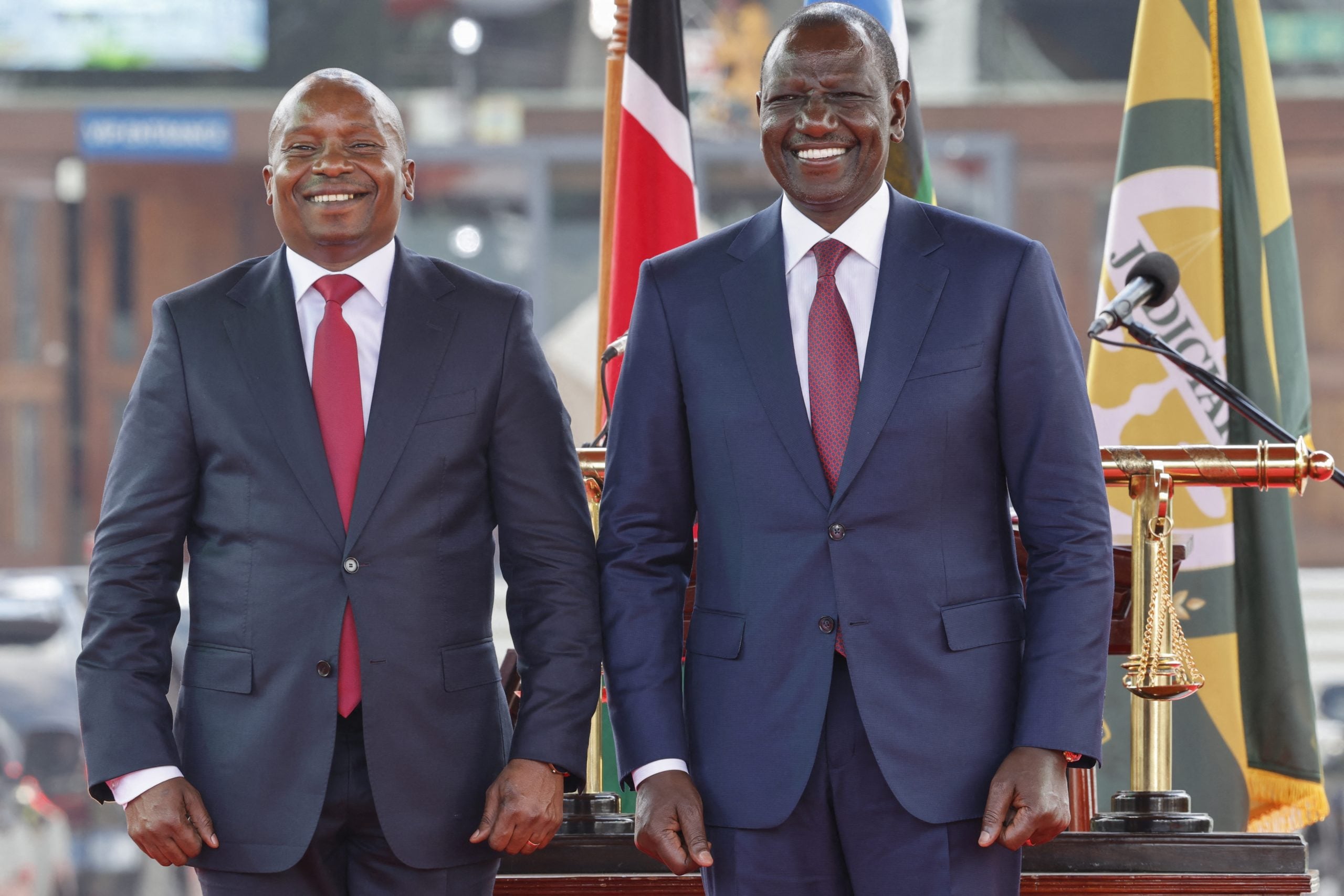
On 13 July 2026, President William Ruto stood before an audience in Northern Kenya and unveiled a National Infrastructure Fund designed to channel state and private capital into energy projects, irrigation works, water harvesting and storage facilities across a region long defined by its marginalisation from national budgets. The pitch, delivered in the arid and semi-arid counties that swing between drought and flood, was the latest in a sequence of infrastructure announcements now running at the rhythm of the 2027 election calendar.
The arithmetic of Ruto's second-term bid has changed. In 2022, a coalition of evangelical churches, hustler-economy messaging and a fractured opposition delivered him the presidency by a margin narrower than the official tally sometimes suggested. Four years on, the opposition has consolidated, the cost of living remains the lived grievance of Nairobi's working classes, and the president's allies are openly wagering that what sermons could not repeat, tarmac can. Roads, markets, the affordable-housing programme and a new federal-style infrastructure vehicle have moved to the centre of the political script.
A new fund, an old political map
The National Infrastructure Fund, as described in The Star Kenya's 13 July 2026 reporting, will prioritise four verticals in Northern Kenya: energy generation and distribution, irrigation to wean herders off rain-fed pasture, water harvesting for livestock and household use, and storage infrastructure to reduce post-harvest losses. The framing is developmental, but the geography is electoral. The northern counties straddling the Ethiopia and Somalia borders have historically returned low turnouts and been treated as a periphery by both Kenya Kwanza and its predecessor Jubilee administration.
Ruto's calculus is straightforward. Northern Kenya's registered voter numbers have grown faster than the national average, partly through biometric registration drives and partly through a youthful population that came of age after the 2017 and 2022 cycles. The Star Kenya reported on the same day that the president's office is coordinating with regional leaders on "equitable development," a phrase that, in the Kenyan political lexicon, signals a deliberate redirection of state resources toward counties that have felt excluded from the patronage networks of Mount Kenya and the Rift Valley.
The counterpoint, offered by independent analysts quoted in regional press and echoed by the Africa Confidential community of subscribers, is that infrastructure funds created on the eve of an election tend to outlive the press conference by about as long as the campaign itself. Several flagship projects announced in 2023 and 2024, including portions of the Last Mile Connectivity electricity programme and the planned Konza Technopolis expansion, have slipped behind schedule. The risk is that the National Infrastructure Fund becomes another vehicle for ribbon-cutting rather than commissioning.
The hustler pivot, recast in steel
The political shift underway in State House is less about policy innovation than about packaging. Ruto's 2022 brand was the hustler: the chicken seller who became wealthy, the bottom-up economic gospel that framed his campaign as a moral correction of dynastic politics. By 2026, that brand has thinned under the weight of a tax regime that the Kenya Kwanza government widened to plug fiscal holes, and a public debt load that the IMF continues to flag in its Article IV consultations.
The new packaging is the builder. Affordable housing towers rising in Mukuru and Kasarani, the Nairobi expressway collecting tolls, the Standard Gauge Railway extension plans to Naivasha and beyond: these are the visible artefacts the government wants voters to grade in August 2027. The Africa Report's 14 July 2026 analysis argues that the churches which propelled Ruto to State House four years ago are now a less reliable delivery mechanism, with several evangelical figures publicly cooling on the administration over the cost-of-living crisis. The pulpit, in other words, is no longer doing the lifting.
In its place, Ruto's strategists have leaned on a familiar Kenyan electoral logic: visible projects, named contractors, and a steady stream of presidential appearances in counties where the Independent Electoral and Boundaries Commission will be counting carefully. The Ruto inner circle profiled by The Africa Report on 12 July 2026 includes advisers who have argued, in terms the publication summarises without naming, that the second-term case has to be made in culverts and classrooms rather than in church halls.
Opposition consolidation as the forcing function
The decision to weaponise infrastructure is not made in a vacuum. The Africa Report's 12 July 2026 dispatch on Ruto's inner circle catalogues a unified opposition coalition now in formation, with former deputy president Rigathi Gachagua's faction, Kalonzo Musyoka's Wiper party and a section of the Mount Kenya political class converging around a single presidential ticket. The mechanics are unresolved and the personality clashes are real, but the structural pressure is the point: for the first time in Ruto's presidency, the 2027 race looks winnable for someone other than the incumbent.
That pressure is what turns the National Infrastructure Fund from a treasury instrument into a campaign organ. When an administration begins earmarking funds along the regional lines of the electoral map, the rubric shifts from technical planning to political triage. Northern Kenya's herding communities, coastal counties sensitive to the 2010 constitutional settlement, and the Lake Region bastions that swung to Ruto in 2022 are all being courted with the same language of "equitable development."
The risk for the opposition is that visible infrastructure, even when delivered late, registers in the gut more durably than policy white papers. The risk for the government is that fiscal strain forces a choice between ribbon-cutting and credible delivery, and that the IMF, the World Bank and domestic bond markets impose discipline at exactly the moment Nairobi most needs to spend.
What to watch between now and August 2027
Three dates are worth pencilling in. First, the Kenya National Treasury's supplementary budget, expected in the autumn of 2026, will reveal whether the National Infrastructure Fund is backed by ring-fenced revenue or by hopeful projections. Second, the IEBC's confirmation of coalition registration rules in early 2027 will determine how fragmented the presidential ballot becomes, and therefore how the government's regional strategy can be sequenced. Third, the next Article IV consultation between Kenya and the IMF, normally timed to the Kenyan financial year, will set the ceiling on how far the state can stretch the public-sector wage bill, debt service and capital projects simultaneously.
The story that the next fourteen months will tell is not whether Kenya can build. It can, and has. The story is whether the construction is durable enough to outlast the campaign, and whether the voters who see new roads outside their trading centres will remember, on polling day, who paved them and who merely cut the ribbon.
Desk note: This piece leans on The Star Kenya's 13 July wire on Northern Kenya and the National Infrastructure Fund, alongside The Africa Report's 14 July analysis of the 2027 reelection strategy and its 12 July portrait of Ruto's inner circle. We have foregrounded the government's framing of equitable regional development while flagging, in line with established reporting, the long-running scepticism about pre-election project delivery in Kenyan politics.
Wire provenance
This editorial synthesis draws on the following public wire/social posts:
- https://t.me/TheStarKenya
- https://t.me/TheStarKenya