The age rule's first stress test: NBA Summer League, the NCAA, and the door that may swing both ways
A first-round pick scores in Las Vegas while the NCAA quietly rewrites who counts as a college player. The result is a labour market that doesn't know which way is up.
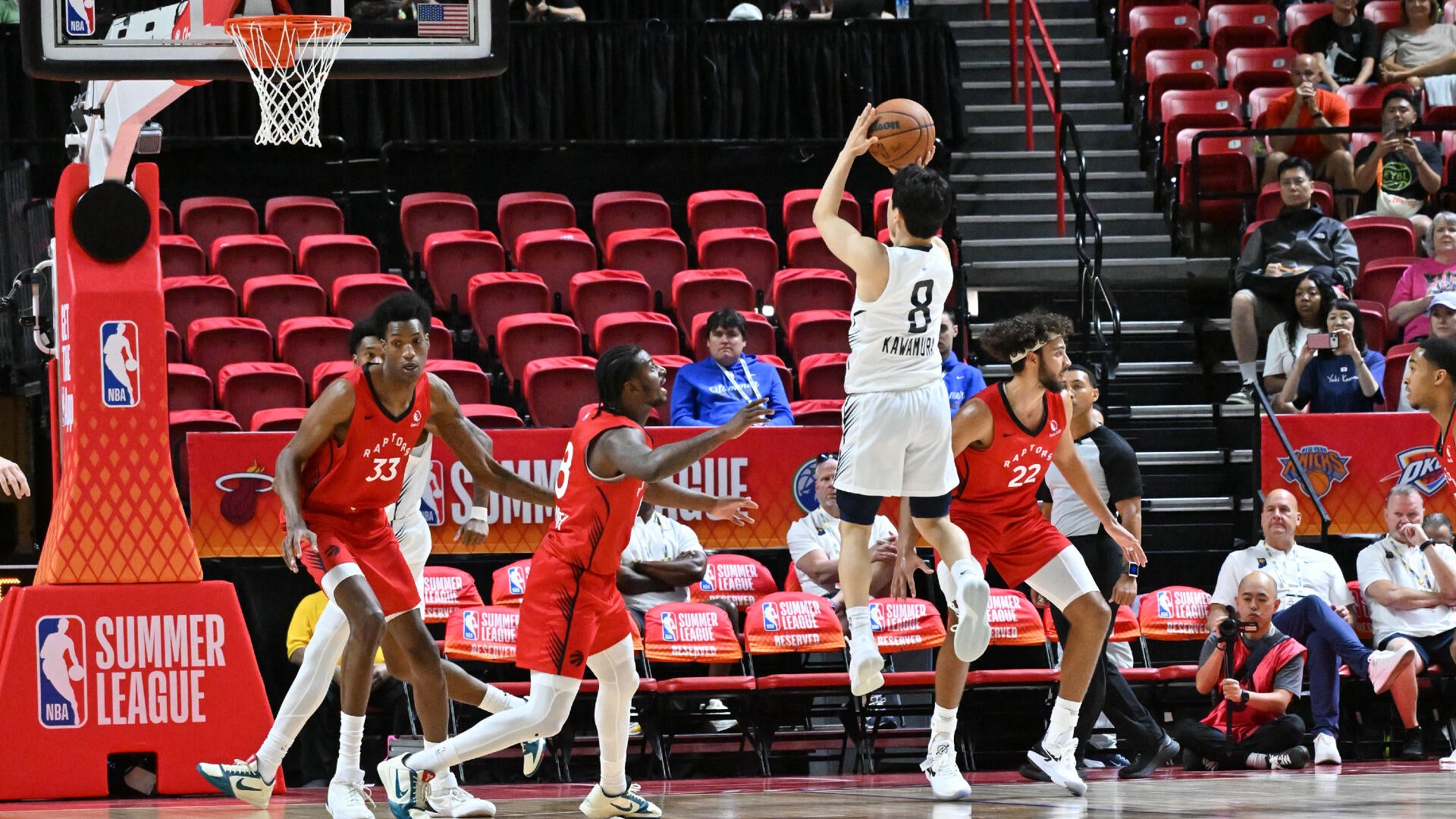
The first-half stat line landed before the question it would raise finished forming. On 14 July 2026, in Las Vegas, Labaron Philon, the No. 22 overall pick in the most recent NBA draft, scored 10 points on 4-of-5 shooting in his opening half of NBA Summer League play, finishing a contested layup through contact that ran on Amazon Prime's broadcast feed. Minutes later, Quadir Copeland used a crossover to create space and powered home a two-hand slam that gave the Houston Rockets the halftime lead.
The Summer League is built for exactly this kind of small theatre. Two months ago, the league's intake happened, and now the league is sorting out which of its newest names actually belong. What is unusual this July is that the sorting has begun to bleed in both directions at once. Philon is trying to show he belongs at the level he was just drafted into. Across town, agents are already mapping the reverse path: NBA to college, professional back to amateur, the front door becoming a side door.
The two stories are connected by a single piece of paperwork the NCAA ratified in 2024 and is now being stress-tested in public: an age-based eligibility rule that allows athletes to compete in college sports until their 23rd birthday, replacing the old freshman-eligibility model tied to high school graduation. The rule was meant to clarify, and in narrow readings it does. In practice, the legal exposure around it is widening the definition of who the NCAA is allowed to police, and that, more than any one prospect's shooting line, is what is making coaches nervous.
A first-round pick finds his footing
Philon's half is the easy part of the story. A second-round half in a Summer League opener is the lowest-stakes evidence an NBA team will ever see from a lottery-tier prospect, and yet it is still the kind of evidence the league's 30 front offices are paying for when they travel to Las Vegas and pay for a developmental coach. Ten points on five attempts through one half is a small-sample preview, not a verdict. The layup through contact, the body control, the willingness to finish at the rim with a defender sliding under him: these are the markers a coaching staff weighs when they decide whether a young guard is ready for backup minutes in November or a longer apprenticeship in the G League.
Copeland's dunk is the other small marker worth recording. Two-hand slams off a live crossover in transition are not unusual for a Summer League forward; what matters is that the possession produced a halftime lead for a Houston franchise that, like every other NBA team, is trying to find rotation players on the cheapest possible contracts. The broadcasts on Prime are running these highlights because the league wants the audience to learn the names now, before the second contract cycle, and before the season tips.
The deeper question, the one that will outlast the box score, is what the Summer League is now supposed to be optimising for. If the pipeline only runs downhill from draft night into the regular season, then Philon's audition is what it has always been. If the pipeline is starting to loop back, then a 19-year-old putting up 10 in a half is competing, without quite knowing it, against players his junior who may yet arrive at a college campus near him next spring.
The rule, the lawsuit, and the loophole
The NCAA's age-based rule was the most consequential change to eligibility since the 1972 Title IX framework and the 2005 academic-progress reforms. Under it, an athlete can play college sports until the calendar year they turn 23, regardless of how long ago they finished high school or whether they have spent time in a professional system. The rule was sold as a fairness measure: it would let late developers, international prospects who arrived late in the US system, and athletes who lost years to injury or amateur-professional transfers compete without losing eligibility.
It has not been sold on those terms for some time. As legal challenges mounted through 2025 and into 2026, the rule's effective scope narrowed in court filings even as its formal text stayed unchanged. Multiple plaintiffs, including certified agents and former players, have argued that the NCAA's enforcement mechanism treats anyone who has signed a professional contract, accepted representation, or received compensation above a defined amateur threshold as a professional for life. The cases are still working through federal courts, and the NCAA's preferred remedy is to keep the rule on the books while negotiating settlements that re-draw who the rule actually covers.
What the agents now see, and what CBS Sports reported on 14 July 2026, is a reverse pathway. If the age ceiling sticks at 23, and if the courts continue to side with players on the narrow question of whether a brief NBA exposure can be wiped from an athlete's record, then a player drafted at 19, sent to the G League, and waived by age 21 is, in principle, eligible to walk on at a four-year program the following autumn. The NCAA's scholarship limits are roster caps now. The transfer portal is a free market. The NIL valuation system treats the college product as a different asset class than the NBA development contract. A player who can choose between a two-way deal and a starting role at a Power conference school may choose the school.
That is the scenario that has college coaches, who otherwise enjoy being quoted only at NCAA tournament media days, sounding unusually sober on background.
What the coaches are actually afraid of
Three concerns come up in every reported conversation with Division I coaching staffs, and they are not the same concern.
The first is roster stability. A college program built around a two- or three-year arc of development now has to plan for a four-, five-, or six-year arc, because the player who used to leave for the draft at 20 can leave, fail, and return at 22. Scholarship limits and roster caps do not become softer because a player is older. They become more brittle. A 23-year-old fifth-year senior taking a scholarship counts against the cap the same way an 18-year-old freshman does.
The second is recruiting asymmetry. High school recruits have always had to weigh a coach's system against an agent's pitch. Now they have to weigh a coach's system against the agent's pitch plus the agent's pitch for the second time around, after the NBA, after the G League, after the short contract in Australia or Turkey. The agent's second pitch is qualitatively different from the first, because the agent is selling a known commodity rather than a projection. The school is being asked to recruit against information it does not own.
The third, and the one most often left out of trade press, is the cultural fit. College basketball at the high-major level is built around a specific cadence of practice, class, travel, and recovery that an older player with professional habits will not share with an 18-year-old teammate. Coaches have managed this with fifth-year transfers before. They have not managed it with fifth-year transfers who already have agent representation, NBA pay stubs, and a public draft grade.
The structural read, in plain language
What is happening in college basketball is the same thing that is happening in minor-league baseball, in European football academies, and in the NCAA's own women's sports: a professional labour market is being asked to coexist with an amateur eligibility framework, and the courts, not the governing bodies, are setting the terms. The NCAA still writes the rules. The agents and the plaintiffs' bar are writing the exceptions. The NBA still drafts the prospects. The schools are absorbing the risk of the gaps.
Two things follow from this.
The first is that the distinction between professional and amateur, which used to be a clean line drawn at the moment of signing a contract, is now a gradient measured in court orders and settlement language. The 23-year-old ceiling is a number, but the rule around it is a negotiation. Agents are now positioning themselves for the negotiation as carefully as they once positioned themselves for the draft itself.
The second is that the NBA Summer League, which was supposed to be the entry point for new professionals, is becoming a piece of evidence in the negotiation. A first-round pick's first half, a two-hand dunk in transition, a box score on a Tuesday in Las Vegas, all of these now feed back into the question of whether a player who has been paid as a professional can still be treated, for eligibility purposes, as an amateur. The Summer League's content arms are owned by Amazon and ESPN. Its data is consumed by agents and GMs. Its talent pipeline now runs both ways.
The age rule, in other words, is not a reform. It is a venue change. The competition has moved from the NCAA's compliance office to the federal courts, and the Summer League is one of the surfaces where the new game is being played.
What the next 12 months will look like
Three dates will tell us how the next phase actually goes.
The first is the start of the 2026-27 NCAA season in early November. By then, any current player who has filed suit or accepted a settlement will know whether their specific case has cleared the eligibility bar. If the first such player takes the court in November, the rule's effective scope will have widened in practice even if its text has not.
The second is the 2027 NBA Draft, which will be the first draft conducted entirely under the current settlement environment and the first in which a meaningful number of prospects will be openly weighing a college return against a guaranteed contract. The agents will price this in. The mock drafts will price this in. The underclassmen will price this in, and the calculus for leaving early will tilt.
The third is the next round of collective bargaining between the NCAA and the Power Five conferences, expected to reopen in mid-2027, where the age ceiling itself may be revisited as part of a broader settlement package. A compromise that hardens the ceiling at 22, or removes it entirely, is more likely than a clean compromise at 23, and either move will reshape who is in uniform that autumn.
Philon's layup and Copeland's dunk will not be on any of those agendas. They will, however, be part of the record that the lawyers, the agents, and the coaches consult when they argue about what an NBA Summer League performance actually proves. The half the Rockets led at the break is a small data point inside a much larger story about who gets to be called an amateur, and for how long.
How Monexus framed this vs the wire: the Summer League clips were treated as evidence inside a structural story about eligibility, labour markets, and litigation, rather than as a stand-alone prospect watch.
Wire provenance
This editorial synthesis draws on the following public wire/social posts:
- https://t.me/NBALive/0
- https://t.me/NBALive/0
- https://t.me/NBALive/0
- https://en.wikipedia.org/wiki/NCAA_age_eligibility_rule
- https://en.wikipedia.org/wiki/NBA_Summer_League
- https://en.wikipedia.org/wiki/Houston_Rockets