The Strait of Hormuz has a new tollbooth, and it isn't American
Iran's lead negotiator says no deal on Hormuz transit was struck in Muscat. A prediction market disagrees, and so does Tehran's own foreign minister.
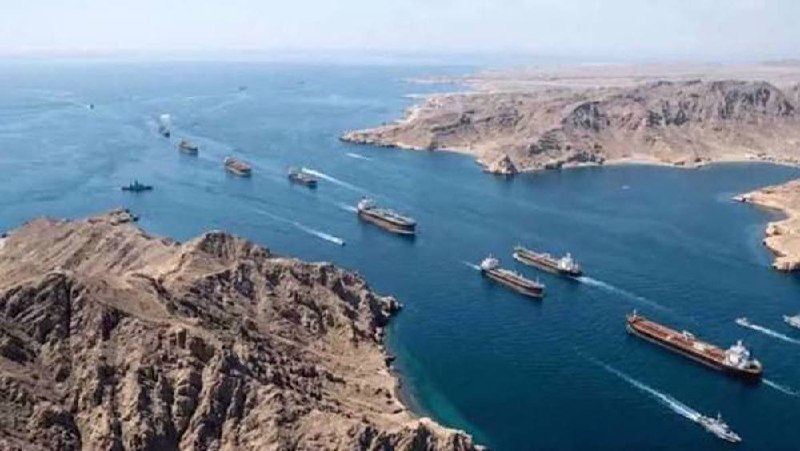
On 14 July 2026, Iran's top negotiator walked back the most consequential shipping-economics story of the month. Asked whether Tehran and Muscat had agreed on the terms under which Iranian authorities would charge transit fees through the Strait of Hormuz, Kazem Gharibabadi answered plainly: no agreement was reached. The line, carried by Tasnim, landed inside a 24-hour window in which a US-headquartered prediction market had already moved to put the probability of such a fee regime at 52 percent by the end of next month.
The pattern is worth naming. A multilateral shipping corridor that handles roughly a fifth of global oil flows is being repriced in public, and the actors setting the price are not the ones who have policed the waterway for the past half-century. That is the story. The politics, the prediction markets, the tweets, and the diplomatic denials are all downstream of it.
A market that prices what diplomats won't confirm
The Polymarket contract in question, posted on 14 July 2026 and resolved to its present 52 percent reading, asks a single binary question: will Iran charge Hormuz transit fees by the end of next month. A second contract, posted a day earlier on 13 July, places the year-end probability at 73 percent. Both numbers treat the fee regime as more likely than not. The diplomatic record, by contrast, is messier and more contradictory. Gharibabadi says nothing was agreed in Muscat. Iranian Foreign Minister Abbas Araghchi, quoted on 13 July, has gone further, declaring that Iran will remain the "guardian" of the Strait of Hormuz forever.
Three readings compete. The first is that the prediction market is pricing an Iranian policy already made, just not yet announced. The second is that traders are pricing the diplomatic theatre, with both sides posturing before a deal that hasn't been concluded. The third, less flattering to the market, is that Polymarket participants are simply reading the same X posts and Tasnim wires as everyone else and magnifying the signal.
The framing Tehran is selling
The "guardian" language is doing real work. It is not a boast about naval capability; it is a claim of sovereign stewardship over a waterway the United States has policed, on and off, since the 1980s. Iran is asserting a right to set terms of passage that the postwar order has, by default, assigned to the US Fifth Fleet. A transit fee, whether nominal or punitive, formalises that claim. It converts rhetoric into revenue.
The structural read is straightforward. The global chokepoint map is being redrawn in real time, and the redrawing is being led not by a Western alliance but by a sanctioned regional power with a coastline. For shipowners, insurers, and oil buyers, this is a different risk surface than the tanker-seizure theatre of the late 2010s. A fee is not a closure. It is something more durable: a permanent price on a previously free passage, levied by a sovereign that does not need anyone's permission.
What Oman is actually doing
Oman's role has been under-reported. Gharibabadi's denial of an agreement was issued in the specific context of negotiations with Muscat, which suggests Oman is acting as the diplomatic intermediary and possibly as the regional hub through which any future fee regime would be administered. That would put Muscat in an unusual position: collecting on behalf of Tehran, or at minimum providing the legal architecture that lets the fee regime pass the smell test in Asian and European ports. Whether Muscat has agreed to play that role is precisely what Gharibabadi says remains unsettled.
For the Gulf states, the calculus is uncomfortable. Saudi Arabia, the UAE, and Qatar all rely on Hormuz for crude and LNG exports. A fee regime that disproportionately benefits Iran, and is administered via Oman, leaves the GCC's two biggest players outside the rentier chain. The diplomatic noise out of Muscat is the sound of that discomfort being negotiated in private.
What to watch
Two filings matter more than the tweets. The first is whether Iran's Supreme National Security Council publishes a formal schedule of transit fees, with vessel-class differentiation and a collection mechanism. The second is whether a major Asian buyer, China, India, Japan, or South Korea, publicly acknowledges paying, or quietly routes more crude via pipelines that bypass Hormuz entirely. Either move would settle the question faster than another round of denial from Tehran.
The Polymarket contract is a useful thermometer, but it is not a source. Tasnim's wire on Gharibabadi is a source. Araghchi's "guardian" line, carried on 13 July, is a source. What is not yet a source is any document, any schedule, any paid invoice. Until one of those exists, the world is pricing a fee regime on rhetoric. The rhetoric is unusually specific. The paperwork has not arrived.
This publication reads the Hormuz story as a sovereignty dispute first, an oil story second. Wire framing has tended to invert the order.
Wire provenance
This editorial synthesis draws on the following public wire/social posts:
- https://t.me/tasnimplus
- https://x.com/Polymarket/status/2077028468982726656