Two fronts, one supply chain: helium and the South China Sea redraw Asia's risk map
A decade after The Hague invalidated Beijing's nine-dash line, Chinese pressure on the Philippines is mounting again. The same week, US helium quietly displaced Qatari supply across Northeast Asia.
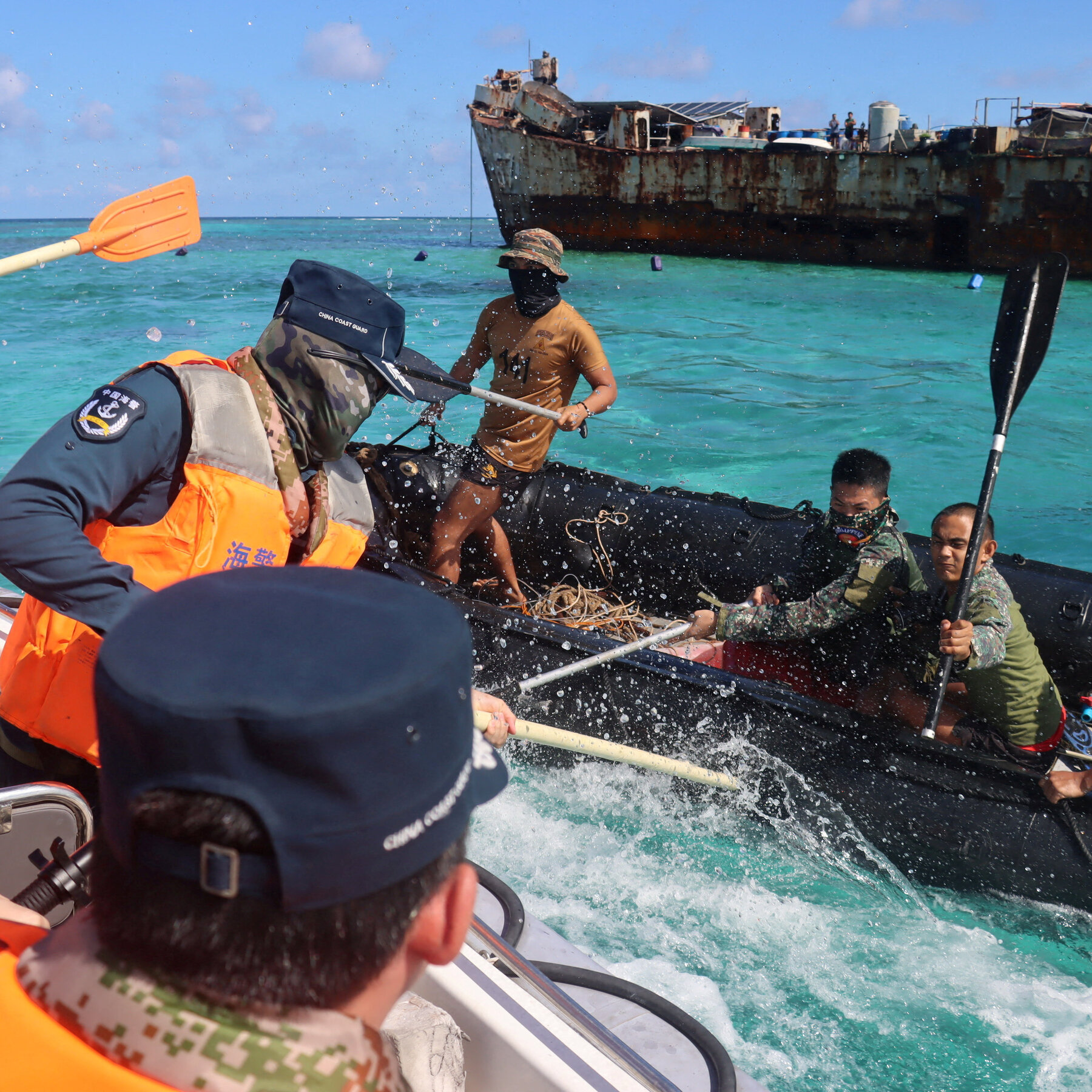
On 13 July 2026, two unrelated Nikkei Asia dispatches landed in the same news cycle and, read together, sketch a quieter version of the contest now running through Asia. The first: the United States has become the largest source of helium for Japan, South Korea and Taiwan, and is positioned to add market share as the Iran war disrupts Gulf production and as Chinese export controls tighten. The second: ten years after the Permanent Court of Arbitration invalidated Beijing's sweeping claim to nearly all of the South China Sea, Chinese pressure on the Philippines has resumed at intensity not seen since the Scarborough Shoal standoff of 2012 to 2016.
The pairing is not editorial flourish. One story is about a critical industrial gas; the other is about a body of water through which roughly a fifth of global trade moves. Both are stories about who holds the leverage when the route or the feedstock gets stressed, and who ends up paying the bill.
The helium map redrawn
The technical premise is small enough to miss. Helium is not a commodity in the ordinary sense. There is no synthetic substitute at scale. Demand is concentrated in semiconductor lithography, MRI manufacture, superconducting magnets and fibre-optic production, and the supply chain is dominated by a handful of plants in Texas, Wyoming, Qatar, Algeria and Russia.
According to Nikkei Asia's 13 July reporting, US producers have displaced Qatari volumes as the leading supplier for Japan, South Korea and Taiwan in recent quarters, a rerouting accelerated by two compounding shocks. First, the war involving Iran has disrupted Gulf production and lifted the geopolitical cost of relying on Qatari facilities. Second, Chinese export restrictions have thinned the alternative that Northeast Asian buyers might otherwise have turned to. Nikkei notes that US producers could capture additional share as those pressures persist.
The structural reading is straightforward. A gas that is mostly invisible to consumers has become a chokepoint input for the chipmaking, medical-imaging and superconducting industries in which the United States, Japan, South Korea and Taiwan happen to specialise. When the United States is the marginal supplier and when China is the principal constraint on the alternative, the result is a quiet consolidation of US leverage over the most advanced segments of the regional industrial base.
The standard caveat applies. Helium is recoverable, and Qatar's plants will return to normal output when conditions in the Gulf allow. Chinese restrictions, whatever their declared rationale, are also reversible in principle. The market share US producers now hold is a function of two disruptions, not of a permanent reshuffle. Nikkei does not specify the magnitude of the gain in tonnes or the share figures; the reporting establishes direction, not scale.
A 2016 ruling, a 2026 pattern
The second Nikkei dispatch carries the obvious anniversary hook. On 12 July 2016, the Permanent Court of Arbitration at The Hague ruled, in a case brought by the Philippines under the UN Convention on the Law of the Sea, that China's nine-dash claim to historic rights over nearly the entire South China Sea had no legal basis. Beijing rejected the ruling the day it was issued and has never altered its position.
Ten years on, Nikkei reports that Chinese pressure on the Philippines has resumed at a level not seen since the run-up to that case. The pattern is familiar: maritime incursions, Coast Guard and maritime militia activity around contested features, and a slow, attritional effort to change the operational reality on the water regardless of what any tribunal decided.
The judgment the article draws is not about whether 2016 was right or wrong. It is about the more boring fact that international rulings depend for their effect on the willingness of parties to comply, and that a decade is a long enough horizon for the dispute to revert to the operating condition that produced the case in the first place. The ruling exists. It has not produced the outcome its authors anticipated.
Two fronts, one buyer
Read the two stories together and a single figure sits at the centre: the Japanese, South Korean and Taiwanese industrial base. It is the deepest pool of advanced manufacturing demand in Northeast Asia, and it is the customer that both Beijing and Washington are trying to bind closer.
The Chinese offer is scale. The largest single market in the region, an integrated supply chain from raw materials through assembly, and political weight at the UN and in regional bodies. The structural problem is that the offer now comes with export controls that bind, and a posture in the South China Sea that makes Manila, Taipei and Tokyo increasingly nervous about maritime routes.
The American offer is reliability of inputs at the chokepoint level: helium, advanced chips, equipment, capital. The structural problem is that the US position depends on sustained political alignment across two or three administrations, and on the Gulf and Russian supply chains that the US itself does not control.
Neither offer is unconditional. Nikkei's reporting shows that the helium story is a function of two simultaneous disruptions; the South China Sea story is a function of a longer-term Chinese posture that has not changed in a decade. A buyer trying to read the next two years faces a market where the safest supplier today is exposed to Gulf volatility, and the largest supplier tomorrow is exposed to its own export-control regime.
What the next quarter is likely to settle
Two dates deserve watching. First, any official Japanese, South Korean or Taiwanese statement on helium procurement diversification. A public diversification framework would harden the US share into something more durable than the current accident of two simultaneous supply shocks. Second, the trajectory of incidents around Second Thomas Shoal, Sabina Shoal and the wider Philippine exclusive economic zone through the autumn monsoon season, when operational tempo around the features typically rises.
The deeper lesson is the one Nikkei's two dispatches illustrate without quite saying it. Asia's industrial policy is no longer made in capitals alone. It is being made in the routing decisions of procurement officers at Tokyo Electron, at the fabs outside Hsinchu, at the shippers moving containers through the Luzon Strait, and at the small number of helium plants on the high plains of Texas. The leverage moves toward whoever owns those decision points, and right now the geography of ownership is shifting faster than the diplomatic commentary that surrounds it.
Desk note: Monexus framed these two Nikkei Asia dispatches as a single supply-chain story rather than treating them as separate regional beats. The wire read is that the helium piece is energy and the South China Sea piece is security; the more useful read is that both are about who holds chokepoint leverage over the same customer base.
Wire provenance
This editorial synthesis draws on the following public wire/social posts:
- https://t.me/NikkeiAsia
- https://t.me/nikkeiasia
- https://t.me/NikkeiAsia
- https://t.me/nikkeiasia