A forest older than France burns again
A wildfire tore into the Fontainebleau forest on 14 July 2026, the latest front in a summer of heat that has stretched French fire services and exposed how thinly European climate adaptation is resourced.
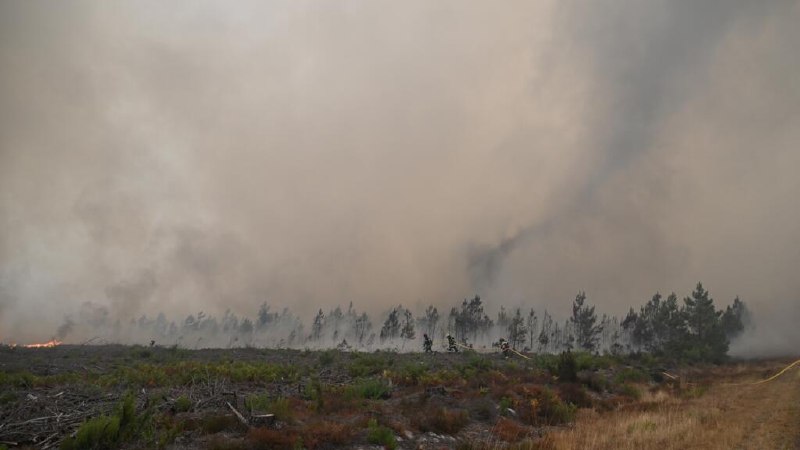
Firefighters in Seine-et-Marne were still drawing containment lines around a wildfire in the Fontainebleau massif on the morning of 14 July 2026, after wind-driven flames pushed through pine and heath on the southern edge of one of France's oldest state forests. Reuters photographers documented fire engines, hose lines and water-bombing aircraft working a perimeter that crews had struggled to hold overnight, with much of western Europe simultaneously sitting under a string of heatwaves that have turned dry undergrowth into fuel.
Fontainebleau is not a remote wilderness. The 25,000-hectare forest sits roughly sixty kilometres south-east of Paris, threaded with motorways, suburban rail lines and the climbing sandstone of the Trois Pignons. It is also a working forest, managed for timber, hunting and the steady weekend traffic of Parisian hikers. When it burns, the smoke drifts over the A6, the air-quality alerts ping phones in Melun, and the country's summer-weekend politics shift.
The fire that became a signal
The Fontainebleau blaze is the kind of incident that, on its own, would rate a regional news cycle. In the context of July 2026, it reads differently. France, Spain, Portugal and parts of Italy have spent the past fortnight under successive heat dome events, with ground-level temperatures repeatedly crossing the thresholds that French forestry agency ONF uses to raise its fire-danger index to its highest tier. Reuters's reporting from the forest on 14 July frames the fire explicitly inside that pattern: a single ignition inside a landscape that has been pre-conditioned, week after week, by weather that historical baselines do not match.
That framing matters because it shifts the question from "did the forest service respond well enough?" to "what does it mean that a forest this managed, this close to the capital, this well-instrumented, is still catching on a windy afternoon?" The honest answer, on the evidence so far, is that European fire suppression capacity was built for a climate that has receded.
The suppression bottleneck
French firefighting runs on a hybrid model: professional sapeurs-pompiers in the cities and a large volunteer and rural reserve in the countryside, with military aircraft (the Sécurité Civile's Canadair and Dash tankers) reserved for the worst campaigns. That model performed credibly in the Gironde fires of 2022, but its limits are now showing. The Canadair fleet is small, the maintenance cycle is long, and the same aircraft are asked to cover the Mediterranean rim, the Pyrenees and the Atlantic coast in the same fortnight. Water-bombing is the visible part of the response; the boring part, the back-breaking hose work and mop-up that holds a perimeter for two days, is done by people in yellow jackets whose municipalities cannot pay them overtime in a budget cycle.
There is a quieter story behind the photos. French local authorities have warned for two successive summers that the volunteer rural fire brigades are ageing out faster than they can recruit replacements. Heatwaves do not only burn forests; they burn out the people who would normally put them out.
Heat as infrastructure problem
The heatwave framing that dominates French press coverage this week is, in one sense, correct: it has been hot, and it has stayed hot. But the more durable story is that heat has become an infrastructure problem, on the same shelf as water, rail and grid capacity, and is being treated as a series of emergencies rather than as a planning constraint.
France has invested in air-conditioning for schools and hospitals and in cooling rooms for the elderly, the visible infrastructure of heat response. It has invested far less in the invisible infrastructure: forest management that thins undergrowth before it becomes ladder fuel, prescribed burning that reduces fuel loads, hydrant networks in peri-urban woodland, and the slow unglamorous work of mapping which massifs are over-loaded with visitors on red-flag days. Spain and Portugal have moved further on prescribed burning; France, with its tighter liability regime and more litigious landowning class, has moved more cautiously. The Fontainebleau fire is the kind of event that resets that calculus, briefly, until the next budget round.
What to watch next
Two near-term signals will tell whether 14 July becomes a one-off or the start of a longer campaign. First, whether Météo-France confirms that the heat dome is anchoring rather than transiting; if the ridge parks over the Bay of Biscay, the Bouches-du-Rhône and the Landes all become candidates in the same week. Second, whether the European Union's rescEU aerial firefighting fleet is mobilised in the way it was in 2022, or whether national capitals have begun to hoard the Canadairs the way they hoarded face masks in 2020. The first test is meteorological; the second is political, and harder.
What remains genuinely uncertain, on the public record, is the ignition source. French investigators typically publish findings weeks after a major blaze, and Reuters's on-the-day reporting does not speculate. The gap between the visible fire and the eventual cause statement is also the gap in which political narratives form: drought, arson, climate, infrastructure under-investment. The fire itself does not adjudicate among them. It just burns.
Desk note: Monexus frames the Fontainebleau fire as a climate-adaptation story, not a single-incident crime story. Where wire copy centres the spectacle of aerial bombing, this piece centres the suppression capacity, the volunteer base and the planning decisions that decide whether the next fire is contained in an afternoon or lasts a fortnight.