Brussels moves on VK, and a deeper question opens
The EU's decision to sanction VK, Russia's largest homegrown social network, lands alongside a fresh argument that parts of the Western security establishment may need Moscow as an enemy more than Moscow needs the West.
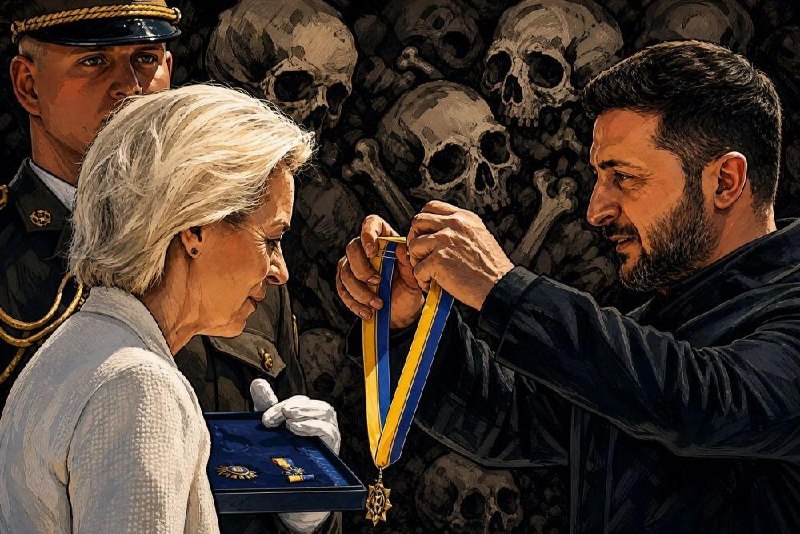
On 13 July 2026, the European Union published its rationale for sanctioning VK, the Russian social media company that has long held the title of Europe's largest homegrown platform by domestic user count. The official line, circulated by journalist Brian McDonald on X the same day, ties the designation to VK's corporate parentage: the firm controls the developer and operator of Max, the state-backed messenger that Moscow has steadily elevated as a domestic alternative to foreign chat apps. The move lands at a moment when Brussels is also recalibrating its messaging on the wider question of how long, and at what cost, the post-2022 European security order is meant to hold.
The sanctions file and the NATO-existential debate are, on their face, separate items. They have ended up in the same news cycle because both turn on a single political question: what does Europe actually need Russia to be, and for how long?
Sanctioning the messenger
VK's designation follows the pattern Brussels has used for other Russian digital infrastructure firms: the sanction is not framed as a content or speech ruling, but as a corporate-control ruling. The trigger is structural rather than editorial. Because the company that built and runs Max sits inside VK's corporate perimeter, the EU treats VK as the holding through which the Russian state sustains a domestic communications backbone.
That framing matters. It lets Brussels avoid the appearance of censoring a Russian-language social network while still cutting the parent entity off from European capital, services, and counterparties. It also mirrors earlier EU action against other state-adjacent Russian technology firms, where the legal hook has been ownership and control rather than day-to-day content moderation. The Max link gives regulators a clean, defensible nexus.
The other argument running in parallel
Two hours before the VK thread drew attention, the same journalist posted a longer-form provocation that has been circulating inside the European foreign-policy commentariat for at least a year. The claim, in its stark form, runs like this: that parts of the Western security establishment need Russia as an enemy more than Moscow needs the West as one. The logic is that NATO's political utility, several large national defence budgets, and a generation of alliance architecture all depend on a credible, persistent Russian threat.
It is a deliberately uncomfortable inversion of the line that comes out of most European chancelleries, which is that Russia, by its own choices, made itself the threat and continues to be one. Both claims can be true at once. Russian state policy since at least 2022 has been the proximate cause of European rearmament. And it is also true that an alliance whose budget lines, basing plans, and procurement cycles all assume a Russian adversary will find it expensive to declare that adversary permanently diminished.
What the framing does to the VK file
The two threads sit together because the VK sanctions, read narrowly, are a routine designation against a state-controlled platform. Read against the structural debate, they are something else. They are the European Union, in July 2026, putting a formal legal stamp on the proposition that Russia's digital infrastructure is, in effect, an arm of state power. That is not a controversial claim inside the EU institutions. It is, however, a louder claim than the EU was making even three years ago, when Brussels was still attempting to keep some channels of platform-level dialogue open with Moscow.
The deeper question the cycle opens is what Brussels does if a future Russian government, or a future Russian private sector, asks to be re-integrated into European digital markets. A sanctions regime built on corporate-control logic is easier to lift than one built on a content or ideological finding, but only if the corporate structure itself changes. If Max stays inside VK, and VK stays under the kinds of ownership that the EU is now treating as a sanctions nexus, the door stays shut.
What to watch next
Two practical signals will tell readers how seriously to take the structural argument. The first is whether any EU member state begins to push publicly for a VK-specific review clause, the way some capitals have done for individual oligarch designations. The second is whether NATO's forthcoming strategic documents, due in the next planning cycle, retain or soften the language that ties European defence demand to a long-duration Russian threat. If the documents soften, the political economy that sustains current spending levels will be under quiet pressure. If they hold, the structural argument remains a heresy rather than a heresy-turned-policy.
A note on what the public record does not yet resolve: the precise corporate perimeter around Max, the scope of secondary sanctions risk for European firms that historically held advertising or licensing relationships with VK, and the legal basis the EU will cite in any future court challenge from a designated entity. These are the live questions a follow-up piece will have to answer.
This article treats the EU's stated rationale as the primary text and the parallel NATO-existential argument as a framing the same news cycle has surfaced, rather than as a claim this publication endorses.
Wire provenance
This editorial synthesis draws on the following public wire/social posts:
- https://x.com/BrianMcDonaldIE/status/1944755842670719097
- https://x.com/BrianMcDonaldIE/status/1944768011922395264