Bahrain under fire while Geneva announces a peace accord
Air raid sirens and interceptor failures in Bahrain on the same afternoon Washington and Tehran confirm a Friday signing in Geneva. The contradiction is the story.
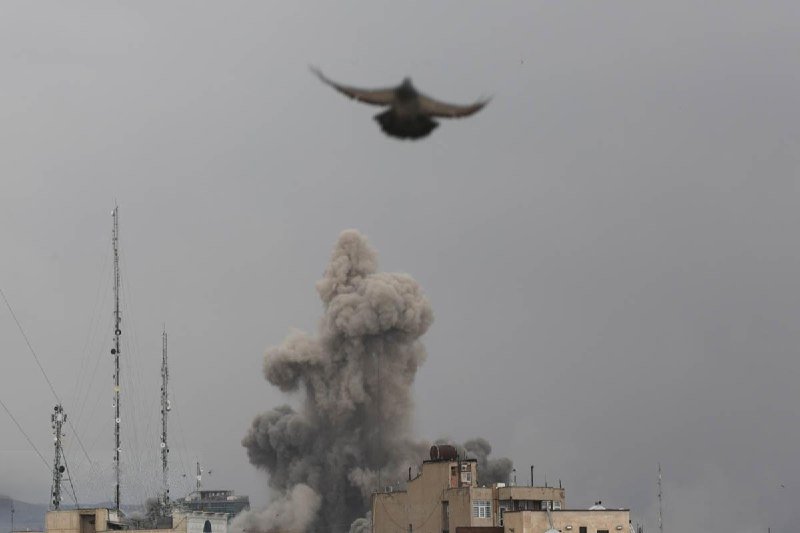
Air raid sirens sounded across Bahrain at 17:47 UTC on 14 July 2026 and, within the hour, regional channels reported multiple direct hits and a failed interceptor over the kingdom, according to Middle East Eye's live blog and a series of posts from the Telegram channel Middle East Spectator. The same afternoon, that same live feed carries a banner headline that the United States and Iran have confirmed a peace accord to be signed in Geneva on Friday.
The juxtaposition is not a journalist's trick. Bahrain is a Gulf Cooperation Council state hosting the US Navy's Fifth Fleet. If Iranian missiles and drones are landing on its soil on the eve of a signing ceremony in Switzerland, then either the war is not over, or the war has been redefined: a managed tit-for-tat running alongside a signed framework that both sides describe as peace.
A signing in Geneva, a strikes list in Manama
Middle East Eye's live blog, updated at 17:47 UTC, frames the diplomatic track and the military track as parallel headlines. The first confirms the Friday Geneva ceremony. The second, posted minutes earlier by Middle East Spectator on Telegram, describes "multiple direct hits" on Bahrain; a follow-up item at 17:30 UTC cites a "failed interceptor," and footage aired by wfwitness at 17:18 UTC shows air defenses activated over the island.
None of these channels are formal command releases. Middle East Spectator and wfwitness are aggregator and witness accounts with verifiable timelines but no editorial standing on attribution. The default reading of a missile hitting a GCC capital is that Iran, or an Iran-aligned militia, fired it. The Iranian state has not, in the source materials available at the time of writing, claimed a strike. That silence is itself news.
What the wires are not yet saying
Consider what is absent. Reuters, the Associated Press and the BBC are not in the source window for this story, and their absence is itself instructive. If a Western capital were taking direct fire on the eve of a US-Iran accord, those wires would be leading their evening editions. The reporting on Bahrain today is coming through a Gulf-focused outlet and Telegram channels, which means either the wire desks have not yet caught up to the day-cycle, or the events have not been independently triangulated at the scale a Western wire would require before publishing.
This is the first flashpoint the public should hold lightly: a treating-the-syrup claim from channels that have been right before, and wrong before, about strikes on Gulf targets. Treat the sirens as confirmed. Treat the hits and the failed interceptor as reported, not verified.
Two clocks running at once
The structural argument worth making is that the Middle East in 2026 has moved into an era of dual-track diplomacy. One clock measures ceasefires, frameworks and signatures in neutral capitals. The other measures rockets, interceptors and air-raid sirens. Both clocks run simultaneously, and the foreign-policy establishments of Washington, Tehran, Riyadh and Tel Aviv have increasingly built the machinery to operate on both at once.
For the United States, that means a peace accord is a deliverable even if Gulf allies absorb hits. For Iran, a deal lifts sanctions pressure but does not retire the missile arsenal that delivered the hits. For a small Gulf state like Bahrain, the arithmetic is not favourable: it hosts the fleet that deters a regional rival, and it absorbs the missile fire that a regional rival directs at that fleet. The sovereign territory of a UN member state is being struck while the Security Council's most powerful permanent member counter-signs a peace accord in the next room.
Who is left to enforce the framework
A signing ceremony scheduled for Friday in Geneva answers the question of whether a piece of paper exists. It does not answer the question of who enforces it. If Bahrain has been hit on Tuesday and a framework is signed on Friday, then either the framework treats the strikes as outside its remit, or the framework treats the strikes as a test of Iranian compliance on the eve of implementation.
The plausible alternative reads of the day's events both deserve airtime. The optimistic read is that the strikes are a final negotiating feint, designed to strengthen the Iranian hand at the table by demonstrating that Tehran can still impose costs. The pessimistic read is that the strikes reveal that whatever is signed on Friday is not, in any operational sense, a peace, and that the GCC is being asked to absorb residual risk in exchange for a diplomatic outcome centred on US-Iran nuclear concerns.
A middle position is also available, and it is the one Gulf ministries are quietly adopting: that the framework itself will be evaluated not by the document's text but by whether Bahraini air defenses, fired at twenty past five on a Tuesday, get the ammunition and the political backing they need before the next round. The signing in Geneva, in other words, is the beginning of the test, not the end.
What remains unverified
The source window does not establish who fired, what was hit, or what damage occurred. The Iranian information apparatus has not claimed the strikes. The US Fifth Fleet has not, in the materials available, confirmed a baseline. The figure to watch on Friday is not the language of the Geneva communiqué. It is whether Bahrain's airspace goes quiet after the signing, or whether the sirens return.
Desk note: this publication treats regional Telegram channels as primary signals and as reporting leads, never as sole attribution. Western wires have not yet published on today's Bahrain events; the desk will update when independent verification arrives.
Wire provenance
This editorial synthesis draws on the following public wire/social posts:
- https://t.me/Middle_East_Spectator
- https://t.me/Middle_East_Spectator
- https://t.me/wfwitness