A 9 PM Address and the Question of What Gets Declassified
The president has booked prime time for Thursday to discuss newly declassified intelligence. What is on the table, what is not, and why the timing matters for a public that has heard this story before.
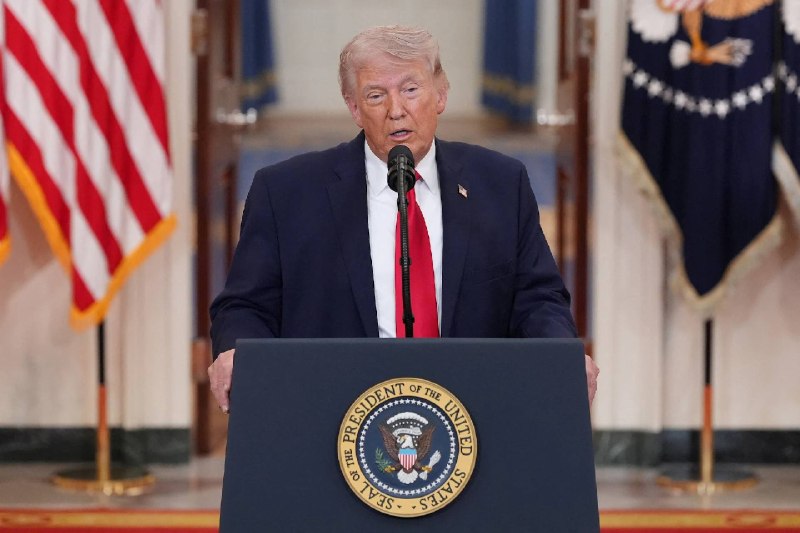
On the afternoon of 13 July 2026, three separate channels, a Middle East-focused Telegram account, an X account that tracks political markets, and a geopolitical intelligence channel, all relayed the same item: President Donald Trump will address the nation at 9 PM Eastern time on Thursday 16 July 2026, and the speech is expected to centre on newly declassified intelligence reports. The first post, from Middle East Spectator, landed at 18:52 UTC; the second, from Unusual Whales on X, appeared eight minutes later; the third, from the geopolitical-watch Telegram account, came in the same window. Within an hour, MS NOW was reporting, via Polymarket's account on X at 20:08 UTC, that the speech will "reportedly address newly declassified intelligence on foreign interference in the 2020 election."
That is, at this moment, the entire publicly available record of the address: a date, a time slot, a one-line summary attributed to MS NOW, and a body of speculation built on top of those three facts. This article proceeds from what can be verified, treats the rest as still-unconfirmed, and reads the moment as a press-politics event as much as an intelligence event. The declassification itself is the news; the choice to put it on television is the story.
What is confirmed, and by whom
Three layers of source stack behind the announcement, in ascending order of authority. The first layer is two social-media posts from 13 July 2026: Middle East Spectator on Telegram at 18:52 UTC, and Unusual Whales on X at 19:00 UTC, both stating in identical language that the president will speak to the nation at 9 PM on Thursday. The second layer is a 19:54 UTC Telegram post from an intelligence-watch channel specifying the time zone ("9 PM EST"), the date (16 July 2026), and adding the substantive claim that the address is "expected to be about newly declassified intelligence reports." The third layer is the 20:08 UTC post on X from the Polymarket account citing MS NOW's reporting, which converts the open-ended intelligence claim into a specific frame: foreign interference in the 2020 election.
No White House statement, no formal press release, and no transcript of a presidential remark appears in the source material available at the time of writing. The announcement, in other words, has travelled from the president to the public through three intermediary channels before reaching a wire-level outlet's byline. That is normal for the first ninety minutes of a presidential scheduling item, but it is also the window in which the framing gets set. The word "declassified," once attached to "intelligence," does a lot of work: it signals that material the government previously withheld is now public, and it does so without anyone yet having to defend the contents.
The 2020 frame, and why it recurs
The MS NOW framing, as relayed by the Polymarket account, is "foreign interference in the 2020 election." That is a familiar headline. It is the subject of the Intelligence Community's March 2021 declassified report on the 2020 election, the 2024 reports from special counsel Jack Smith that included interference allegations, and a long sequence of congressional hearings and inspector-general findings since 2021. The president himself has, on the record, framed the 2020 election as compromised by foreign involvement, and his allies in Congress have echoed the claim.
The recurrence is the point. A 9 PM address dedicated to newly declassified intelligence on a five-year-old election is, on its face, a different kind of event from a 9 PM address about an active military confrontation or an ongoing economic crisis. It is closer to a referendum on a question that has already been litigated in public, repeatedly, by official and unofficial actors. Two readings of the choice are plausible. The first is that the declassification contains new material, not previously in the public record, that materially changes the public's understanding of what happened in 2020. The second is that the speech is a political act that uses the apparatus of declassification to ratify a position the administration has long held, with the camera and the prime-time slot as the delivery mechanism. The available sources do not, at present, allow a confident choice between the two.
Declassification as performance
The mechanism on the table is not a leak and not a court-ordered release. It is an executive-branch decision to move material from a classified to a public status. That decision sits inside a defined legal architecture: the president has broad authority to declassify information, and the modern practice is that a declassification is accompanied by a public release, often redacted, of the underlying documents. The substantive effect, however, depends on what the released material contains.
The recurring template in such episodes is that the public release is partial, that the cover document does more rhetorical work than the underlying intelligence, and that the press cycle is dominated by the release's framing rather than its specifics. The 2021 declassification of Russia-related materials, the 2024 release of materials related to the 2020 election's aftermath, and the various Trump-era releases of materials related to the Russia investigation followed this pattern. The pattern is not a conspiracy: it is what happens when an executive branch with a political position to defend has the unilateral ability to choose what enters the public record. The press is then put in the position of reporting on a release it cannot fully verify, against a backdrop of official encouragement to treat the release as authoritative.
A counter-reading is also available. The intelligence community has, in past instances, withheld material that the public had a legitimate interest in knowing, and the declassification process is one of the few available corrective mechanisms. A new release of 2020-related intelligence could in principle correct a gap, not ratify a position. Whether 16 July 2026's address does the one or the other is a question that depends on the contents of the release, which the source material does not yet disclose.
The state of the field, and what to watch for
Three things will be visible in the first twenty-four hours after the address. The first is the document itself: whether a single consolidated release is published, or whether the declassification is announced without a corresponding document dump, with the documents to follow. The second is the cast of officials who brief on the record after the speech: which intelligence-community figures speak, which stay silent, and whether the Director of National Intelligence, the Attorney General, or the heads of the relevant agencies appear. The third is the response of the officials and former officials who were in office during the 2020 election and its aftermath, who are the only people with first-hand knowledge sufficient to contest the release on the merits.
The political economy of the moment is straightforward. A 9 PM address in mid-July, five months before midterm elections, on a topic the president's base has been instructed to care about, is a high-leverage communication event. The decision to use the declassification mechanism rather than a series of interviews, op-eds, or social-media posts is itself a signal. It says the administration wants the weight of an official release, the trappings of a national-security action, and the symmetry of a 9 PM slot. The substantive material must, in other words, carry the rhetorical weight the format is lending it. If it does not, the address will be remembered as performance. If it does, it will be remembered as an inflection point. The source material available at the time of writing does not yet let the reader pick between those two outcomes.
What remains uncertain
Three gaps are worth naming. First, the contents of the declassified material are unknown; the announcement has been made, but the release, as of the last post in the source thread, has not. Second, the legal and procedural status of the declassification is not specified in any of the source items: whether it is a presidential declassification, a coordinated interagency release, or a referral-driven disclosure is not stated. Third, the relationship between this release and prior releases on the same topic is not addressed; whether it builds on, supersedes, or sits alongside the 2021 and 2024 documents is an open question. The address itself, on 16 July 2026 at 9 PM Eastern, will be the first moment those gaps are closed. Until then, the sources are consistent on the schedule and consistent on the topic at the level of "foreign interference in the 2020 election," and not much further.
The desk covered this as a press-politics and intelligence-disclosure story, not as a verdict on the underlying 2020 questions. The wire sourcing in the first 24 hours is light; the document release, when it comes, will determine whether the speech is a procedural disclosure or a political act with the formal weight of one.
Wire provenance
This editorial synthesis draws on the following public wire/social posts:
- https://t.me/Middle_East_Spectator
- https://t.me/GeoPWatch
- https://t.me/rnintel
- https://t.me/Middle_East_Spectator
- https://t.me/GeoPWatch
- https://t.me/rnintel