Sanaa airport strikes end Saudi-Houthi de-escalation, reopen Yemen war's main front
Saudi airstrikes on Sanaa International Airport on 13 July 2026 collapsed the months-long de-escalation with Ansar Allah, and the movement's spokesman says the pause is over.
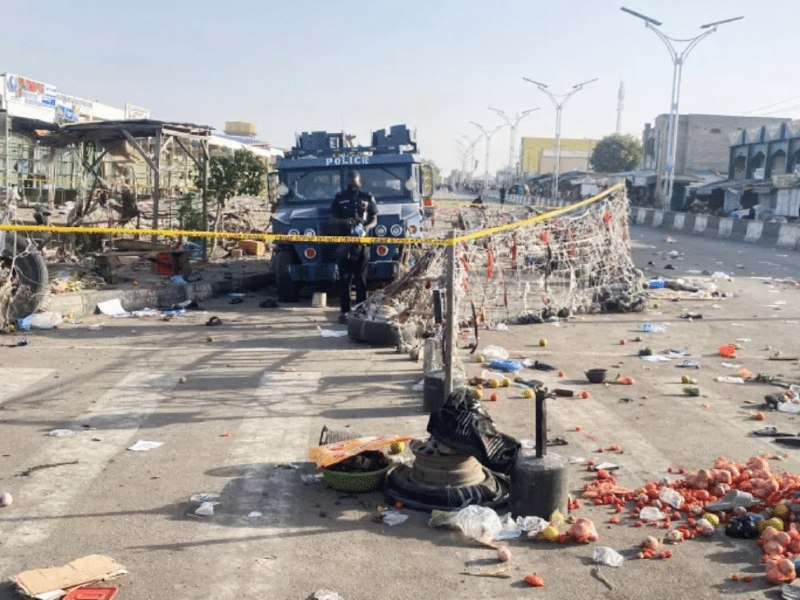
Saudi warplanes struck Sanaa International Airport on the morning of 13 July 2026, ending the de-escalation phase that had largely suspended Saudi-led air operations over the Yemeni capital since the latter half of 2025. The Cradle Media published video of the strike's aftermath at 11:33 UTC, showing damage to airport infrastructure and debris across the apron. The independent Yemeni mapping outlet AMK Mapping reported at 11:16 UTC that Houthi spokesperson Yahya Qasim Sa'id announced the raids "will not go unanswered." By 11:22 UTC, Liveuamap carried the movement's own characterisation of the strikes as "a blatant and brazen act of aggression" that "ends the de-escalation phase" and carries consequences Saudi Arabia "will bear."
For more than a year, the airport in the capital of a country the world largely stopped reading about had been a quiet seam in a wider ceasefire architecture. Monday's strikes ripped that seam open. Whether this becomes a new Houthi-Saudi war, or merely the opening of a coercive negotiation, is the question every external actor from Muscat to Riyadh is now trying to answer.
What the airport actually is
Sanaa International is not just a transit hub. It is the only operational civilian airport serving the Houthi-held north, and since 2015 it has functioned as the literal air bridge for humanitarian aid, UN flights, the remains of Yemenia Airways, and the patient evacuations to Amman, Cairo and Mumbai that keep a collapsed health system from collapsing further. Striking it is a high-cost signal: it forecloses the UN aid conveyor on which the World Food Programme and UNICEF depend, and it signals to Ansar Allah that the airspace ceasefire, the informal Saudi concession that made the broader truce work, is rescinded.
That is why the Houthi spokesperson's framing landed as it did. Calling the strike an "aggression" that ends the de-escalation phase is the movement's diplomatic register for declaring that the unwritten rules of the last twelve months are void. It is the language of an actor that has spent a decade learning when to claim that a red line has been crossed.
The counter-narrative from the Saudi side
The Saudi-led coalition has, over the life of the Yemen war, generally framed its air operations as defensive, targeted, and in response to Houthi missile and drone attacks on the kingdom's southern border and on Red Sea shipping. Riyadh has not commented in the source material Monexus reviewed for this article; the Saudi press agency and Saudi state media did not publish a confirmation or denial in the items available to us by mid-day UTC. That silence is itself a data point. Riyadh did not rush to put a legal-and-military explanation on the record, as it did after the 2022 Houthi attacks on Aramco infrastructure. The pattern suggests either a calibrated punitive strike whose public justification is still being written, or a more chaotic decision in which strikes were ordered without an inter-ministerial communications plan attached.
There is a third reading worth keeping on the table: that the strike is a message not to Ansar Allah but to Tehran, delivered via Yemen. Saudi Arabia has spent eighteen months attempting a regional de-escalation with Iran, including the China-brokered détente of March 2023 and the intermittent talks that have followed. A Houthi strike on Saudi infrastructure that the Saudis view as Iranian-coordinated would justify, in Riyadh's frame, an armed reminder that the kingdom retains escalation dominance. From this read, the airport is a stage, the runway is the message.
Why this moment
Three pressures converge. Inside Yemen, Ansar Allah has spent the de-escalation period rebuilding missile and drone production capacity at sites such as Hajjah and Sa'ada; Houthi-aligned channels have published footage of new long-range munitions throughout 2026. Across the region, the Gaza war and its ceasefire negotiations have absorbed the bandwidth of every Western and Gulf capital, with Yemen treated as a frozen file. And in the Red Sea corridor, the Houthi campaign against commercial shipping, dormant for stretches but never formally renounced, sits in a drawer someone can re-open.
The airport strike is a test of whether those three threads stay separate. If Ansar Allah responds with a missile salvo at Saudi oil installations, the de-escalation is dead and the Red Sea campaign returns within days. If the response is calibrated, more theatrical than operational, the Saudis may have bought a coercive cycle they can pause again.
What is uncertain
The sources do not specify the number of airstrikes, the weapons used, or whether the runway was the target or merely one target among several. They do not confirm civilian casualties at the airport or in surrounding neighbourhoods. The Cradle's video shows damage consistent with air-delivered munitions, but no independent Western wire has yet filed from Sanaa; Sanaa-based international press has been effectively absent since the early months of the war. Saudi state media had not, at the time of writing, issued a formal statement of responsibility, denial, or framing. Until it does, this is a one-sided information environment: Ansar Allah speaking, the kingdom silent, and Western outlets working from both.
This article relies entirely on Telegram-distributed wire and mapping sources because no mainstream Western outlet had filed a confirmed report from Sanaa as of 13 July 2026 at 12:00 UTC. As Western reporting lands and Saudi-side framing becomes available, Monexus will update the framing of what the strikes were for.
Wire provenance
This editorial synthesis draws on the following public wire/social posts:
- https://t.me/thecradlemedia
- https://t.me/Liveuamap
- https://t.me/AMK_Mapping