A brigade commander in cuffs: the Luchanov case and what it reveals about wartime discipline
Kyiv detained the commander of the 155th Mechanised Brigade over a suspected double murder. The case tests how seriously Ukraine is willing to police its own ranks while the war grinds on.
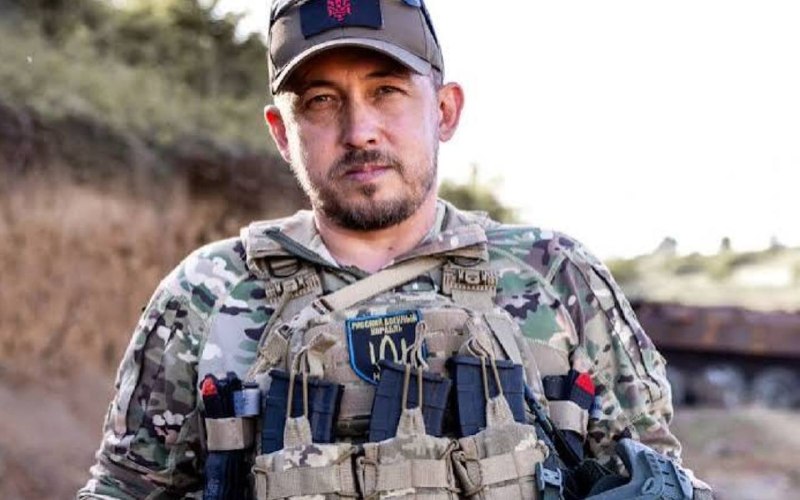
At 10:10 UTC on 13 July 2026, the Ukrainian outlet Censor.Net, writing through journalist Yuriy Butusov's Telegram channel, reported that the brigade commander of the 155th Luchanov Mechanised Brigade had been detained in Kyiv. Twelve minutes later, the same channel updated the news: the outlet's editors had confirmed the detention with the Prosecutor General's Office. By 10:59 UTC, a first photograph of the detained officer, identified as Stanislav Luchanov, was circulating alongside the line that his soldiers are suspected of killing two brothers in the Kyiv region. The full chain of events leading to the killing, the identities of the victims, and the formal charges have not yet been published in the thread material. What is on the record is narrow but consequential: a serving brigade commander in the Armed Forces of Ukraine is in custody, and the office of the Prosecutor General is the confirming authority.
The story matters less for the crime alleged than for what the response to it signals. Ukraine is fighting a full-scale invasion on its eastern and southern front; it is also, simultaneously, asserting that its own uniformed personnel are bound by domestic law. The two obligations are in constant tension, and the Luchanov case will be read as a measure of which side wins when they collide.
What Censor.Net actually said
The reporting chain is short and worth tracing. Butusov's Telegram channel first flagged the detention on the basis of Censor.Net's own sources, the standard phrasing the outlet uses when a story has not yet been nailed down to an on-the-record official. The follow-up twelve minutes later converted that sourcing: the detention was confirmed by the Prosecutor General's Office, which is the institution that would, in the normal course, be supervising a pre-trial investigation against a serving officer. The third item in the sequence added a name and a face, identifying the detained commander as Stanislav Luchanov and pinning the allegation to soldiers under his command, not to the commander himself as principal. Telegram commentary underneath the post repeated social-media handles for Facebook, Instagram, X and TikTok; those lines are outlet cross-promotion, not substantive reporting, and they should be treated as such.
The thread does not contain the date of the alleged killing, the names of the victims, the specific article of the criminal code under which the investigation is being run, or any statement from the 155th brigade's press service. Censor.Net's confirmation from the Prosecutor General's Office is the only institutional verification on the public record so far. Until more is published, every claim beyond "a brigade commander of the 155th has been detained on suspicion connected to a murder by his subordinates" is conjecture.
The counter-frame the West tends to miss
Western coverage of Ukrainian military conduct under wartime conditions tends to oscillate between two poles. One pole treats any allegation against a Ukrainian unit as evidence of a moral equivalence with the Russian forces that have, in documented and adjudicated cases, committed mass civilian killings, filtration-system sexual violence, and the forcible deportation of children. The other pole treats Ukraine as a purely victimised actor whose internal frictions are not news. Both framings are lazy, and both will flatten the Luchanov case if they are allowed to.
The structurally serious read is more boring and more accurate. Ukraine, as a state under invasion, is trying to do two things at once: generate enough combat power to repel an aggressor, and maintain enough institutional discipline that its armed forces do not become a parallel coercive authority inside the country they are supposed to be defending. That is the standard every conscript-era army in history has failed to meet at some point. The question is not whether failures happen. It is whether the state has a working response when they do. A commander detained, a prosecutor's office confirming the detention, and a press corps willing to name him are the working response. So is the absence, so far, of any public pressure from the political leadership to make the case go away.
Why the institutional plumbing matters
The Prosecutor General's Office in Kyiv has, since the start of the full-scale invasion, carried an unusually heavy load. It is simultaneously pursuing war crimes cases against Russian personnel, coordinating with the International Criminal Court, and supervising domestic criminal investigations that touch serving members of the Armed Forces. The fact that an office under that kind of pressure was the body confirming the Luchanov detention, rather than the Security Service of Ukraine (SBU) or the Military Law Enforcement Service acting alone, is itself a piece of information. It points the case toward the regular criminal-track machinery, not the security-track one. That distinction is not decorative; it determines who runs the investigation, what procedural safeguards apply, and how the file eventually surfaces, or fails to surface, in open court.
For Western readers used to the procedural choreography of NATO militaries, the Luchanov case will look under-documented. There is no public charge sheet, no named magistrate, no court date. The Ukrainian system does not run on the same publicity rails, and wartime conditions compress the timeline further. The relevant comparator is not a US Army court-martial docket; it is the working pace of a domestic prosecutor's office in a country absorbing daily missile and drone strikes on its cities. By that standard, the speed at which a brigade commander was located, detained, and publicly identified by name is fast.
Stakes, and what to watch
Three things are worth tracking over the next two weeks. First, whether the Prosecutor General's Office publishes the article of the criminal code under which Luchanov and any subordinates are being held, and whether the alleged offence is treated as a command-responsibility matter (failure to prevent or report) or as a direct-act charge. Second, whether the 155th Mechanised Brigade's command structure is reconstituted or left in suspension, and what that signals about whether the case is read in Kyiv as an isolated criminal matter or as a discipline problem across multiple units. Third, whether the victims' family retains access to Ukrainian media; the absence of named civilian voices in the early reporting is a feature of the war reporting environment, not a sign that the case is being suppressed, but it is the kind of absence that invites conspiracy framings if it persists.
There is a fourth, longer-horizon stake. Ukraine's case for continued Western support rests, in part, on its claim to be a functioning European state under extreme stress. That claim is not rhetorical; it is paid for, in part, by the visible operation of its own legal institutions against its own armed forces. The Luchanov file is small. It will not determine the war. It will, however, be read as a stress test of whether the claim holds under the kind of pressure that every long war eventually produces.
The desk's read: Western wires are likely to under-cover this story because it does not fit the available Ukraine frame, which is either "heroic resistance" or "aid fatigue". The structurally more interesting frame is institutional: can a state under bombardment still police its own army? Monexus treats this as the lead question, not the alleged crime itself.
Wire provenance
This editorial synthesis draws on the following public wire/social posts:
- https://t.me/ButusovPlus
- https://t.me/ButusovPlus
- https://t.me/ButusovPlus