The Louvre Heist Trial and the Myth of the Lone Thief
Two defendants in the October 2025 Louvre jewel heist say a mysterious patron sent them a video filmed inside the Apollo Gallery. The case is testing France's appetite for a quieter story about who really plunders national patrimony.
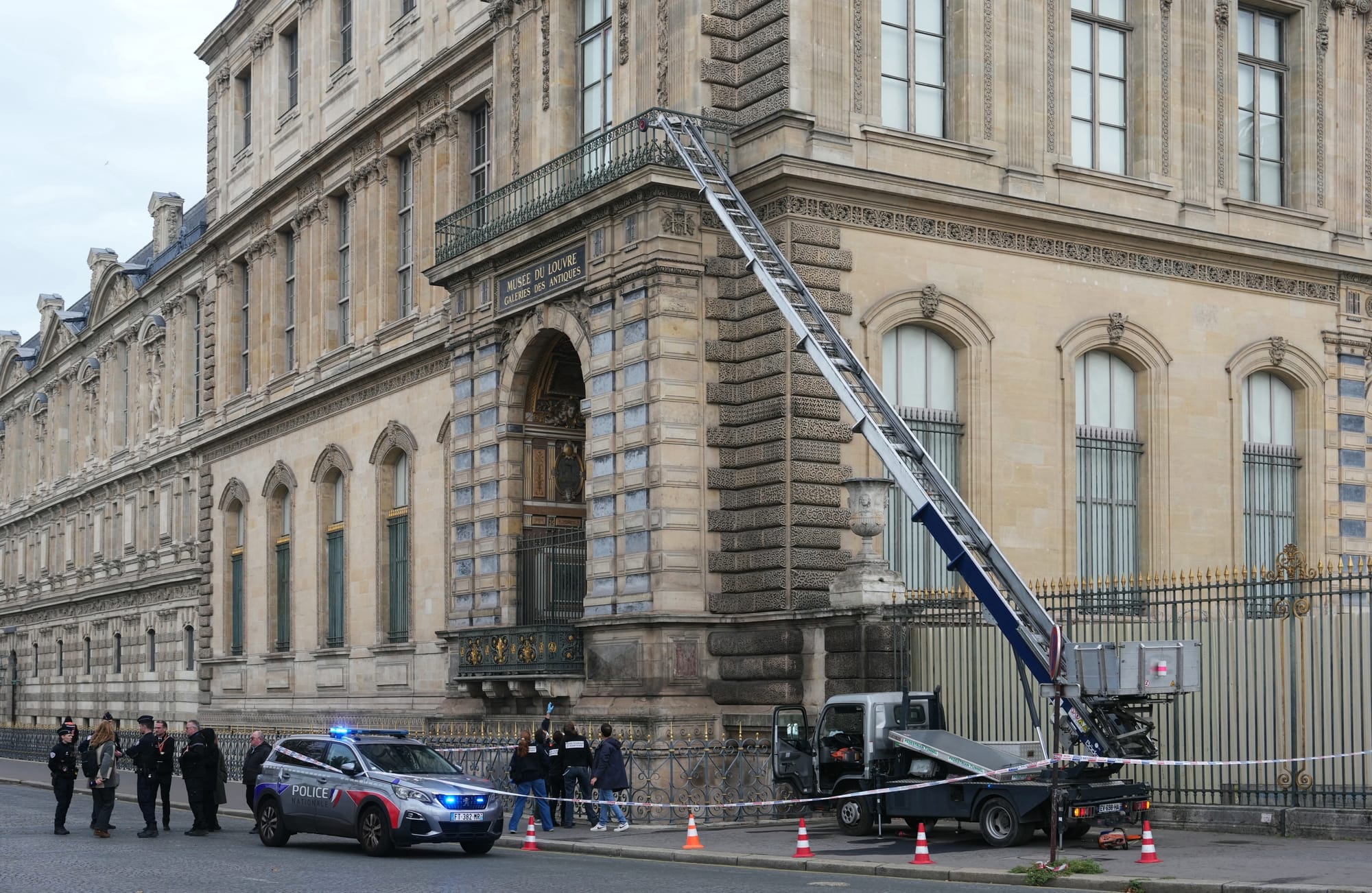
On 19 October 2025, four masked figures on a mechanical lift pulled up to the Apollo Gallery of the Louvre in broad daylight and walked out with eight pieces of the French crown jewels. Eight months later, the public defence is more interesting than the heist itself.
The two suspects in custody told investigators that a "mysterious sponsor" had orchestrated the operation, according to reporting published by ARTnews on 13 July 2026. The alleged patron reportedly sent the pair a video filmed inside the Apollo Gallery showing the royal jewels on display, material that would have been difficult to obtain without inside access to the world's most-visited museum. The framing pushed by the defence is a familiar one in French criminal lore: the homme de main, the frontline hand, is recruited, directed, and discarded by a figure who never appears in the footage.
The case arrives at a moment when the cultural establishment is already on edge about provenance, display, and the politics of ownership.
A defence that aims upward
The two defendants, both in their thirties and identified in French press as residents of the Paris region, are pursuing a line that does not deny the theft but redirects culpability. Their account, as summarised by ARTnews, leans on a single piece of physical evidence: the pre-operational video. If the footage was filmed inside the Apollo Gallery with sufficient resolution to plan the extraction window, the obvious follow-up questions concern museum staff, contract cleaners, private-security contractors, conservators, and any of the dozens of accredited suppliers who pass through the Louvre's galleries in a normal week.
A defence built on "the real planner is still out there" is a slow-motion indictment of the institution itself. It invites French prosecutors to widen the inquiry from a closed circle of suspects into the open question of who, exactly, has unrestricted access to a wing that holds the crown diamonds. The Louvre has so far declined to comment on staffing, surveillance procedures, or the contractor roster, citing the live investigation. That silence reads, in the court of public opinion, almost as confirmation.
The museum that can't afford another crack
The heist exposed a security posture that critics had warned about for years. The Apollo Gallery's windows were, at the time of the break-in, fitted with older laminated glass and protected externally by municipal railings rather than purpose-built anti-ram barriers. CCTV coverage of the water-side approach was, according to subsequent reporting in French outlets, sparse. The museum had been operating under a deferred-maintenance backlog that successive directors acknowledged but never closed. A 2024 Cour des comptes review of France's grands musées had flagged the Louvre's perimeter security as inadequate to the value of the holdings.
The October break cost the institution more than the eight jewels. The Galerie d'Apollon, a seventeenth-century ceiling painting by Charles Le Brun celebrating the sun king's cosmic order, was opened to the public for the first time in 2001 after a two-decade restoration. The room sits inside the Denon wing and frames the French state's self-image as heir to the royal collections. Its violation, however temporary, is a domestic-political event as much as a criminal one.
What the "mysterious sponsor" actually buys
There is a counter-narrative worth taking seriously before the courtroom consensus hardens. The two defendants may be constructing a sponsor the way every thief caught on camera constructs one: to trade a name the police do not have for the name the police do. A fabricated patron who "never appears" cannot be cross-examined, cannot be confronted with the video, and cannot be excluded by an alibi. It is the easiest person in the world to invent.
The structural point, though, persists independent of whether this particular sponsor is real. Theft from national collections in France is overwhelmingly prosecuted at the level of the courier and the fence. The upstream layer, the buyers, the laundering intermediaries, the private collectors and family offices that absorb stolen patrimony into documented holdings, is rarely charged in France and almost never extradited. The 2018 Sardinian theft from a church near Pavia; the 2019 smash-and-grab at the Green Vault in Dresden; the long-running market in antiquities lifted from Iraqi and Syrian sites during the 2010s, all follow the same pattern. The line stops where it becomes expensive.
A trial that reaches the "mysterious sponsor" would be unusual in the European record. A trial that stops at the two figures who walked out on the lift would be the norm.
A wider stake than eight jewels
The cultural-policy question hanging over the case is whether France treats the Louvre breach as a one-off lapse or as evidence that the operating model of the great national museum is no longer fit for the holdings it carries. Visitor numbers, conservator headcount, perimeter design, and the contractual architecture that governs outsourced security all sit inside that question. So does a quieter one: how much of the French state's self-understanding is invested in a building that eight masked people on a rented lift were able to enter at 9:30 on a Sunday morning and leave eight minutes later.
The next hearing in the inquiry is expected later this summer. If the prosecution widens beyond the two defendants, the case will reshape a routine theft story into a probe of the institution itself. If it does not, the Louvre will spend the autumn replacing glass, reinforcing balustrades, and explaining, again, why a museum that holds the regalia of a thousand-year state cannot keep its windows intact.
Desk note: Monexus framed this piece around the institutional and cultural-policy stakes rather than the tabloid register most wire copy adopted in October 2025, where the heist was reported principally as a spectacle of daring. The ARTnews dispatch is the only source to date that surfaces the pre-operational video and the "mysterious sponsor" defence in detail.
Wire provenance
This editorial synthesis draws on the following public wire/social posts:
- https://en.wikipedia.org/wiki/2025_Louvre_jewel_heist
- https://en.wikipedia.org/wiki/Apollo_Gallery
- https://en.wikipedia.org/wiki/Louvre