Hormuz war of words: Tehran and Washington stake competing claims on the strait
On 13 July 2026, Iranian military spokesmen declared the Strait of Hormuz off-limits to US interference, hours after Donald Trump said Washington would seize and 'manage' the waterway. The exchanges point to a contest for control of the world's most consequential oil chokepoint.
At 14:23 UTC on 13 July 2026, Iran's state-run IRNA news agency published a single declarative line from the spokesperson of the Khatam al-Anbiya Central Headquarters: the country's armed forces would not permit the United States to interfere in the Strait of Hormuz. Five minutes earlier, the same outlet had carried an even blunter formulation from a spokesperson for the Islamic Revolution Guards Corps, who said Iran would "steadfastly maintain" sovereignty over the waterway. By 15:20 UTC, IRGC spokesman Brigadier General Mohebi had escalated further, accusing Washington of having "seriously jeopardized global oil and gas security" through its interference in the strait and demanding accountability.
The trigger sat on the other side of the exchange. At 14:28 UTC, a Telegram channel aligned with Donald Trump carried a transcript of the US president's response to what he framed as an Iranian attempt to take control of the strait: "We will seize the strait. Most likely, we will also manage it. We will become the guardians of the strait." Within hours, Tehran's two principal military command spokes structures had replied in near-unison, and a quiet maritime corridor had become the staging ground for a fresh round of brinkmanship.
Two governments, one chokepoint
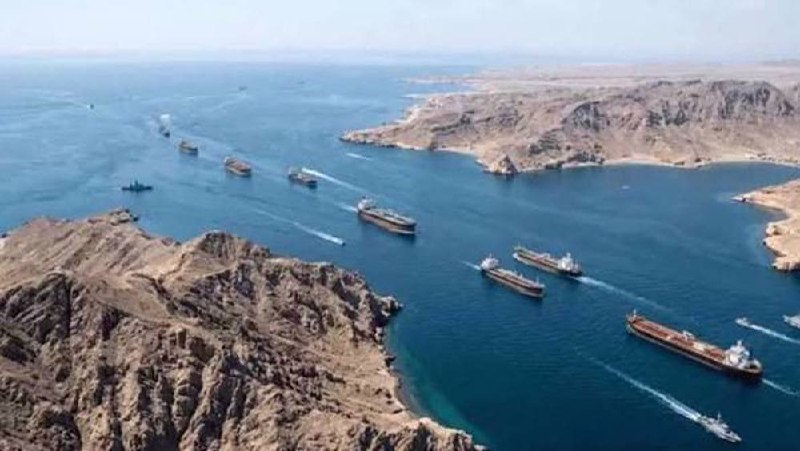
The Strait of Hormuz is the narrow passage between Iran and the Arabian Peninsula, linking the Persian Gulf to the Gulf of Oman and, beyond it, the Arabian Sea. It is the single most consequential oil transit point on earth. The contemporary argument between Washington and Tehran is not about whether the strait should remain open. Both governments insist they want free passage. It is about who gets to say so, and on whose terms.
Trump's statement, as relayed by the channel that carries his remarks, frames the issue as a contest of management. The United States, in this telling, would not just guarantee the strait but run it. The Iranian response, articulated by the IRGC and by the Khatam al-Anbiya Central Headquarters, treats the same framing as a provocation: an external power declaring it will "seize" and "manage" a waterway that abuts Iranian territory is, from Tehran's vantage, the very definition of interference. The two statements cannot be reconciled without one side backing down.
What the Iranian statements actually say
The wording matters. The IRGC spokesman's line, carried by IRNA, anchors the claim in sovereignty: Iran will "steadfastly maintain" control. The Khatam al-Anbiya spokesperson's line, also carried by IRNA, broadens the claim institutionally: Iran's armed forces, as a whole, will not permit US interference. Mohebi's later statement, distributed through PressTV's Telegram channel, adds a third register, accusing Washington of having already damaged global energy security and demanding accountability. Read together, the three statements form a layered warning: a sovereign claim, an institutional commitment, and a framing of the United States as the destabilising actor.
All three were issued by Iranian state or state-aligned channels. None of them have yet been matched, in the source material available, by an independent Western wire confirmation of the precise wording, and the English translations are Tehran's own. That is the nature of the information environment in which Hormuz politics now plays out: the first read of every Iranian statement comes through Iranian media, and the first read of every Trump statement on this subject comes through channels that carry his remarks directly. The corroboration lag is itself part of the story.
The structural frame
What is happening in the Gulf is best understood not as a one-off exchange but as a recurring pattern: two governments that share an interest in the strait remaining open nevertheless treat control of the framing as a strategic asset. Washington wants the world to read the strait as a US-managed commons. Tehran wants the world to read it as Iranian sovereign space into which external powers venture at sufferance. Both positions have legal and historical antecedents. Neither can be made good unilaterally.
For the broader audience, the practical stakes sit in three places. First, oil flows: a serious disruption at Hormuz would move global crude prices by tens of dollars a barrel within hours, and the insurance and freight markets that price that risk are already attentive to the language coming out of Tehran and Washington alike. Second, military positioning: the IRGC's navy operates across the strait and the Gulf of Oman, and US Central Command maintains a permanent presence in the surrounding waters; the statements exchanged on 13 July are signals sent across that pre-existing posture. Third, the diplomatic lane: the same week has produced competing claims of authority from two capitals that are, on paper, still bound by the constraints of a global energy market neither can afford to break.
What remains uncertain
The exchanges of 13 July are statements of intent, not reports of action. No source item reviewed here describes a seizure, a boarding, a diversion of a tanker, a deployment of new forces, or a specific incident at sea. The Trump remarks, as carried by the channel that published them, are conditional ("we will…"); the Iranian responses are categorical. The gap between a conditional threat and a categorical refusal is precisely where escalation risk lives.
What is also not yet clear is the operative chain of command on each side. The IRGC is a parallel military structure to Iran's regular armed forces; the Khatam al-Anbiya Central Headquarters is a joint operational command. Whether either spoke in coordination with the civilian government, or in advance of it, is a question the public record does not resolve today. On the US side, the statement attributed to Trump was carried by a single Telegram channel; the White House has not, in the sources available to Monexus, issued a corresponding formal communication.
For readers watching the ticker, the date to mark is not 13 July itself but the days that follow. Declarations of intent in the Gulf are routinely followed, within a window of days to weeks, by either de-escalatory clarification or by the first concrete move at sea. Until one of those two arrives, the strait sits in the uncomfortable middle ground where both governments claim authority and neither has yet tested the other.
This article was prepared from Iranian state-media wire output and a single channel carrying Trump's remarks; Monexus did not have access to independent Western-wire confirmation of the precise wording on the day of publication.
Wire provenance
This editorial synthesis draws on the following public wire/social posts:
- https://t.me/presstv/
- https://t.me/presstv/
- https://t.me/presstv/
- https://t.me/Irna_en/
- https://t.me/englishabuali/
- https://t.me/Irna_en/