The final four meet the rankings: England, Argentina, France and Spain one win from a World Cup final
Argentina, France, Spain and England arrived at the 2026 World Cup as FIFA's top four and now stand two wins from the trophy, a bracket that confirms what the rankings had been saying for months.
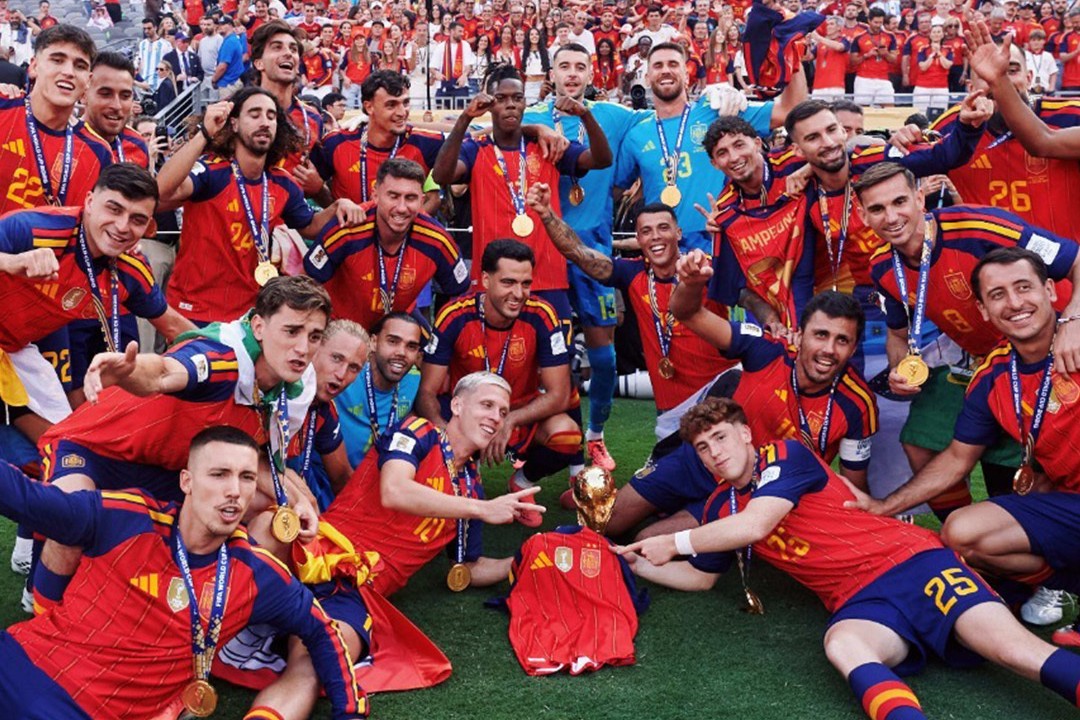
Argentina, Spain, France and England walked into the 2026 FIFA World Cup as the top four teams in the world, and on 12 July 2026 the bracket caught up with the form book: for the first time in the competition's history, FIFA's pre-tournament top four have all reached the semifinals, two matches that will decide who plays at the MetLife Stadium on 19 July.
The two ties, scheduled for the week ahead, are Spain versus France and England versus Argentina. The second is a rerun of the 2022 quarterfinal in Lusail, when Argentina knocked England out on the way to the title Lionel Messi is still chasing, this time with a place in a third straight World Cup final on the line. France, holders of the 2018 crown and runners-up four years ago, will try to clear a Spain side that has topped the FIFA rankings for stretches of the year. Whichever pairing emerges from the other side of the bracket will meet on 19 July. The tournament has, almost by design, produced the four teams the global football economy had been pointing toward.
What the data was already saying
Rankings are a blunt instrument, but they have a habit of arriving first. FIFA's pre-tournament list placed Argentina, Spain, France and England at the summit in that order, and ESPN's 12 July round-up frames the final four as the moment the leaderboard "stopped lying." The statistical case for each is straightforward: Spain have the deepest positional possession pool in the tournament, France have the most decisive individuals on the counter, England have the most consistent defensive structure across a five-game sample, and Argentina have the only forward still operating at the level the 2022 run required.
CBS Sports' own ranking of the semifinalists, published earlier on 12 July, complicates that hierarchy. The piece places Argentina fourth of the four, behind England, France and Spain, citing Messi as an "exception to be respected" rather than a baseline to be ranked around. The argument runs as follows: that Argentina in 2026 are a shakier defensive unit than the 2022 vintage, that the goalscoring load is concentrated in one player who will be forty during the next World Cup cycle, and that the other three semifinalists have more ways to win on a neutral night. Argentina remain the holders and still carry the only man to lift the trophy in three different decades; that combination is harder to score than to play against.
The Albiceleste's narrow path
Argentina's run to this point has been less procession than passage. Messi has not dominated tournament play in the manner he did in Qatar 2022, where his seven goals and the supporting cast around Julián Álvarez, Alexis Mac Allister and Rodrigo De Paul carried Scaloni's side past the Netherlands in the quarters and France in the final. What he has done is contribute the moments that decide tight games: an assist, a free kick, a run that pulls two markers out of the spine and frees a teammate in the box. The 12 July Al Jazeera brief on the England–Argentina semifinal frames the tie explicitly in those terms, as a clash between the reigning champions carrying one generational talent and an England side carrying a squad, where the question is whether the squad holds together without producing one of its own.
England's route through the knockouts has been the inverse. Gareth Southgate's successors, whoever they may be by the semifinal, have built a side that wins the second half, that concedes few high-quality chances, and that finishes its opportunities with the sort of efficiency that turns a 1–0 into a 2–0 once a deadlock breaks. The structural test against Argentina is whether that defensive shape can absorb the gravitational pull of a single player for ninety-plus minutes without help from the referee.
France and Spain as a referendum on style
The first semifinal pairs the two teams most likely to dictate terms regardless of opponent. Spain have moved the ball through the lines with a patience that has drawn comparisons to their 2010–2012 era, though the personnel differs almost entirely from the Xavi–Iniesta spine. France, by contrast, have leaned on the most lopsided talent distribution of the field: Kylian Mbappé operating from the left half-space, with a supporting cast that has improved across the tournament but does not pretend to the same systemic coherence.
CBS Sports' companion piece on potential finals, also published 12 July, ranks the four possible matchups for the 19 July final and arrives at a counter-intuitive order: Argentina in any final would top the list, an England–France final would be the most watchable contest, and a Spain–France final, however glamorous on paper, ranks below both. The framing tracks how international football has been sold to broadcasters in recent cycles: finals featuring Messi or England move subscription metrics, and France bring the individual highlight reel. Spain, for all their quality, do not move the needle the same way.
What the bracket has already settled
Two things are already decided. First, a new entrant will lift the trophy: no 2022 semifinalist other than Argentina has reached this stage in 2026, which means the player who touches the trophy at MetLife on 19 July will be hoisting it for the first time. Second, the global game has cycled back to the four federations that have won every World Cup since 2006. Brazil, the perpetual favourite of the pre-tournament betting markets, are not in the final four. Neither are Germany, Italy or the Netherlands. The list of potential champions has narrowed to a clean oligopoly, and the television rights-holders who paid the premiums on this tournament cycle will receive the audience they priced.
That oligopoly is, more than any single matchup, the story of the 2026 World Cup. The four teams left in are also the four whose domestic leagues generate the largest broadcast revenues, whose clubs employ the largest share of the players on the pitch, and whose national federations sit at the centre of FIFA's governance. A tournament that began with forty-eight teams and 104 matches ends with a final contested by two of the same four countries. The expansion widened the field; the bracket narrowed it.
What the semifinals will decide, beyond a trophy, is which of those four inherits the next four-year cycle of seeding. FIFA's World Cup draw uses the rankings from the moment the final whistle blows, and the distribution of the August 2026 update will shape every qualifier group drawn in the autumn. A win in the semifinal is not only a place in a World Cup final; it is a friendlier path to the 2030 tournament.
Desk note: this article treats the four remaining teams as a structural story, not just a sports story, because the source items all converge on the same conclusion. Monexus wrote the four-nation oligopoly frame ourselves; the points of fact are in the links above.