Eight games, ten draft picks: Vegas Summer League opens its real test week
The Las Vegas Summer League's eight-game slate on 12 July 2026 puts this year's lottery class on a single court schedule. The bench depth, not the lottery pedigree, is what will decide who separates.
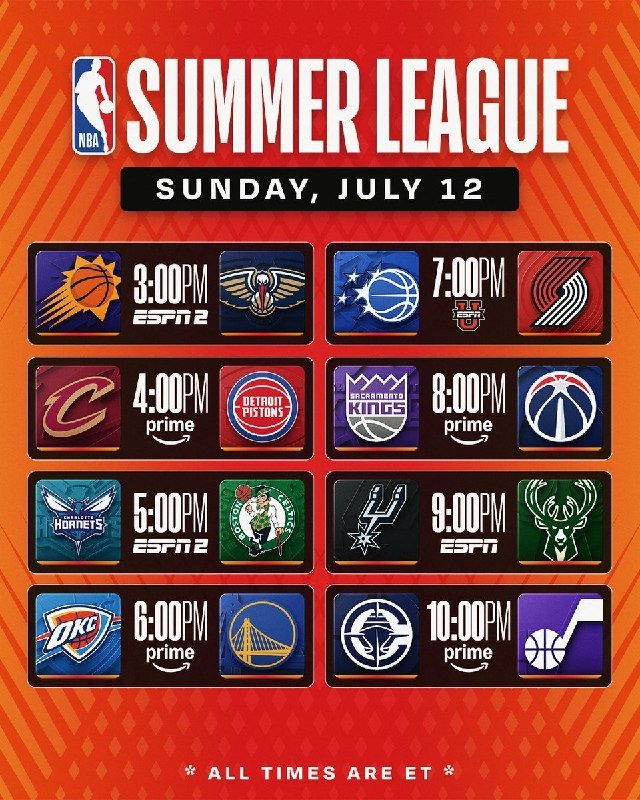
At 3:00 pm Eastern on 12 July 2026, the Las Vegas Summer League runs eight games across the Thomas & Mack and Cox Pavilion complexes, with coverage split between Prime Video, ESPN, ESPN2, ESPNU and the NBA League Pass streaming tier. The slate, broadcast schedule and confirmed lottery-pick appearances were circulated in advance by the NBA Live wire on Telegram. The draw is no longer a tryout. It is the second full week of the league's new calendar structure, and the gap between players who arrived with lottery contracts and those fighting for two-way invitations has started to harden.
This stretch of the Summer League is where the front-office opinions actually move. Scouts file reports that get attached to rookie-scale extensions three years out; agents set the anchors for second-contract negotiations that begin the moment a player crosses into restricted free agency. Eight games in two days compresses a normal month's worth of evaluation into a single viewing window, and the lottery class of 2026, headlined by No. 6 pick Mikel Brown Jr. and No. 8 pick Kingston Flemings, is finally getting the volume of possessions needed to read its own ceiling.
A schedule built for volume, not drama
The league office has stacked the slate deliberately. Eight games means roughly 320 rotation minutes per lottery pick across the day, the kind of sample that lets a staff separate rhythm from noise. A 20-point outing in one half-emptied Cox Pavilion afternoon game has always meant less than a 14-point outing against a switch-heavy second unit that knows how to take away a player's first action. The 12 July card, beginning at 3:00 pm Eastern and stretching into the West Coast night, is built to give coaching staffs exactly that distinction.
Mikel Brown Jr. enters his second Summer League week with a clearer role definition than most lottery sophomores. Flemings, drafted one slot behind him, has spent his first week adjusting to NBA pace after a college career built on pull-up volume. The matchup between the two, scheduled for the early evening window on the broadcast card, is the single most-watched individual contest of the day and the one where both scouting departments will be filing notes in real time.
Why the bench is the story
The reading most league evaluators share privately is that the lottery pedigree has already been priced in. What separates the players who will hold rotation spots from the ones who bounce through two-way deals is the second unit: how they handle a closing stretch when the lead guard sits, how they read a broken play, whether they can guard a switching big without fouling out of a 24-minute run. Summer League rosters are deliberately uneven, stacked with second-year players returning from G League assignments, undrafted invitees on make-good contracts and a few veterans parachuted in by their parent clubs to set the temperature.
That mix is the point. It produces possessions that resemble a January regular-season game more than a July showcase, because the veterans stop playing politely once the cameras are off them. The lottery pick who looks composed against that texture is the one whose second contract is already half-written.
The counter-read
The skeptical case is simpler, and it deserves its air. Eight games in two days is still Summer League. The referees swallow whistles that would be called in October. The shot clock is treated as advisory in the first three quarters of most games, and coaches run sets they would never run in a regular-season opener. A player can play his way into or out of a rotation in this window, but the underlying mechanics of player development, the G League stints, the offseason skill work, the year-two leap, do most of the heavy lifting regardless of what happens in Vegas.
There is also the question of how much front offices actually trust the data. Some organisations have scaled back their Summer League travel in recent years; others have leaned in harder. The wire's broadcast-partner lineup, with Prime Video anchoring the early window and ESPN family networks filling out the night, suggests the league itself is still treating the Las Vegas stretch as a primary product rather than a development footnote. That is not nothing.
What to watch by Monday
The clearest read will come from the second halves of the late-window games, when coaches start experimenting with closing lineups. Lottery picks who close for their teams are getting coached, not showcased. Lottery picks who get pulled at the six-minute mark of the fourth are getting preserved, which is its own statement. The 13 July slate, lighter at four games, will be where the weekend's notes get tested against a smaller, more deliberate sample.
The wire's 11 July preview highlighted the Brown-Flemings matchup as the headline draw; the 12 July card widens the lens to the full lottery class in a single day. The question is not who looks best in a one-game highlight. It is whose role definition survives the second rotation, and whose does not.
This publication treated the Summer League's midweek slate as a draft-evaluation event rather than a marquee product story, on the view that the rotational information is more durable than any single-game storyline.
Wire provenance
This editorial synthesis draws on the following public wire/social posts:
- https://t.me/NBALive/1137
- https://t.me/NBALive/1102