US strikes hit Ahvaz and Sistan-Baluchestan as Iran reports wave of blasts
Unverified Iranian state-media reports at 22:06–22:29 UTC on 12 July 2026 describe blasts in three southern provinces after US strikes, with Ahvaz Airport named as a preliminary target.
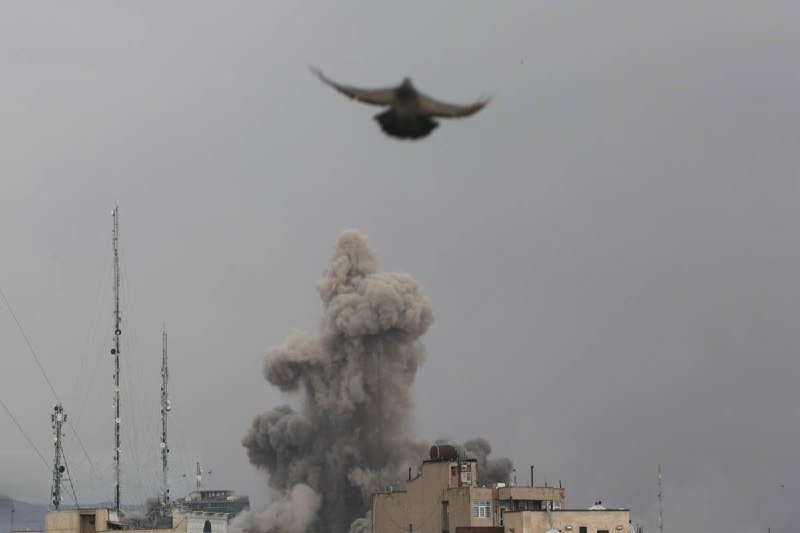
At 22:29 UTC on 12 July 2026, the Telegram channel Intelslava circulated a still captioned "scenes from Ahvaz, southwestern Iran" alongside a US-versus-Iran flag pairing, hours after Iran's state broadcaster began reporting blasts in three southern provinces. The image and the cluster of messages that preceded it amount to the first wave of visual and verbal evidence from inside Iran describing what Press TV, the Islamic Republic's English-language outlet, called US strikes.
The picture is still fragmentary, sourced almost entirely from Iranian state media and channels republishing its dispatches. But the geographic spread is the story: in the space of roughly 25 minutes, Press TV moved from reporting blasts in Sistan and Baluchestan to identifying Ahvaz, and the warfront-witness channel wfwitness added a third site, Bandar Abbas. If the early Iranian accounts hold, the United States has struck targets across southern Iran in a single evening, hitting infrastructure rather than the country's better-known nuclear or missile sites in the centre and west.
What Press TV says happened
The reporting began at 22:05 UTC, when Press TV posted on Telegram that "reports of several blasts" had reached Iran's southern province of Sistan and Baluchestan "after US strikes." Eleven minutes later, wfwitness reposted the Press TV line and added its own claim that "preliminary reports" identified Ahvaz Airport as a target. At 22:28 UTC, Press TV raised the volume: "unconfirmed reports of heavy explosions in Iran's southeastern city of Ahvaz following US attacks," followed by an attribution to an Ahvaz provincial official confirming strikes on two parts of the southern city. By 22:06 UTC the same evening, footage was circulating that allegedly showed the aftermath of a strike in Bandar Abbas, on the Strait of Hormuz coast, again via wfwitness citing Press TV.
Three locations in roughly 200 minutes, all in the south, none of them the obvious candidates. Iran's nuclear programme is concentrated around Natanz, Fordow and Isfahan; its missile facilities cluster around Shahroud, Semnan and Karaj. Ahvaz, the capital of Khuzestan, sits over the country's oil heartland. Bandar Abbas handles the bulk of the Strait of Hormuz shipping. Sistan-Baluchestan runs along the Pakistani border and has been a transit corridor for weapons流向 Afghanistan and the Gulf. Strikes in those three provinces would land on energy, ports and logistics, not on the facilities most associated with Iran's nuclear and ballistic work.
The provenance problem
Every claim above flows from a single upstream source: Press TV, an outlet operated by the Iranian state, with its Telegram posts then redistributed by Intelslava and wfwitness, two channels whose editorial立场 sits closer to Tehran than to Western wire desks. No Western outlet had confirmed the strikes as of 22:29 UTC. No Iranian opposition source, no Reuters or AP bureau in the Gulf, no US Central Command briefing appears in the cluster of dispatches that produced this article.
That asymmetry matters. Press TV is a legitimate journalistic outlet by the standards of any country's state broadcaster: it has reporters on the ground, it interviews officials, and its footage, when verifiable, has held up in past strikes. But in the first minutes of an active bombardment, state outlets also have an institutional incentive to frame events in terms that suit the government in Tehran. The decision to identify Ahvaz Airport as a preliminary target, for instance, comes from the same Press TV pipeline that, two hours earlier, was reporting strikes whose scale could not be independently confirmed. A reader relying on these channels alone is reading only one party's account of a fast-moving event.
The "unconfirmed" qualifier is doing real work in the Press TV posts themselves. Even Iranian state media, in its most urgent dispatches, stopped short of asserting that the strikes had hit the specific targets now being named. That epistemic caution is the right frame for anyone outside Iran trying to make sense of the cluster.
Why the southern geography matters
If the Iranian accounts survive independent corroboration, the choice of southern targets tells a particular story. Khuzestan produces the majority of Iran's crude; an attack on Ahvaz, or on the airport that connects the province to Tehran, would be read in oil markets as a signal that the United States is willing to damage Iranian energy infrastructure directly. Bandar Abbas is the container terminal that handles most of Iran's seaborne trade, and it sits a few kilometres from the main naval base of the Iranian Revolutionary Guards' navy. Sistan-Baluchestan, remote and predominantly Sunni, has been the site of past Iranian operations against separatist groups and against smuggling routes used by Sunni militants.
Hitting all three in a single evening would mean the United States has chosen to broaden the target set from counter-force strikes, the kind of operation that disables missile and nuclear facilities, to something closer to counter-value targeting, the wartime doctrine of striking an adversary's economic and logistical infrastructure. The distinction matters because counter-value targeting typically widens wars. Iran's oil revenue, port throughput and supply routes are the parts of its economy most exposed to escalation; they are also the parts that, if damaged, raise the cost of war for civilian populations and for neighbouring states that import Iranian energy or transit the Strait of Hormuz.
The geographic pattern is consistent with an operation designed to degrade Iran's ability to sustain a prolonged fight, not to dismantle a specific weapons programme on a single night. That is a meaningful editorial judgment, and it is one the Iranian state-media sources do not make. They report strikes; they do not characterise them.
What remains unverified
As of 22:29 UTC on 12 July 2026, the source cluster does not establish several things a reader would normally want to know. The number of strikes is not given. The weapons used are not identified. There is no casualty figure, no damage assessment, no statement from US Central Command or the Pentagon, no reaction from the Iranian foreign ministry, no comment from Gulf states whose airspace the strikes may have traversed, no oil-market move to corroborate the energy-infrastructure angle. The "two parts of the city" line attributed to an Ahvaz provincial official is the most concrete detail, and it comes from Press TV alone.
What the cluster does establish is narrower but real: that Iranian state media, at the highest editorial urgency, is reporting coordinated strikes across three southern provinces, that the reporting is timestamped inside a 25-minute window, and that the United States is named as the attacker in every dispatch. The remainder is conjecture built on a single pipeline of state-aligned sources, and this publication treats it as such.
Desk note: Monexus is publishing this from a cluster of Iranian state-media and adjacent Telegram channels. We name Press TV in line and treat Intelslava and wfwitness as redistributors. Western wire confirmation, Iranian opposition verification, and independent footage geolocation are pending; the article will be updated as those arrive.
Wire provenance
This editorial synthesis draws on the following public wire/social posts:
- https://t.me/intelslava
- https://t.me/presstv
- https://t.me/presstv
- https://t.me/wfwitness
- https://t.me/wfwitness
- https://t.me/presstv