Russia's fuel map is shrinking: shortages reach almost every region
An economic observer's note that petrol queues are stretching across Russia has been picked up by translation desks and OSINT channels, putting a domestic logistics story on the front page of the war.
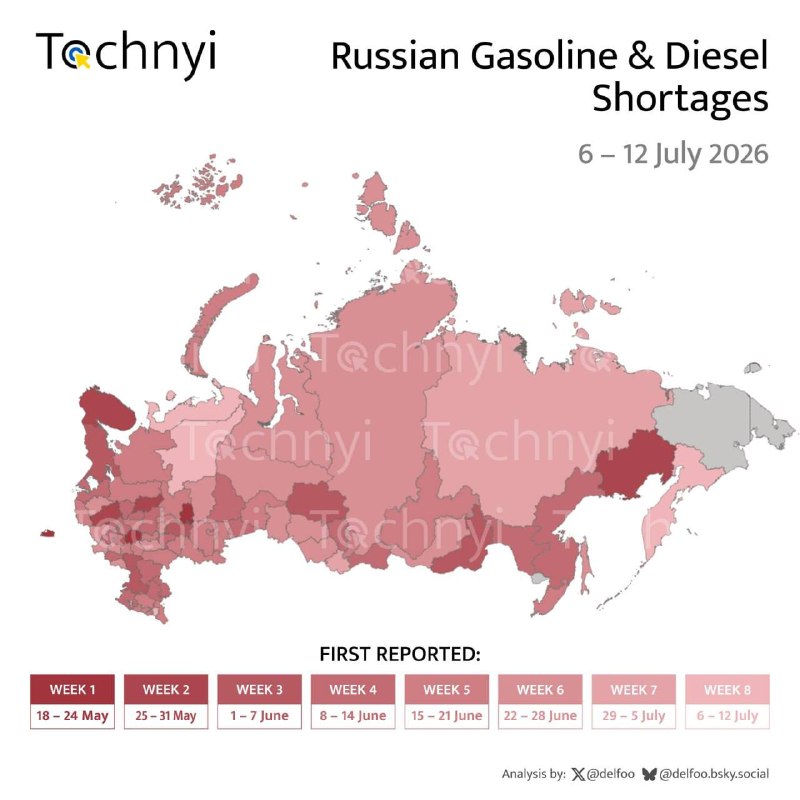
A short bulletin posted on Telegram by the Ukrainian news agency UNIAN at 09:48 UTC on 12 July 2026 has travelled further than its author probably intended. Economic observer Stanimir Dobrev, writing about Russia's internal fuel market, concluded that shortages are no longer a regional embarrassment but a country-wide problem. Within twenty-six minutes, the English-language translation desk WarTranslated had picked up the line. By 10:41 UTC the same morning, OSINTLive had repackaged the same paragraph with the same wording. The story's substance is narrow; its provenance is not.
What Dobrev described, in summary form, is a fuel map that has contracted to almost nothing. Of Russia's eighty-nine federal subjects, only two, the remote Chukotka Autonomous Okrug on the Bering Strait and the Jewish Autonomous Region on the Chinese border, are reported to be unaffected. Every other region, from Kaliningrad to Kamchatka, sits inside the shortage zone. The mechanism behind the squeeze is not spelled out in the source material. Dobrev is an economic observer, not a refinery analyst; the original alert is a single paragraph. But the speed with which the line propagated across translation and OSINT desks, and the unanimity of the wording, tells its own story: an internal Russian logistics story has become, in the space of a news cycle, a piece of war reporting.
How a paragraph becomes a fact
Telegram has reorganised the rhythm of wartime news. A Ukrainian wire drops a translation; a niche translation account posts it with a clean English gloss; an OSINT aggregator reposts that gloss verbatim. Within an hour, three independent-looking accounts are saying the same thing in the same words. By the time a reader encounters the claim, the apparent corroboration is the reposting, not the underlying reporting. The risk is not fabrication. The risk is a single observer's framing crystallising into consensus before anyone has tested it.
Dobrev is a known quantity in Eastern European economic commentary. His track record, to the extent it can be assessed from the Telegram channel ecosystem, is one of sober regional analysis rather than polemic. The fuel-shortage framing is consistent with what Russian regional governors and the federal ministry have been signalling for months: refinery utilisation has been uneven, export margins have at times exceeded domestic margins, and the federal price-suppression mechanism has been tested by rising wholesale costs. None of those structural points appear in the source items this publication has read. They belong to a wider context that the Telegram thread does not contain.
What the wire did and did not say
What the three Telegram items establish is narrow. First, that an economic observer named Stanimir Dobrev has stated that fuel shortages in Russia are now an all-Russian problem, observed in almost all regions. Second, that the same observer specified that Chukotka and the Jewish Autonomous Region remain unaffected. Third, that this characterisation has been transmitted, with consistent wording, through UNIAN, WarTranslated, and OSINTLive within a fifty-three-minute window.
What the items do not establish is anything quantitative. There is no figure for litres withheld, no regional retail-price delta, no refinery-by-refinery downtime schedule, no attribution to the Russian Energy Ministry, no governor quoted on the record, no comparison with prior shortage episodes. The framing that this is "an all-Russian problem" is Dobrev's framing. The decision to publish it as a wire item is UNIAN's editorial call. The translation choices are WarTranslated's. The aggregation decision is OSINTLive's. None of those choices, individually, is a small one in a media ecosystem that prizes speed.
A domestic story, reframed for an audience abroad
The interesting structural point is not whether Dobrev is right. It is that a sentence about petrol queues has been treated, by three different desks, as a story about the war. The implicit logic is that a fuel squeeze inside Russia, even if caused by ordinary refinery economics, has strategic weight when the Russian state is fighting a sustained ground war in Ukraine and sustaining a defence-industrial base at high tempo. A truck that cannot refuel is a logistics cost. A tractor that cannot refuel is a harvest cost. A conscript's family that cannot drive to a funeral is a political cost. The aggregation of those costs is the kind of slow-burn pressure that does not produce headlines and does not produce peace.
This publication has no independent confirmation of the regional spread claimed in the Telegram thread. We have not, on the basis of the three source items available, interviewed refinery operators, cross-referenced wholesale pricing data, or filed freedom-of-information requests to regional Russian ministries. What we can confirm is the propagation pattern: a single paragraph, three Telegram posts, fifty-three minutes, near-identical English. That is the story of how wartime news now travels. The substance of the claim is for slower desks to test.
What to watch before the next bulletin
Three dates matter. First, any revision of the Russian federal fuel-price damping mechanism, which has been the main policy lever keeping retail margins compressed; a tightening or a loosening would change the economics of prioritising export volumes over domestic volumes. Second, the next published run of refinery utilisation data from the Russian Energy Ministry or from independent trackers such as the ones maintained by Western consultancies; a sustained drop below 90 percent of nameplate capacity would be diagnostic. Third, regional governor statements from the affected federal subjects; in past episodes, governors have been the earliest on-the-record voices, and their tone, more than the federal line, has been the leading indicator of political concern.
If Dobrev is right, and the fuel map really has contracted to Chukotka and the Jewish Autonomous Region, the consequences are not immediate. Russia's refining system has weathered shocks before, and the federal government's capacity to allocate scarce supply, by administrative fiat if necessary, remains real. The deeper question is whether a domestic squeeze of this breadth can be held at sub-political intensity through the autumn, when seasonal demand rises and the war economy is asking more of every part of the logistics stack. The Telegram thread does not answer that question. It does, however, give it a sharper edge than it had at sunrise.
Desk note: Monexus framed this as a provenance story first and a fuel story second. The Telegram thread establishes what was said, by whom, and through which desks, but the regional spread is a single observer's characterisation. We have resisted the temptation to dress a paragraph up as a country-wide dataset.
Wire provenance
This editorial synthesis draws on the following public wire/social posts:
- https://t.me/uniannet
- https://t.me/wartranslated
- https://t.me/osintlive
- https://t.me/wartranslated
- https://t.me/uniannet
- https://t.me/osintlive
- https://en.wikipedia.org/wiki/Chukotka_Autonomous_Okrug
- https://en.wikipedia.org/wiki/Jewish_Autonomous_Oblast