Three Iranian ballistic missiles hit Kuwait's Shuwaikh port, jolting a Gulf still absorbing the shock of June
Kuwait's commercial waterfront came under Iranian ballistic-missile fire for the first time, hours after sirens sounded near the Iraqi border and fires broke out across the port zone.
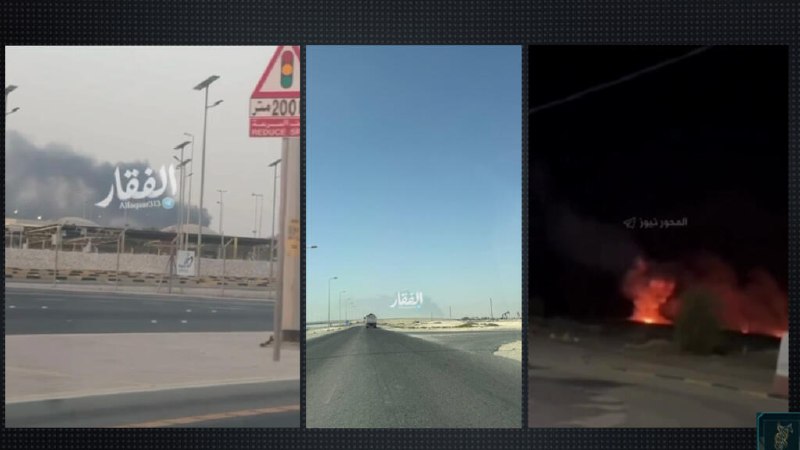
Three Iranian ballistic missiles struck the vicinity of Shuwaikh Port in Kuwait City at roughly 15:46 UTC on 12 July 2026, according to Telegram channels monitoring regional military traffic. Within minutes, witnesses reported smoke columns rising from the blast zone near the Iraqi border and large fires breaking out across the port area, with social-media footage showing burning containers and damaged dock infrastructure.
The strike lands Kuwait, a US-aligned Gulf monarchy that has spent two decades carefully positioning itself outside the region's direct fire, inside the same Iranian missile envelope that has hit Iraq, Syria and the Gulf littoral in successive escalations. The question now is whether Washington reads the attack as a calibrated signal, or as the opening of a new phase in which neutral Gulf geography no longer offers cover.
What the early reporting actually shows
The two Telegram feeds tracking the incident agree on the headline facts but diverge on sequencing. The channel rnintel reported at 15:46 UTC that three Iranian ballistic missiles had impacted the vicinity of Kuwait City's Shuwaikh Port, the country's principal commercial waterfront and the nerve centre of its import-dependent economy. A second feed, DDGeopolitics, posted at 15:23 UTC that smoke columns were rising from the explosion area near Kuwait's border with Iraq and that large fires had erupted, with some of its sources noting the incident.
Neither feed identifies the missile type, the launch point, or the intended target with certainty. The open-source picture so far is consistent with a short-range strike package rather than a full IRGC barrage, but the sources do not specify warhead class, CEP, or whether the rounds were intercepted. Kuwait's civil aviation authority, the Kuwaiti Ministry of Defence, and US Central Command had not issued on-record statements at the time of writing.
Why Shuwaikh matters
Shuwaikh is not a symbolic target. It handles the bulk of Kuwait's containerised imports, including food, medical supplies and refined-fuel transfers, and sits a few kilometres from the US military's Camp Arifjan and the broader Kuwaiti-American basing footprint that has hosted coalition logistics since 2003. A successful hit on the port would carry economic shock far beyond the physical damage: insurance war-risk premia for Gulf shipping, which already moved sharply after Iranian strikes on Gulf shipping infrastructure in earlier rounds of escalation, would reprice again.
The strike also lands inside Kuwait's long-standing strategic posture. Kuwaiti diplomacy has spent forty years insisting it is not a party to the Iran-Saudi rivalry, mediated the 2021 Jeddah talks, and maintained a working relationship with Tehran even as it hosted US and Gulf state forces. That posture depended on a tacit understanding that Kuwait's neutrality would, in extremis, be respected. Sunday's impact pattern suggests that understanding no longer holds.
The corridor question
Iranian ballistic strikes on Gulf infrastructure have historically followed a logic of escalation management rather than territorial conquest. The 2019 Abqaiq–Khurais attack, attributed to Iran by Western and Gulf intelligence, hit Saudi Aramco's eastern processing facilities and was read by most analysts as a calibrated signal: the kingdom's oil infrastructure was reachable, but not destroyed. The 2024 and 2025 rounds of strikes on northern Iraq followed a similar logic, hitting US-adjacent facilities while avoiding US personnel directly.
Shuwaikh does not fit that pattern neatly. Kuwait hosts US forces, but it is not an active front in any ongoing Iranian campaign. The most plausible readings of the strike are therefore either (a) a missile-navigation failure in which a salvo intended for a more eastern target drifted across the Gulf, (b) a deliberate warning to the United States that neutral Gulf geography is no longer off-limits, or (c) an effort to test Kuwaiti and US air-defence response times. The sources do not let this publication adjudicate between the three.
What Ankara and Riyadh will read into it
Gulf reaction will not wait for forensic certainty. Saudi Arabia, which has spent the last two years managing a fragile détente with Tehran brokered through Beijing and Baghdad, will treat any strike on a GCC state's civilian infrastructure as a test of that détente's limits. The United Arab Emirates, whose territory was struck by Iranian proxies in earlier rounds of escalation, will press for a coordinated GCC response regardless of attribution. Iraq, where Iranian-backed militias already operate with relative freedom, will read the strike as cover to escalate against remaining US positions in Anbar and Nineveh.
Turkey, which has spent 2026 positioning itself as a regional security broker and has a small but visible defence-cooperation footprint in Kuwait, is likely to use the incident to argue for a non-Iranian, non-American security architecture in the Gulf, one in which Ankara's defence industry and its mediation networks play a larger role. That argument lands more easily when Iranian missiles are visibly reaching the Gulf's neutral coast.
Stakes and what to watch next
The trajectory matters more than the single incident. If Sunday's strike is treated by Washington and the GCC as a one-off, the precedent will harden: any regional actor can reach Kuwaiti civilian infrastructure with little cost. If it is treated as a red line, the response options are themselves escalatory: US strikes on Iranian launch infrastructure, expanded CENTCOM force posture in Kuwait, or a GCC-wide air-defence integration that pulls Kuwait formally inside the Saudi-Emirati-Qatari-Bahraini coordination grid.
Kuwait's domestic political room is narrow. The Al-Sabah ruling family has been navigating the post-2024 parliamentary turbulence and an unpopular austerity programme, and a missile strike on the country's main port will intensify pressure on the prime minister's office from a National Assembly that has already been combative. Expect an early emergency session, a request for additional US air-defence batteries, and a public demand for Gulf solidarity funding to rebuild port capacity.
The single most important uncertainty is attribution confidence. Telegram-channel sourcing carries the risk of duplication, recycled footage, and embedded assumptions that travel as fact once they hit a wide audience. Until Kuwait's defence ministry, CENTCOM, or an independent UN monitoring mission puts an on-record assessment in writing, the dominant narrative will be set by the channel that posts fastest, not by the one that posts most accurately. This publication will update if and when primary-source confirmation arrives.
How Monexus framed this: Telegram-channel reporting carries the bulk of the on-the-ground detail, with Western wire confirmation still pending. The piece foregrounds the strategic posture question, Kuwait's four-decade neutrality and what the strike means for it, rather than the kinetic damage, which the open-source record does not yet support with hard numbers.
Wire provenance
This editorial synthesis draws on the following public wire/social posts:
- https://t.me/rnintel
- https://t.me/DDGeopolitics