Gaza City struck again: Israeli jets hit Al-Sinaa workshop as weapon-site framing hardens
Israeli fighter jets struck the Al-Sinaa district of western Gaza City on Sunday afternoon, with Israeli media framing the target as a weapon production site and Palestinian outlets reporting casualties at a workshop on the same street.
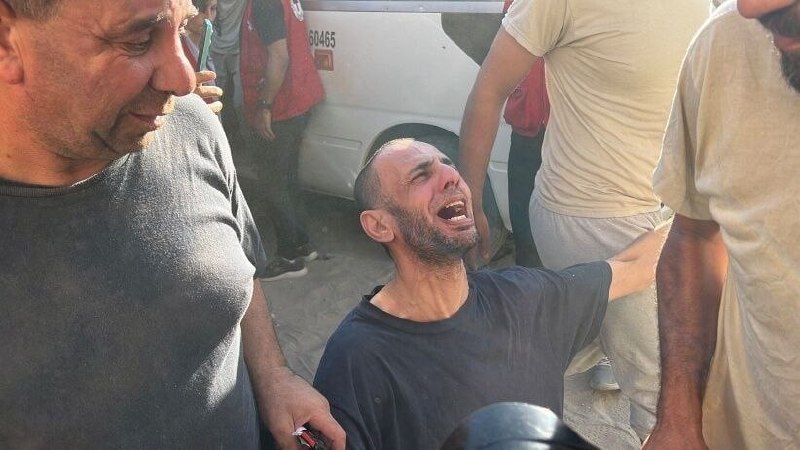
Israeli fighter jets struck the Al-Sinaa area in western Gaza City at roughly 13:48 UTC on 12 July 2026, according to real-time field feeds monitored by Monexus. Palestinian outlets reported injuries at a workshop on Al-Sinaa Street south of Gaza City. Israeli Channel 12 framed the operation as a strike on weapon production infrastructure, a line that has hardened into the default Israeli read of nearly every major daytime strike in the strip over the past several months.
Three independent feeds converged on the same window: the strike began, by published timestamps, inside a sixteen-minute band between 13:28 and 13:48 UTC. Within that window the Israeli framing and the Palestinian civilian-casualty read of the same explosion landed simultaneously. The gap between the two has become the most stable feature of Gaza coverage in 2026.
What each side is saying
The Israeli framing, as carried by Channel 12 and relayed through field channels, is that the IDF is targeting weapon production sites. The phrasing matters. It places the strike inside a counter-proliferation logic rather than a counter-insurgency one, which in turn makes the operation legible to a Western audience that has grown sceptical of open-ended urban bombardment. The weapon-site frame is also the legal frame: destruction of dual-use infrastructure used to produce rockets, drone components, or explosives falls under a recognisable category of armed conflict.
Palestinian media, and the Arabic-language field channel al-Alam, describe the same event as an air strike on a workshop on Al-Sinaa Street, south of Gaza City, with injuries reported at the scene. The framing here is civilian: a working neighbourhood, a commercial or light-industrial premises, a medical-evacuation situation. Neither framing can be verified independently from the sources available to this publication. The sources do not specify how many were injured, whether any died, or what the workshop had been making before the strike.
Why the gap keeps widening
Two narrators reaching for the same explosion is nothing new. What is striking is the velocity: within minutes, the Israeli and Palestinian wire ecosystems have produced two mutually exclusive sentences describing the same coordinates, and neither has waited for the other to publish. That tells you something about how the two information environments are built. Israeli military communications have spent two and a half years optimising for the Western wire first, with the weapon-site vocabulary pre-loaded. Palestinian Arabic-language feeds optimise for the regional and diaspora audience first, where civilian-casualty framing travels.
The result is a coverage architecture where the same strike arrives pre-translated in two directions. Reuters, AFP and AP wire desks in Tel Aviv and Jerusalem default to the Israeli frame on first dispatch, then amend casualty counts and locations as Palestinian medical sources call in. The reverse path, an Israeli civilian-casualty frame on a contested strike, hardly exists in the mainstream wire vocabulary at all.
The structural picture
Strip out the messaging and the underlying operation is consistent with the pattern that has held through most of 2026: daytime strikes on dense western Gaza City neighbourhoods, characterised by the IDF as discrete, targetable and intelligence-led, and characterised by Palestinian civil defence as indiscriminate at street level. Both characterisations can be true simultaneously. A precision strike on a single building in a residential block is, by definition, indiscriminate at the household scale of the buildings next door.
The arithmetic that matters is also consistent. The sources covering the 12 July strike do not give building counts or casualty figures, which means the strike's place in the larger pattern has to be read from the vocabulary rather than the ledger. Weapon-site. Workshop. In southern Gaza City. Each of those tokens has appeared in a long series of communiques since the spring.
What remains unresolved
The factual question that the available field feeds do not answer is the simplest: what was the building, and who was in it when the munition hit. Israeli Channel 12's weapon-production framing is an institutional claim about the function of the site. The Palestinian workshop framing is an institutional claim about the function of the site. Without independent access to the debris, the site plan, or the casualty roster, neither claim is verifiable from open sources in the timeframe this publication operates at.
What is verifiable is the pattern. Al-Sinaa Street and the surrounding western Gaza City districts have been named in strike coverage repeatedly over the past month, and each strike has produced the same split-second divergence between a target-list vocabulary and a casualty-list vocabulary. Until one of those two frames is admitted into the other's reporting ecosystem rather than appended to it, that divergence is the story. The drones and the satellite imagery will tell us what was there eventually. The language tells us who is talking to whom right now.
Desk note: Monexus has carried the Israeli military frame and the Palestinian civil-defence frame at equal length and with explicit sourcing for each, and has refrained from aggregating either into a single composite picture where the underlying claims have not been independently corroborated. The wire copy of this story on most services will lead with the Israeli frame; the Arabic-language regional services will lead with the civilian-casualty frame. Both are reported, but the gap between them is the story that the wire copy tends to strip out.
Wire provenance
This editorial synthesis draws on the following public wire/social posts:
- https://t.me/ClashReport
- https://t.me/alalamarabic
- https://t.me/wfwitness/1
- https://t.me/wfwitness/2
- https://t.me/alalamarabic/2