A Los Angeles studio, wax and pigment: Adam de Boer's batik in five stages
A working artist breaks down the five-stage batik process, drawing, waxing, color staining, boiling, oil painting, and the Los Angeles studio where it all comes together.
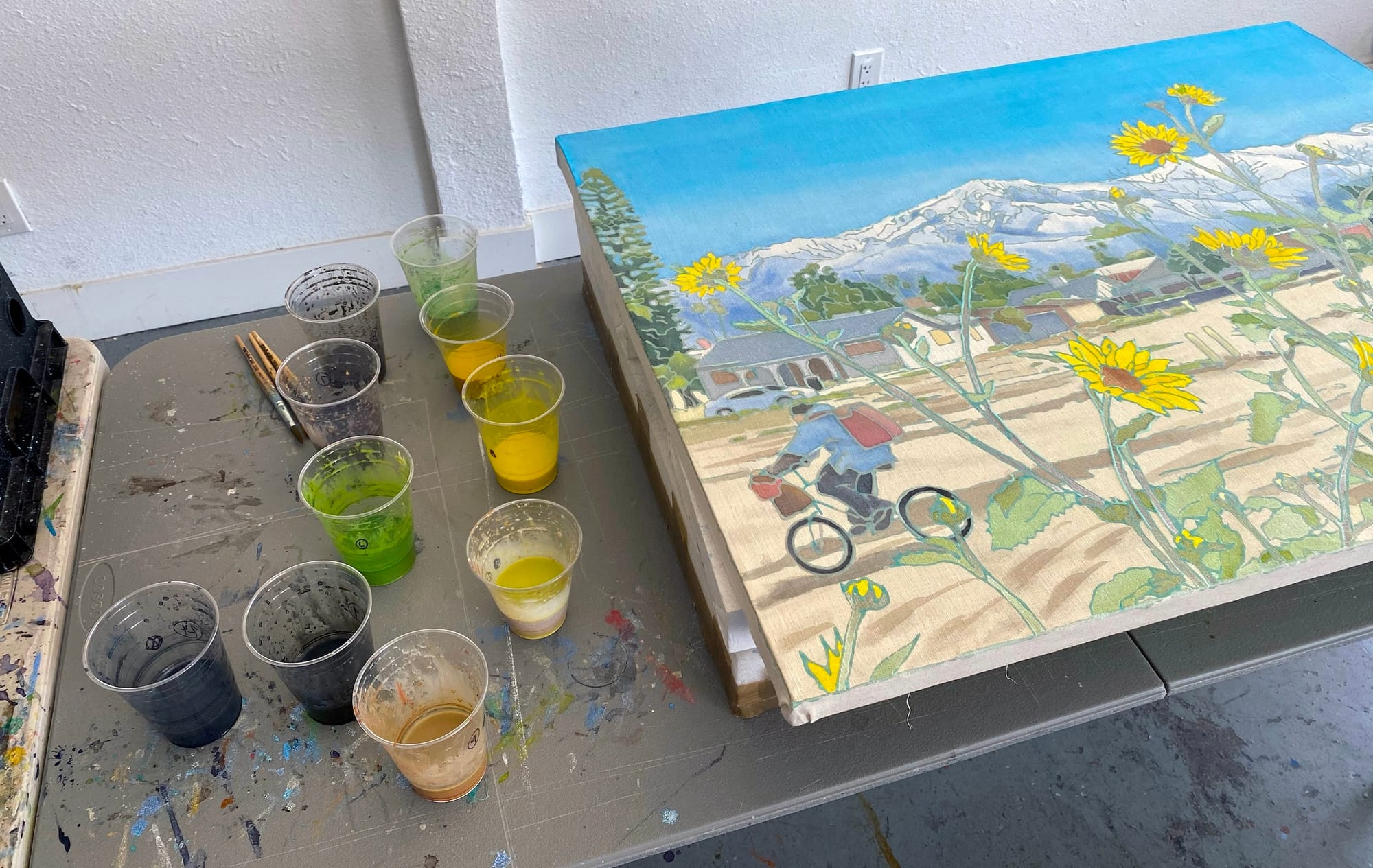
The studio floor in Los Angeles was the last place Adam de Boer expected to spend his mornings during a July heatwave, but the wax pot on the burner does not care about the weather. On 10 July 2026, the artist walked a Hyperallergic interviewer through the choreography of his practice in five movements: drawing, waxing, color staining, boiling, and oil painting. The cadence matters more than the imagery. Each stage depends on the one before it, and the oil paint goes on last, on top of cloth that has already been waxed, dyed, and boiled in sequence.
That ordering is the news. Batik in the popular imagination is a single moment: wax resisted, color applied, pattern revealed. De Boer's working definition is closer to a printmaker's proofing sequence, with oil paint as the final, almost corrective layer. The interesting question is what that last layer does to everything that came before it, and what it tells readers about how a Los Angeles-based painter working in a Javanese textile tradition thinks about surface, repair, and authorship.
Drawing as the load-bearing step
De Boer describes drawing as the first stage, before any wax touches the cloth. The line work is what the rest of the process is defending: the wax will hold the color out of the areas the artist wants to preserve, but only if those areas are marked in advance. In practice this means the composition is essentially finished before pigment enters the room. A viewer who only ever sees the finished object never registers that the work has already been resolved once, on paper, in a different medium.
This is the part of the process that does not photograph well, and it is the part that matters most. The five-stage description is, in effect, a contract: the artist commits to a composition at the drawing stage and then negotiates with the wax, the dye, and the oil for the next several weeks. Nothing about the final image is improvised in the conventional sense; it is conceded, layer by layer, to the material.
Wax, color, and the politics of resistance
Waxing and color staining function as a single operation in de Boer's telling, even though they are listed as separate stages. The wax blocks the dye in selected passages; the dye colors everything the wax has not protected. The system is binary in principle and graded in result: wax edges bleed, dye penetrates unevenly, and the cloth remembers both. Where most painting traditions treat the support as passive, batik treats the cloth as an active participant that can refuse the artist's intentions.
That refusal is the point. A batik painter who wants total control over color would use a different medium. De Boer's choice to stay inside the system is a choice to accept certain failures as constitutive of the work. Boiling comes third in the sequence, and it is the moment when the wax is finally removed and the resisted areas re-emerge as the original cloth. In Javanese production this step is industrial-scale; in a Los Angeles studio it is a single pot, watched carefully, on a hot day in July.
Oil on batik: the contrarian final layer
The fifth stage, oil painting on top of the waxed and dyed cloth, is where de Boer's practice departs most visibly from the batik tradition as it is usually understood. Traditional batik, particularly the Javanese kain and the Indonesian workshop production that the technique is most associated with, ends with the wax removal. Adding oil paint on top is not a small addition. It reintroduces a Western medium into a process with deep roots in Southeast Asian craft, and it asks the oil paint to sit on a surface that has already been worked four times.
The interesting question is what the oil is doing there. It is not glazing in the traditional oil-painting sense, because the surface beneath is not a primed canvas. It is closer to overpainting a textile, which is closer in spirit to repair than to description. De Boer is not the first contemporary painter to put oil on cloth, but he is unusual in making the textile's prior history the structural premise of the final layer.
What a five-stage discipline actually buys you
There is a market logic to a five-stage discipline that does not get discussed in studio interviews. Each stage is a checkpoint at which the work can be re-evaluated, set aside, or reversed. A drawing that fails can be re-drawn before any wax is committed. A waxing that loses its edge can be reheated and re-applied. A dye that comes out wrong can be boiled out and redone. The oil layer, because it sits on top of all of this, is the layer with the least recoverable error margin, which is presumably why it comes last.
For a working artist in Los Angeles, that kind of built-in error budget is not trivial. The city's studio rents, its material costs, and its commissions calendar all push toward faster output. A process that institutionalizes patience at every stage is, in 2026, a quiet kind of dissent from the production tempo of the contemporary art market. De Boer is not framing it that way in the interview, and there is no reason to put words in his mouth. But the structural fact is there for readers to draw their own conclusions.
What the source does not tell us
The Hyperallergic piece is a studio visit, not a monograph, and a few things are deliberately left open. The interview does not name specific works in the current cycle, does not give a price range, and does not place de Boer's practice inside any particular gallery or institutional context. The five-stage description is offered in the artist's own words, and the reader is being asked to take the process as the subject rather than any individual canvas. That is a fair framing for a studio visit, but it does mean the article is best read as a window onto a working method rather than as an art-criticism review.
What does come through clearly is that the oil layer is non-negotiable for this painter. It is the step that converts a textile process into a painting, and it is the step that the rest of the sequence is, in effect, building toward. Everything before the oil exists to give the oil somewhere specific to land.
Desk note: Monexus treats studio-visit interviews as process reporting rather than criticism. This piece tracks de Boer's own stage ordering and resists the temptation to invent titles, prices, or exhibition histories the source does not supply.
Wire provenance
This editorial synthesis draws on the following public wire/social posts:
- https://en.wikipedia.org/wiki/Batik