A tomb plaza already built: reading Iran's Mashhad monument
Iranian channels published images this week of a tomb plaza at the Imam Reza shrine in Mashhad framed as belonging to Ayatollah Ali Khamenei, sharpening a question Tehran has avoided in public for decades.
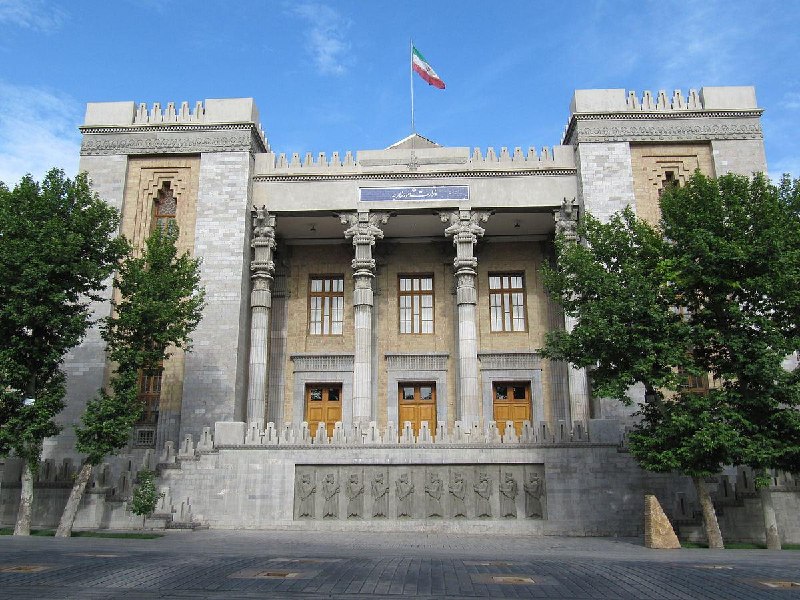
Two images circulated on 11 July 2026, hours apart, by Iranian-aligned channels on Telegram. The first, posted at 15:33 UTC by Abuali Express, and the second, posted at 15:56 UTC by English Abuali, both carry the same caption: the tomb plaza of Ali Khamenei at the Imam Reza shrine in the city of Mashhad. The framing is not casual. Mashhad, in Iran's north-eastern Razavi Khorasan province, has been the geographic centre of Twelver Shi'ism for centuries, the burial site of the eighth Imam, Reza. Building a tomb complex there is a statement about who sits at the apex of the Islamic Republic's clerical hierarchy.
The photographs show a long, recently paved esplanade running through the shrine complex, framed by arcades and dressed stone. No body is in it. There is no date of death. There is no obelisk, no green dome, no inscription panel. The channels are presenting the shell of a tomb, not a burial. That distinction matters, because the question of what happens when Iran's 86-year-old supreme leader leaves the scene has been one of the most carefully policed subjects in the country's political life.
What Mashhad is for
The Imam Reza shrine is not just Iran's largest religious complex. It is the operational centre of the Astan Quds Razavi endowment, one of the wealthiest charitable foundations in the Muslim world, and historically the gravitational pole around which Iranian Shi'a identity has organised itself. A tomb in Mashhad is not an estate decision. It is a doctrinal and political decision about where, geographically and symbolically, the office of the Supreme Leader is meant to rest after the office-holder dies.
Iran's first supreme leader, Ruhollah Khomeini, is buried south of Tehran, in Behesht-e Zahra, his mausoleum deliberately placed near the city rather than at a religious shrine. That choice signalled the revolution's populist-republican logic: the Supreme Leader belonged to the nation, not to the clerical estate. Khamenei, if the Mashhad framing holds, would invert that logic. His resting place would sit inside the holiest shrine in the country, fusing the office with the shrine economy and the clerical establishment in a way Khomeini carefully avoided.
The placement would also say something about succession. Mashhad is the stronghold of conservative clerical networks aligned with the osoulgarayan faction and the Razavi Khorasan clerical establishment. A tomb there signals which coalition is meant to inherit the post-Khamenei order, or at minimum which coalition is meant to feel that the order has been honoured.
What the channels are, and what they are not
Both channels distributing the photographs are small, pro-Iranian outlets operating on Telegram, not state media. English Abuali and Abuali Express are not on the list of outlets the Iranian presidency, the Foreign Ministry, or the Islamic Republic of Iran Broadcasting (IRIB) typically use to plant visual signals. They are closer in function to activist-aligned diaspora or sympathetic networks, the kind that push religious-cultural framing rather than official policy.
That is the second notable thing about the images. State media has not, as of the timestamps above, carried the photographs, and Iranian officials have made no public statement about a Mashhad tomb. The two Telegram posts are the entire evidentiary trail. The framing is therefore best read as an interpretation imposed on a piece of architecture, not as an official announcement. Plain editorial caution: a tomb plaza exists; whether it has been designated as Khamenei's resting place by anyone authorised to speak for him is a different claim, and the sources do not establish it.
Why the question matters now
Khamenei turned 86 in April 2026. Public discussion of his succession is constitutionally murky and politically radioactive. The 1989 constitutional amendment that created the Supreme Leader's current office left the succession procedure deliberately vague: a clerical body, the Assembly of Experts, chooses the next leader, but its deliberations are not public and the body has never, in practice, exercised that role. Speculation about a designated successor, a hidden shortlist, or a managed transition has been a recurrent feature of Tehran-watchers' reporting for the better part of a decade.
Into that vacuum, visual claims do political work. A tomb already built suggests that one faction has decided the question. A tomb already built in Mashhad suggests which faction. Neither claim needs to be officially confirmed to operate. The message travels through photographs on Telegram, and it lands in the WhatsApp groups and seminaries of Razavi Khorasan long before it ever needs to be printed in Kayhan.
What the sources do not show
Three uncertainties remain. First, the photographs could be of an existing plaza at the shrine complex that has been retroactively captioned; the resolution and angle are consistent with that possibility. Second, even if the plaza is genuinely intended for Khamenei, the construction timeline is unknown. The shrine complex is in a state of continuous expansion, and not every new paved area is a designated tomb. Third, and most consequentially, Iranian state media silence on the question is itself ambiguous. It could mean the framing is correct and Tehran is letting it propagate softly; it could mean the framing is premature and Tehran is waiting until death occurs; or it could mean the framing is contested inside the system.
The honest reading is that this publication cannot, on the basis of two Telegram posts, confirm that a tomb has been officially designated for the Supreme Leader at Mashhad. What can be said is that the visual claim has been made, the claim sits inside a coherent political logic, and the absence of an official denial will itself be read as information by the actors who matter.
Desk note: Monexus treated the two Telegram posts as a visual-signal event rather than an official announcement, and held back from asserting a designation that no Iranian state outlet has confirmed.
Wire provenance
This editorial synthesis draws on the following public wire/social posts:
- https://t.me/englishabuali
- https://t.me/abualiexpress