Olive groves on fire: Israel's south Lebanon operation grinds past the ceasefire line
On 11 July 2026 Israeli artillery and airstrikes hit three southern Lebanese towns within an hour, with forces setting fire to homes and olive groves in Houla and carrying out controlled demolitions in Khiam. The pattern tests the November 2024 arrangement more openly than at any point since it was signed.
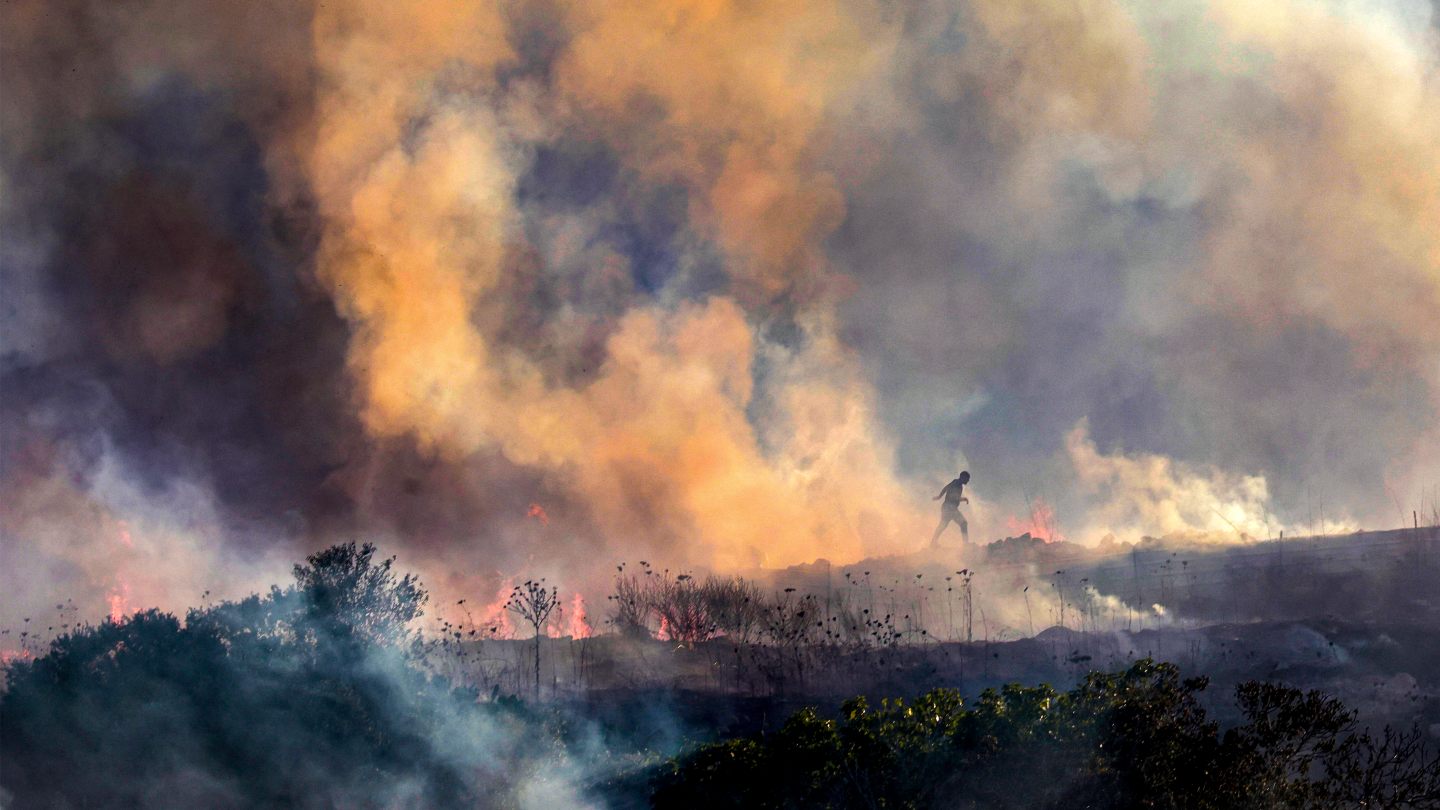
At 13:37 UTC on 11 July 2026, two field monitors reported in the same minute that Israeli artillery had shelled the town of Mansouri in southern Lebanon, that Israeli forces had carried out controlled demolitions in Houla a few kilometres north, and that soldiers had set fires in Khiam while conducting what the monitors described as a large-scale operation. Within the next hour, an Iranian state broadcaster showed the aftermath of an Israeli airstrike on Mansouri, a Lebanon-based field channel posted footage of fires spreading through olive groves around Houla, and a third monitor logged a third Israeli airstrike on Mansouri itself, at 13:52 UTC. By 15:30 UTC the same channel reported Israeli forces had set fire to multiple homes and the surrounding olive groves in Houla. In roughly two hours, three towns south of the Litani had been struck, set alight, or demolished, in what the monitors explicitly framed as violations of the ceasefire arrangement that ended the 2024 war between Israel and Hezbollah.
The November 2024 ceasefire was built on a quiet premise: that Israel would retain the right to act against what it called immediate threats in southern Lebanon, while Hezbollah would refrain from firing across the border and the Lebanese army would deploy into the area between the Litani and the Blue Line. The premise has frayed for months, but the pattern visible on 11 July is qualitatively different. It is not a single retaliatory strike after a rocket; it is a sustained sequence of demolitions, fires and airstrikes across multiple towns in one afternoon, carried out while monitors who document them describe them in the same breath as ceasefire violations. The question is no longer whether the arrangement is being tested. It is what kind of arrangement is replacing it.
What the afternoon actually looked like
The first public timestamp on the sequence is 13:37 UTC. The Cradle Media, a Beirut-based outlet that has covered the south-Lebanon front closely, posted that Israeli artillery had shelled Mansouri, that Israeli forces had carried out controlled demolitions in Houla, and that soldiers had set fires in Khiam during a large-scale operation. Two of those three locations sit within the band of villages that Israeli ground forces have entered repeatedly since the ceasefire took effect; Khiam in particular has been the site of earlier demolitions documented by UN agencies and Western wire reporters. The framing in the post was categorical. It named the activity, it named the towns, and it named the legal frame within which the activity sits.
Four minutes later, at 13:40 UTC, PressTV, the English-language outlet of Iranian state broadcasting, carried footage of the aftermath of an Israeli airstrike on Mansouri. PressTV's framing is openly partisan; its presence in the source record matters precisely because it shows how the same incident is being amplified into Iranian-language media coverage and beyond. Twelve minutes after that, at 13:52 UTC, the field channel @wfwitness posted that a third Israeli airstrike had hit Mansouri, and circulated footage showing damage to civilian structures. Mansouri is a small town; the word "third" inside fourteen minutes is itself the news.
The sequence then moved north. At 14:05 UTC, the mapping collective AMK_Mapping logged an Israeli airstrike on Al-Mansouri and described it, in the same post, as a violation of the ceasefire agreement with Hezbollah. At 15:26 UTC, @wfwitness reported Israeli artillery fire on Haddatha, further up the coastal road towards Tyre. At 15:30 UTC, the same channel reported that Israeli forces had set fire to multiple homes and the surrounding olive groves in Houla. Two hours, five towns, three different mechanisms (artillery, airstrike, ground demolition and arson) and one explicit legal framing: ceasefire violation.
What the ceasefire actually permits
The November 2024 arrangement, brokered under United States and French pressure, gave Israel the right to act against what its security cabinet defined as immediate threats in southern Lebanon, and committed Hezbollah to remaining north of the Litani. The Lebanese Armed Forces were to deploy into the zone between the Litani and the Blue Line. In the months since, Israel has conducted near-daily strikes inside what it describes as a residual threat landscape, including air operations in the Beqaa Valley and ground incursions that have been the subject of repeated complaints from Beirut. The Lebanese government has framed each wave as a violation; the Israeli government has framed each strike as defensive and consistent with the arrangement's threat clause.
That legal dispute is older than 11 July. What the day's reporting adds is operational texture. Controlled demolitions, in the language of military spokespeople on all sides, are a deliberate act of area denial; they are not the improvised destruction of a firefight. Setting fire to olive groves in mid-July, when the harvest is weeks away in the southern villages, is an act with an economic signature as well as a military one. The combination, across three towns in an afternoon, is the kind of pattern that Human Rights Watch and Amnesty International have previously classified as collective punishment when applied to populated civilian areas. The reporting from the field on 11 July is not enough, on its own, to establish that legal characterisation, but it is enough to put the question on the table.
The counter-narrative, stated fairly
The Israeli government's case, as articulated by officials and amplified by Israeli English-language outlets in previous similar episodes, runs in three layers. First, that residual Hezbollah infrastructure south of the Litani has not been fully dismantled, that the Lebanese army deployment has been slower than the timetable required, and that Israel therefore retains both the right and the obligation to act. Second, that each specific incident reported on 11 July involved a target with a military signature, even where the surrounding damage fell on civilian structures. Third, that Hezbollah's continued refusal to fully disarm and its periodic attempts to rebuild launch positions in the south make a baseline level of Israeli fire unavoidable until verification arrangements are in place.
Each of those claims has a structural answer. The first elides the difference between targeted counter-operations and the demolition-and-arson pattern visible on 11 July. The second requires evidence the field reporting from this news cycle does not contain; without named targets, the claim is an assertion, not a finding. The third is the strongest of the three, because it is true that the disarmament timetable has slipped and that the international monitoring mechanism foreseen under the arrangement has not been fully stood up. None of those structural answers, however, is the same as a defence of the specific sequence on 11 July. They are arguments about why Israel might be operating in the area at all. They are not arguments about why three towns were hit in two hours in the manner described.
Why the structural frame matters
The southern Lebanon front is not the largest theatre in which Israel is engaged, but it is the one in which the ceasefire architecture is most actively being renegotiated in practice, strike by strike. The November 2024 deal was the first arrangement between the two sides that was, in effect, guaranteed by Washington and Paris rather than by a UN Security Council resolution. That changes the politics of enforcement. When a violation occurs, the question is not whether the Security Council will convene; it is whether the White House and the Élysée will choose to call it one. On 11 July, as of the timestamps in the source record, neither had.
The political economy of the south also matters. The olive harvest in the villages between the Litani and the border is the main cash crop and a cultural anchor; a season of arson and demolition in the groves has compounding effects on displacement, return, and reconstruction politics that will be visible well into 2027. The towns struck on 11 July are precisely the ones that Hezbollah presented, during the 2024 war, as having been reconstituted after previous rounds of Israeli action. Each cycle raises the political cost of return for the communities that left, and each cycle widens the constituency inside Lebanon for whom the ceasefire is, in practical terms, no longer operative.
What remains contested, and what to watch
The reporting on which this article rests comes from three field monitors and one Iranian state broadcaster, supplemented by the mapping collective AMK_Mapping. None of those sources is a Western wire. None of them is on the ground in a verifiable institutional sense; @wfwitness and AMK_Mapping are Telegram channels that aggregate eyewitness and open-source material, and the geographic specificity of their reporting is their main claim to credibility. The Cradle and PressTV are openly partisan outlets, though on a story of this kind that partisanship does not, by itself, falsify the operational facts they are reporting. What the source record does not yet contain, and what any responsible assessment of 11 July still requires, is on-the-record confirmation from the Israeli military spokesperson, the Lebanese Armed Forces, or UNIFIL of the operational facts in the afternoon's reporting. If those confirmations arrive and align with the field accounts, the day's pattern is established. If they contradict the field accounts on specific strikes, the contradictions will need to be itemised. If they are silent, that silence is itself a fact about the political standing of the arrangement.
Three near-term watchpoints follow from the day. First, whether the Lebanese government formally requests a UNIFIL sitrep on the afternoon's activity. Second, whether the office of the US special envoy for the region issues a statement that names the activity as a violation, as a defensive action, or chooses not to characterise it at all. Third, whether the next forty-eight hours bring a Hezbollah rocket or drone response from the other side of the line; the cadence of retaliation, not the cadence of Israeli fire, is the variable most likely to determine whether the afternoon becomes a day, and the day becomes a week.
Desk note: Monexus's framing on this story follows the wire lead in treating the field reporting as the operational record for 11 July, while flagging the source mix (two field channels, one mapping collective, one openly partisan outlet, zero Western-wire confirmation) in the body rather than burying it. The Israeli government's standing position on operations south of the Litani is stated in its strongest form before being weighed against the specific pattern of the afternoon.
Wire provenance
This editorial synthesis draws on the following public wire/social posts:
- https://t.me/wfwitness
- https://t.me/wfwitness
- https://t.me/AMK_Mapping
- https://t.me/wfwitness
- https://t.me/wfwitness
- https://t.me/presstv
- https://t.me/thecradlemedia
- https://t.me/TheCradleMedia