A Mediterranean pipeline returns: Iraq, Syria and the US prepare to unveil an old route around Hormuz
Baghdad, Damascus and Washington are putting final touches on an agreement to revive a long-dormant transit line carrying Iraqi crude to the Mediterranean, cutting the Strait of Hormuz out of the route.
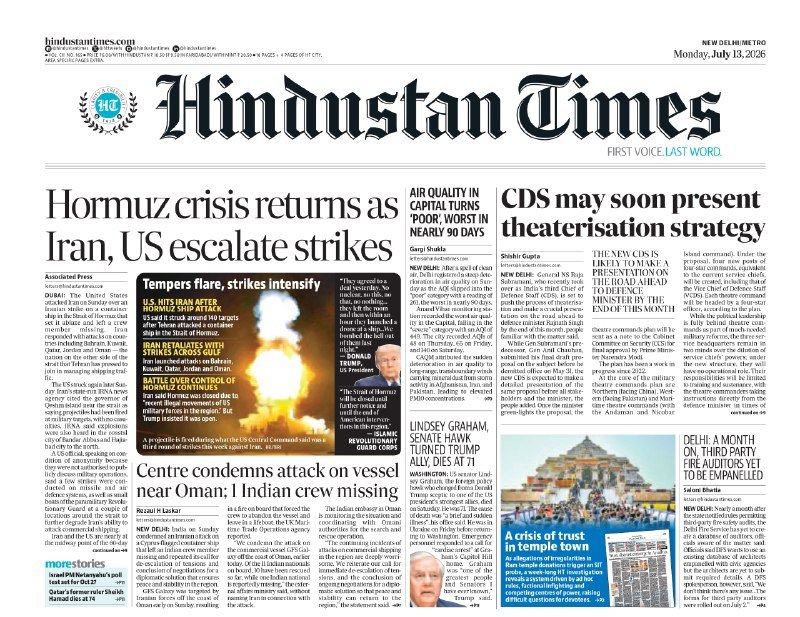
A trilateral agreement between Iraq, Syria and the United States to revive a long-dormant pipeline carrying Iraqi crude to the Mediterranean coast is expected to be unveiled next week, timed to coincide with Iraqi Prime Minister Mohammed Shia' al-Sudani's visit to the White House. Middle East Eye reported on 11 July 2026 at 16:59 UTC that the framework, brokered in talks that have accelerated over the past several months, would reopen a transit corridor across Syrian territory, ending years in which Iraqi exports bound for European and Levantine buyers had to be routed either through the Strait of Hormuz and the Suez Canal, or via the Kurdistan Region's independent line to Ceyhan in Turkey.
The deal sits at the intersection of three pressures the Biden administration's regional successors, and their counterparts in Baghdad and Damascus, have been trying to relieve at once. Iraq wants a second, politically controllable export route for its southern fields. Syria's transitional government wants reconstruction money and Western diplomatic rehabilitation. Washington wants a way to move Gulf-origin crude that does not depend on the narrow chokepoint at Hormuz, where Iranian-aligned forces have, on several occasions in recent years, harassed commercial shipping.
The route, and why it matters now
The pipeline in question is the long-idle Kirkuk–Baniyas line, originally built in the 1930s under a French mandate concession and upgraded repeatedly through the 1980s and 2000s to carry northern Iraqi crude to the Syrian port of Baniyas on the eastern Mediterranean. Its capacity, in its last operational configuration, was roughly 300,000 barrels per day. Repeated sabotage during the Syrian civil war, the territorial disruption after 2011, and the political rupture between Baghdad and Damascus after 2012 put the line out of service; sections inside Syria were reported damaged or looted, and the cross-border pumping station at Al-Yaarubiyah went silent.
A revived line would not be a marginal piece of infrastructure. A 300,000-barrel-per-day flow rerouted around Hormuz changes the calculus for refiners in the Mediterranean basin, for the pricing of Iraqi grades versus Saudi and Emirati barrels in European refineries, and for the political leverage Tehran currently enjoys over the strait. Polymarket reported on 11 July 2026 at 17:14 UTC that the project is being framed inside Washington as a way to "sidestep the Strait of Hormuz"; that phrasing is doing real work. It signals that the strategic case for the pipeline is at least as much about Iran as it is about Iraq.
A counter-read from Tehran and Damascus's eastern borderlands
The framing is not unanimous. Iranian commentary on the proposal, surfaced through state-linked outlets in recent days, argues that any new overland corridor that bypasses Hormuz is, by construction, an instrument of containment. Tehran has historically treated transit fees and tolls on Gulf shipping as a quiet instrument of regional leverage, even when it has not exercised them overtly. A pipeline that pulls a meaningful slice of Iraqi crude out of the maritime lane reduces that lever without firing a shot. The Iranian line, as carried by PressTV and Tasnim in earlier coverage, holds that the arrangement will deepen Syria's exposure to US sanctions enforcement and lock Baghdad into a bilateral dependency that bypasses its eastern neighbour entirely.
A second counter-read sits closer to the ground in northern Syria. Kurdish-controlled areas east of the Euphrates have, since 2011, been the de facto gatekeepers of any overland crude movement out of northeastern Syria and northern Iraq. A pipeline deal negotiated between central authorities in Baghdad and Damascus without an explicit carve-out for the Autonomous Administration of the North and East Syria (AANES) will be difficult to insure, guard, or maintain across the 200 kilometres or so of territory where the line would be physically exposed. The deal's viability, in other words, is not only a question of diplomacy in three capitals; it is also a question of who controls the ground the pipeline crosses.
The structural frame, in plain prose
Strip the announcement of its diplomatic furniture and the move is legible as a corridor play. The incumbent American grand strategy in the Gulf, since at least the Carter Doctrine, has rested on the assumption that oil moves freely through the strait on commercial terms. That assumption has frayed as Iran has fielded fast-attack craft, proxy drones, and selective seizures of commercial tankers, and as Saudi Arabia has, episodically, allowed itself to be pulled into regional confrontations that spike insurance rates for the entire maritime lane. A second, land-based, politically controlled route is a hedge against that fraying. It also gives Washington a piece of leverage inside Syria's post-conflict reconstruction that does not depend on the slow-moving Geneva process.
For Baghdad, the calculus is domestic. Iraq's federal government has long resented the Kurdistan Region's independent export relationship with Turkey, which it considers a violation of the constitution's treatment of oil as a federal resource. A federally controlled line through Syria, financed and protected with US backing, would be a counter-weight to the Ceyhan route. It would also give Sudani, who faces an uneasy coalition in Baghdad, a tangible reconstruction-era deliverable to point to before any electoral test.
For Damascus, the deal is a payment. Syria's transitional authorities, installed after the December 2024 collapse of the Assad government, have been seeking the diplomatic normalisation and Western reconstruction access that the Gulf states and Europe have so far extended only sparingly. A pipeline that benefits Iraqi crude flows and reduces Mediterranean freight costs is a concrete commercial reason for Europeans to engage; it is also a reason for Washington to keep Damascus inside the tent rather than driving it back toward Moscow and Tehran.
Stakes, dates to watch, and what remains unclear
If the announcement lands next week as expected, three dates will tell readers how seriously to take it. First, the operational timeline: how quickly the Al-Yaarubiyah crossing and the Syrian-side pumping infrastructure are reported to come back online. Second, the legal scaffolding: whether the deal is presented as a bilateral executive agreement, a trilateral memorandum, or a UN-recognised transit treaty, since each carries different exposure to US sanctions enforcement on the Syrian side. Third, the quiet diplomacy with Erbil and the Autonomous Administration in northeast Syria: whether Kurdish authorities are brought into the arrangement as commercial partners, as security contractors, or, in the worst case, simply expected to acquiesce.
What the public reporting does not yet establish is the financing structure, the tariff regime, or the security arrangement for the line. Sources do not specify which Western or Gulf capital is underwriting the rehabilitation cost, nor whether Russian or Chinese firms, both of which retain legacy positions in Syria's energy sector, will be formally excluded from the work. The most consequential details of a deal like this are precisely the ones that surface last, and the ones that determine whether the pipeline is a working piece of infrastructure five years from now or another ribbon-cutting on a line that never moves commercial volumes.
What is clear is that the geography of Gulf oil exports is being rewritten in real time, and the next week, with the Iraqi prime minister at the White House, is when the first draft of that rewrite goes public.
Desk note: Monexus is following the announcement against two competing framings. The wire read treats the pipeline as a US-led hedge against Iran; the Tehran read treats it as a containment instrument dressed up as commerce. The reporting here holds both at arm's length and flags the Syrian ground reality as the variable most likely to determine whether the plan ever operates at scale.
Wire provenance
This editorial synthesis draws on the following public wire/social posts:
- https://x.com/polymarket/status/