A succession built on vengeance
Tehran's new Leader frames his first hours in office around retribution for his predecessor. The vocabulary of state TV tells readers more about Iranian direction of travel than any policy paper could.
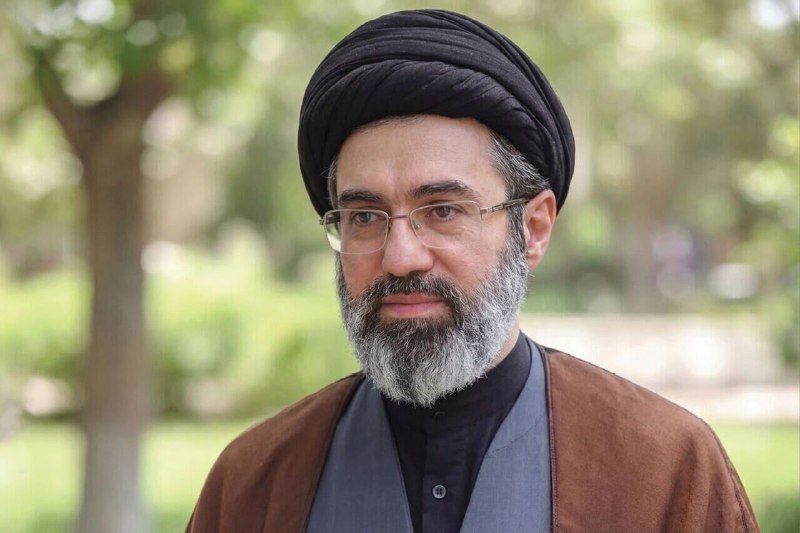
At 13:31 UTC on 11 July 2026, Press TV broadcast a single sentence to a global Persian-language audience and the diplomats who monitor its wording. Ayatollah Mojtaba Khamenei, identified by the channel as the new Leader of the Islamic Revolution, told viewers that the Iranian nation "demands revenge for the blood of the martyred Leader" and that "the vengeance must definitely take place." Two hours earlier, IRNA's English service had run the same message from the office of the Leader, framing it as a vow to "avenge martyr Ayatollah Khamenei's blood." Within twelve hours of the predecessor's death, the vocabulary of Iranian state media had narrowed to a single repeated word: revenge.
The point of this piece is not the rhetoric. It is what the rhetoric tells readers about who is now running Iran, and in whose name. A succession that opens on a pledge of retribution is, deliberately or otherwise, a programmatic statement. It tells foreign ministries, the IRGC's regional command, and the domestic opposition what kind of state they will be dealing with for the next decade.
The language of legitimation
Funeral turnout is the second variable worth watching. Press TV pinned a separate bulletin at 13:43 UTC on 11 July praising a "historic" funeral turnout and again tying the new Leader's authority to vengeance for the slain predecessor. The pairing is not accidental. In a system that does not hold competitive elections for the top job, mass presence at a funeral doubles as a coronation ceremony. The bigger the crowd on state television, the harder it becomes for rivals inside the clerical establishment, the regular army, or the bazaar to claim the transition was imposed rather than embraced.
That is the political work the photographs are doing, even before any policy emerges. State-aligned messaging is asserting a continuity that goes beyond personnel: the same enmities, the same obligations, the same unfinished accounts.
A read against the grain
Skeptics will point out that vowing revenge in the first hours of a transition is also boilerplate. Successor regimes the world over ritually invoke the wounds of their predecessors, from Khomeini's 1989 framing of an America that "could do nothing" against him, to the 2004 oath-of-revenge language in the early months of the post-Zarqawi Iraqi insurgency. Vengeance rhetoric can be cathartic, a way of binding the base, signalling strength to internal rivals, and buying time while the new leadership finds its footing. The new Leader may yet govern pragmatically, pursuing the same de-escalation lines his predecessor quietly explored with Gulf intermediaries.
That reading deserves airtime. But the counter-reading is stronger. The previous round of de-escalation produced the events that led to the predecessor's death, by the logic of Tehran's own framing. A leadership that defines its legitimacy through retribution has reduced the political space for a return to quiet diplomacy, at least in the medium term. The cost of being seen as soft on the predecessor's killing is now structurally higher than the cost of escalation.
What the structure says
The succession sits inside a wider pattern worth naming plainly. Across the Middle East, leadership changes in states under external pressure have produced a recurring dynamic: the more constrained the regime's margin for manoeuvre, the louder and more absolute the public rhetoric. Authority is demonstrated not by what a state can do, but by what it says it will do, because the audience for the words is largely domestic and the speech act is itself the act.
Iran is the most exposed version of this dynamic. The new Leader inherits a country under heavy sanctions, a regional axis that has absorbed successive blows, and a domestic population that has watched inflation and protest cycles reduce the social contract to its barest form. Vow-revenge rhetoric in this context is not a luxury of ideology. It is a load-bearing element of internal legitimacy. The state is telling Iranians, in code: the machine still works, the enemy still bleeds, the leadership still owes the blood-debt its predecessor took on.
What to watch over the next fortnight
Three concrete indicators will tell readers whether the rhetoric hardens into policy or dissipates into ritual. First, the composition of the new Supreme National Security Council and the foreign minister's first press conference: are the same negotiators who managed the 2025 de-escalation track retained, or replaced with figures tied to the IRGC's external operations wing? Second, the wording of the first communique marking the 40th day of mourning, a date in Shia political theology that historically carries operational as well as ceremonial weight. Third, the readouts from Oman, Qatar, and Iraq, the three regional intermediaries who have carried messages in both directions over the last eighteen months. A flurry of back-channel traffic in the next ten days would suggest the new leadership is preserving optionality; silence would suggest it has closed that door.
None of the available reporting specifies the answer to any of these questions yet. The sources are unanimous on the rhetoric and silent on the operational implications, which is itself the story. A new Leader has been named, a funeral has been held, and a promise of vengeance has been broadcast. Everything that follows will be measured against that first sentence.
Desk note: Monexus is covering this succession from the language outwards. The state-aligned wire copy is the primary source for what the new leadership wants the world to hear; independent confirmation of the underlying facts of the predecessor's death, and of regional escalation dynamics, will be sourced from Reuters, the BBC, and the Guardian as those filings become available. Today's piece reads the rhetoric as evidence of direction of travel, not as a forecast of specific military action.
Wire provenance
This editorial synthesis draws on the following public wire/social posts:
- https://t.me/Irna_en
- https://t.me/presstv
- https://t.me/presstv