What the wires out of Gaza City at 21:00 UTC actually tell us
Three Telegram channels and a state Iranian outlet carried the same line about a 'massive explosion' inside Gaza City within twenty minutes. Reading the sourcing pattern is the story.
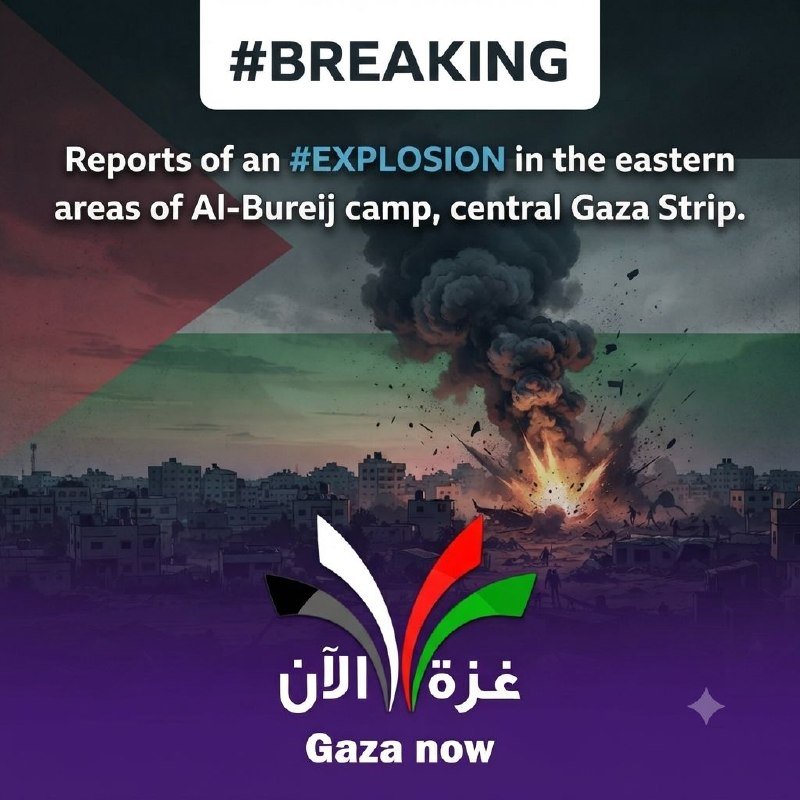
On 11 July 2026, at 21:09 UTC, the Telegram channel @gazaalanpa pushed a single line into the wire: "The sound of an explosion shakes Gaza City." Two minutes later the same channel added that residential blocks east of the city had been demolished. By 21:29 UTC, Al-Alam Arabic was carrying the same event, framed as "occupation forces blow[ing] up residential squares east of Gaza City." In the space of twenty minutes, an unattributable blast had acquired a cause, an actor, and a location precise enough to drop on a map. The story of that twenty minutes is the story.
The reporting did not arrive in that order. Earlier in the evening, Al-Alam Arabic had already filed two "urgent" items: artillery shelling east of Bureij camp in the central Gaza Strip at 19:55 UTC, and a raid on the town of Ya'bad, southwest of Jenin, at 20:13 UTC. Both were attributed to "Palestinian sources." At 21:11 UTC, the Iranian state outlet Tasnim's English desk and its Farsi-language sister @TasnimNews both pushed the Gaza City line, describing the explosion as "massive" and conceding that the nature of the blast was "still unknown." Then the attribution hardened, and the framing arrived with it.
The chronology the sources actually show
The raw wire is thin. A blast was heard. Local Palestinian accounts placed it east of Gaza City. Tasnim, citing "local Palestinian sources," repeated the same line and openly noted the cause had not been confirmed. Within eighteen minutes, Al-Alam Arabic closed the loop with a flat assertion that occupation forces had blown up residential squares. No casualty count, no footage, no IDF or Israeli government statement, no UN OCHA confirmation, no wire-service corroboration from Reuters, AP, AFP, BBC, or Al Jazeera English appears anywhere in the sequence the sources actually carry. The whole reporting chain is sourced, on every link, to "Palestinian sources" relayed through channels with clear editorial alignments.
That is not a criticism of the underlying events. Bureij and Ya'bad are real places inside a war that has been live for the better part of two years, and the wider pattern of Israeli operations in Gaza is well documented elsewhere. The point is narrower: in the absence of independent confirmation, the version of the story that travels fastest is the version the most prolific amplifiers choose to push. The thing readers are consuming in real time is not the event. It is a claim about the event, dressed as the event.
What the framing does
The phrase "occupation forces blow up residential squares" performs a specific journalistic act. It collapses three separate things, an explosion, a demolition, and a confirmed perpetrator, into one declarative sentence. By the time it lands on a phone screen, the reader has not seen an Israeli military spokesperson, a satellite image, a name of a destroyed building, or a figure for displaced families. They have seen an attribution. Al-Alam Arabic and Tasnim are not fringe accounts; they are state-aligned outlets with global reach, and their editorial decisions set the terms on which a story circulates in Arabic-language and diaspora networks. Their reach, in turn, is what later wires will treat as "reported" when they catch up, if they catch up at all.
The Buriej and Ya'bad items, filed earlier and carrying the same "Palestinian sources" formula, are not necessarily wrong. But the sourcing pattern is identical: one named category of source, repeated across every line of the day's bulletin, with no on-the-record official, no Western wire, and no international humanitarian body attached. For a publication that wants to be honest about what it knows, the responsible move is to say so plainly: this is what these channels are reporting, this is what they are not.
What the sources do not say
Nothing in the chain specifies the number of buildings destroyed, the type of ordnance, the Israeli unit involved, or whether the demolition was part of a pre-existing operational pattern in the eastern districts of Gaza City. Nothing names a hospital, school, or shelter affected. Nothing references a prior evacuation order. Nothing carries a casualty figure, a response from COGAT, or a statement from the IDF Arabic-language spokesperson. By the editorial standards this publication holds itself to, that gap is the story almost as much as the blast itself is.
Two questions follow. First, will the major Western wires (Reuters, AP, AFP, the BBC, Al Jazeera English) pick the event up overnight, and if so, with what attribution, in what tone, and with how much on-the-ground detail? The pattern of coverage in this war suggests the gap between the Iranian-state and Western-wire versions will narrow only partially, and slowly. Second, will the residential-block framing, "blow up," survive contact with whatever footage and witness testimony emerges, or will the language soften as the institutional sourcing thickens? The honest answer is that we do not yet know, and the responsible thing to say out loud is that we do not yet know.
This piece was filed from Telegram reporting only. Monexus is publishing the attribution chain and the gaps inside it, rather than the underlying event, because the chain is the only part of the story that is independently verifiable as of 21:30 UTC on 11 July 2026.
Wire provenance
This editorial synthesis draws on the following public wire/social posts:
- https://t.me/alalamarabic/
- https://t.me/alalamarabic/
- https://t.me/gazaalanpa/
- https://t.me/TasnimNews_EN/
- https://t.me/JahanTasnim/
- https://t.me/tasnimplus/
- https://t.me/alalamarabic/