Tehran's Escalation Calculus: Reading the IRGC's Midnight Ultimatum
A flurry of IRGC communiqués after midnight UTC warn that any repeat of American strikes on Iranian infrastructure will draw retaliation against US bases across the region. The framing deserves scrutiny before the cable-news echo chamber sets the narrative.
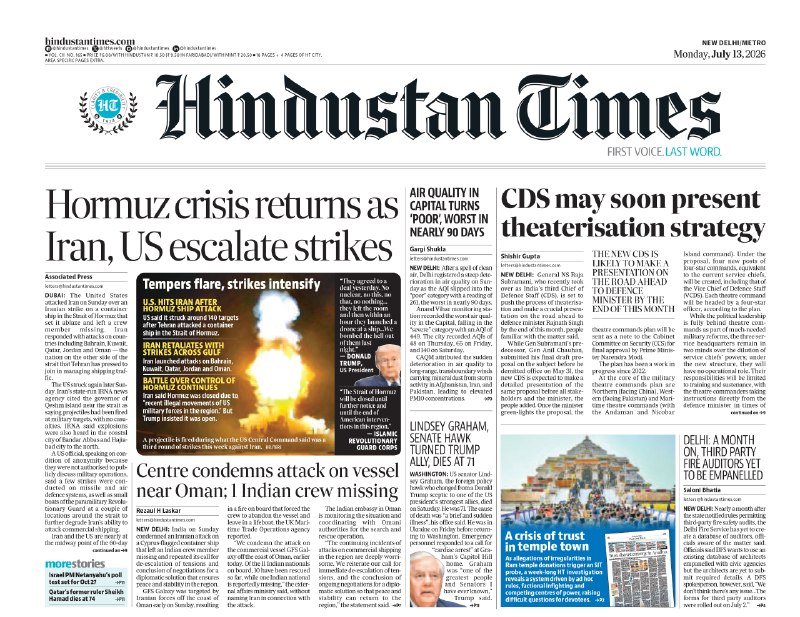
A sequence of urgent statements from Iran's Islamic Revolutionary Guard Corps crossed the wire between 02:22 and 02:29 UTC on 9 July 2026, warning that any renewed American strike on Iranian territory will trigger retaliation against US bases across the region. The communiqués, distributed via the al-Alam Arabic Telegram channel and framed around the funeral of a senior Iranian commander killed in earlier US action, set the rhetorical floor for what could be the next escalation in the US-Iran shadow war. They deserve to be read carefully — not amplified.
What the IRGC actually said
The five dispatches are short, formulaic, and unmistakably choreographed. At 02:22 UTC the IRGC addresses "the Iranian people and the honourable people of Iraq," thanking them for the funeral procession and invoking the "deep mutual love between the people and the martyred leader." Two minutes later, at 02:24 UTC, the Guard claims the funeral "terrified the arrogant people sitting in the palaces and pushed them to react hastily toward the power of the people." At 02:25 UTC, the substantive accusation: the United States, "in an anti-population move," struck two bridges in the eastern provinces along routes toward the holy city of Mashhad in order "to cover up the news of this unprecedented action." At 02:26 UTC the Guard denounces "the American army, the killer of children." At 02:29 UTC the threat becomes explicit: "In the event of a repeat of the aggression, our overwhelming responses will expand to include other American bases in the region."
Each step escalates. The shift from solidarity messaging, to boast, to specific military accusation, to dehumanising language, to a conditional strike threat, is a textbook escalation ladder, compressed into seven minutes.
The Western frame — and why it falls short
The default cable-news read on a statement like this is "Iran threatens regional war." That framing is not wrong, but it is incomplete. By foregrounding the threat and burying the triggering event, Western coverage of similar incidents has historically produced a discourse in which Iranian retaliation is treated as the originating fact, rather than as a response. The Mashhad bridges are named. The earlier American action that allegedly killed the senior commander at the funeral — the action the IRGC explicitly cites as the trigger — is the fact the rhetoric is built on. Coverage that quotes only the ultimatum produces a clean moral story; it is not, however, a full report.
There is also the question of sourcing. The Mashhad strike claim has, at the time of writing, only the IRGC as its source. al-Alam is an Iranian state-aligned outlet; the communiqués themselves come from the IRGC's propaganda apparatus. Until the bridges' damage is independently corroborated — by Reuters, by the BBC's Persian service, by Planet or Maxar imagery of the relevant eastern approaches to Mashhad — the accusation is a single-source claim and should be reported as such. The bridge-strike framing may be a casualty figure cooked up to legitimate the funeral spectacle; it may be real. The sources available to this publication do not let us distinguish.
What the IRGC's own language reveals
The communiqués do something the cable translations often miss: they perform grief. The Guard is not issuing a tactical warning from a military operations centre. It is publicly organising mourning for a named dead leader, crediting Iraqi Shia crowds with a display of "mutual love," and presenting the funeral as a fait accompli that "terrified" US decision-makers into a clumsy reaction. This is not a statement about military balance. It is a statement about legitimacy — about who gets to claim the dead on either side.
Read that way, the 02:29 UTC ultimatum is the rhetorical pay-off of a domestic-mobilisation operation, not a standalone strategic threat. The funeral is the message; the bridges accusation is the cover story; the threat to US bases is the line the Guard wants the region's audiences to repeat. This does not make the threat non-existent. Operational signalling and propaganda are not mutually exclusive categories. But it changes the analytic frame: the question is no longer "will Iran attack" but "what domestic constituency is the Guard mobilising, and through which narrative."
Stakes and a serious reading
If any of this materialises beyond rhetoric — and it must be said clearly that we do not know yet whether it will — the consequences land first on the roughly 45,000 US troops and contractors stationed across the Gulf, in Iraq, and in the wider CENTCOM area of responsibility. Beyond that, any direct Iranian strike on a US base in the region risks a retaliatory cycle that pulls in Iraqi Shia militias, possibly Lebanese Hezbollah, and certainly the Strait of Hormuz tanker traffic on which the global energy market still depends. The economic transmission to Europe and East Asia would be felt within days.
This publication's reading is that the IRGC's midnight communiqués are best understood as a mixture of genuine operational signalling and a domestic legitimation narrative built around the funeral of a martyred commander. The threat to US bases is real as a posture; whether it is real as an order-of-battle decision is a question the next 72 hours of satellite imagery, regional wire traffic, and CENTCOM briefings will answer. Until then, the responsible line is the boring one: read the communiqués in sequence, name the trigger, demand independent corroboration of the Mashhad bridges claim, and resist the temptation to print the ultimatum as a standalone headline.
Desk note: Monexus reports the IRGC communiqués in full chronological order and flags the Mashhad bridge strike as a single-source claim pending independent verification — a framing the wire cycle so far has elided in favour of the ultimatum alone.
Wire provenance
This editorial synthesis draws on the following public wire/social posts:
- https://t.me/s/alalamarabic