The Czech PM's confession: NATO summits now run on small talk and evasion
Andrej Babiš walked out of his White House dinner and told the world what every NATO capital already suspects: the talking points are gone, and nobody at the top is saying the word "peace."
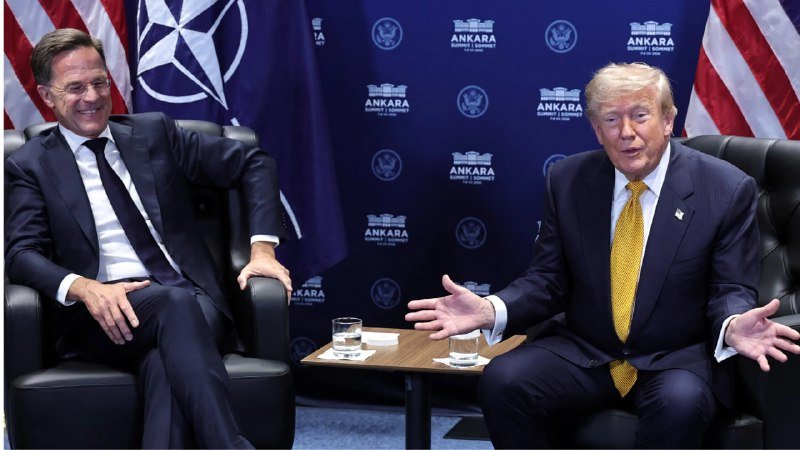
At a White House dinner on the evening of 7 July 2026, Czech Prime Minister Andrej Babiš appears to have given the most candid read-out of a NATO-leader meeting with Donald Trump that any European head of government has allowed on the record in this cycle. Within hours, his comments — relayed by the Telegram channel Clash Report from a press availability — were being parsed across European foreign-policy circles for what they reveal about how the alliance now actually functions in the room.
The picture Babiš painted is not flattering to either side. There was, he said, "nothing about NATO spending" at the dinner. The conversation ran to food, football, the Hague — and, in a lighter moment, to the whereabouts of the First Lady. "We asked Trump where Melania was," Babiš reported. "President Trump explained that, of course, making such a trip would be exhausting for her." The Czech prime minister added that Trump "is very proud of Melania." It is the kind of anecdote that, in another era, would have stayed inside the room. In 2026, it is the substance of allied diplomacy that European publics are being offered.
A 90-billion-crown hole and a missing number
Babiš used the same appearance to confirm what Czech fiscal documents have implied for months: the country will not hit the NATO two-percent-of-GDP defence-spending target this year. He blamed an inherited budget shortfall of roughly 90 billion Czech crowns and the political choice not to freeze highway and bypass construction to plug it. The structural problem is older than his government. Successive Czech administrations have promised the two-percent line as a flagship commitment to the alliance while running budgets that cannot deliver it without cuts to domestic priorities that no governing coalition wants to make.
The honest version of the Czech position is therefore narrower than the alliance's communiqués usually allow. Prague is rhetorically committed to the target; practically, it is choosing roads over rearmament in the current fiscal year, and asking allies to accept the trade-off.
The word nobody said
The most damaging line in Babiš's read-out was almost an aside. "Everyone is talking about war, everyone is talking about rearmament," he said, "and yesterday I didn't hear the word 'peace' even once." That is a striking thing for a NATO-frontline prime minister to say on the way out of the alliance's de facto leader's residence. It also maps onto a wider European anxiety: that the political energy of the past eighteen months has been consumed by capability targets, ammunition stocks, and industrial-base questions, while the diplomatic question of how the war in Ukraine actually ends has been left to drift.
The counter-read is straightforward and worth taking seriously. NATO is a defensive alliance; its job is to deter and to prepare, not to negotiate. "Peace" in the formal diplomatic sense belongs in other formats — the tracks that involve Kyiv, Moscow, and a set of intermediaries the alliance itself does not lead. By that logic, Babiš's complaint confuses the forum with the function. The rejoinder is fair. But it is also true that when European publics hear their leaders talk about "rearmament" week after week without any visible horizon for a negotiated end-state, the silence on "peace" stops reading as procedural and starts reading as political.
The dinner question
The Melania anecdote deserves more attention than it will probably get. Babiš volunteered it; Trump reportedly answered it; both sides let it stand. Whatever one makes of it as small-talk diplomacy, it confirmed a pattern that has defined this administration's hosting of European leaders: the operational agenda is thin, the optics are calibrated for an American audience, and visiting heads of government are increasingly willing to say so in public.
That has consequences. NATO's cohesion in this period rests less on shared strategic vision than on a set of bilateral relationships that can survive a presidential tweet. When the prime minister of a frontline state walks out of the dinner and tells reporters the conversation was about football and the First Lady's travel schedule, he is not leaking a scandal. He is describing an alliance that is being held together by habit and by the absence of a plausible alternative — neither of which is a strategy.
Stakes
The Czech position is a small, honest data point inside a much larger European problem. If Prague cannot reach two percent in 2026 without breaking its domestic capital budget, the same arithmetic applies — with different numbers — in Bratislava, Budapest, Bucharest, and Rome. The alliance's political centre of gravity is moving toward a world in which the headline target is officially reaffirmed at every summit while the underlying trajectory bends the other way. Babiš has now said that out loud, on the steps of the building where the target was first set as a floor rather than a ceiling.
What remains genuinely uncertain is whether this is the opening phase of a renegotiation — allies quietly accepting that two percent is a stretch goal rather than a near-term floor — or whether it is the prelude to a sharper clash between Washington and a group of European capitals that would rather keep talking about highways and football than about what comes after the war.
Desk note: Monexus has reported Babiš's remarks as conveyed by Clash Report, the Telegram channel that posted the original read-out, rather than paraphrasing a wire summary. Where the Czech government's own communiqués contradict the prime minister's public remarks, this publication flags the gap rather than smoothing it over.
Wire provenance
This editorial synthesis draws on the following public wire/social posts:
- https://t.me/ClashReport
- https://t.me/ClashReport
- https://t.me/ClashReport
- https://t.me/ClashReport