Canada's submarine pivot is about more than submarines
A 12-boat German-Norwegian contract is being sold as a NATO procurement story. It is also a quiet declaration of intent about which hemisphere Ottawa intends to anchor its security to.
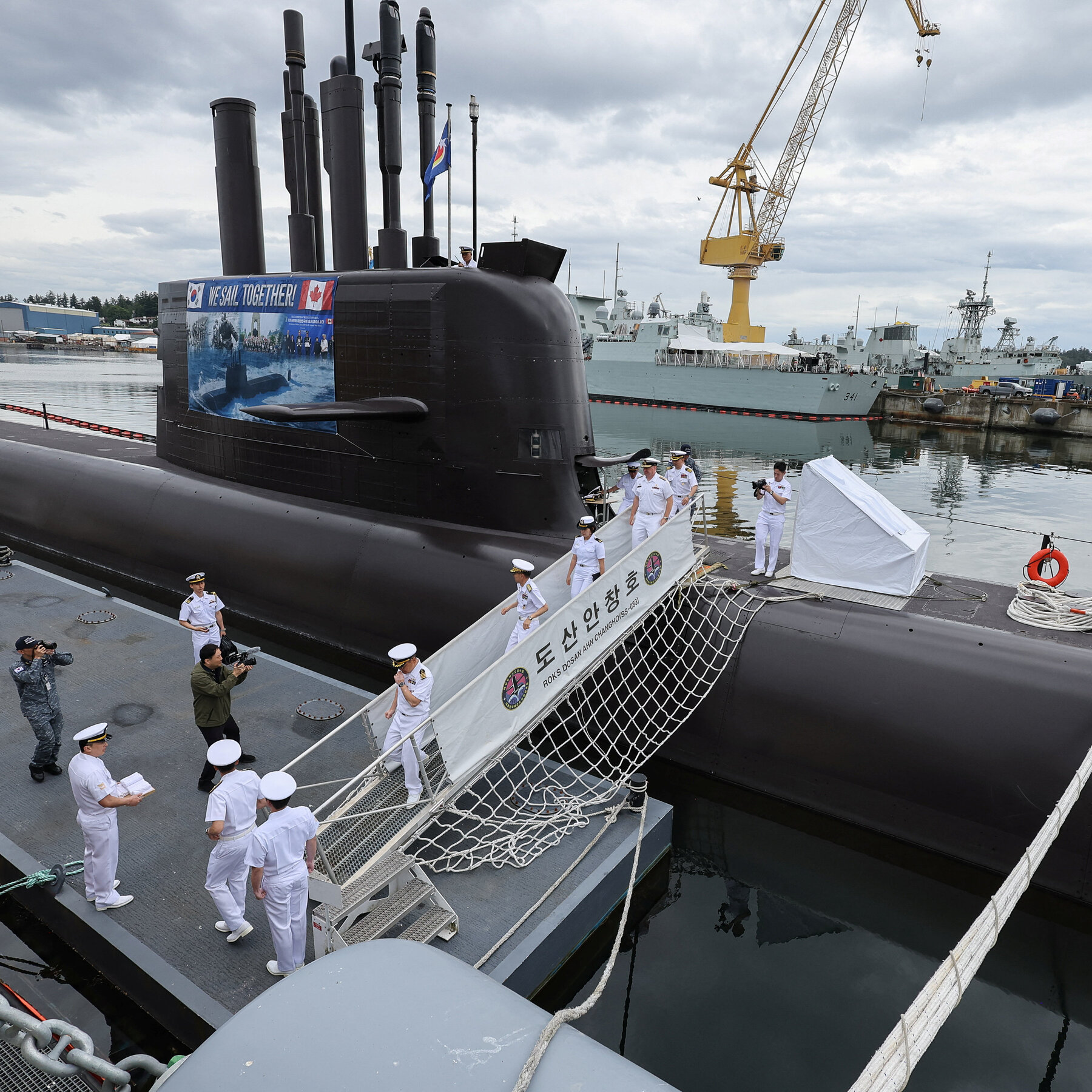
On 6 July 2026, Prime Minister Mark Carney announced that Canada will procure up to twelve submarines from a joint German-Norwegian bid, calling the contract "the largest in Canadian history." The deal, framed by Ottawa as a routine NATO-era procurement, lands three days before the alliance's summit in Ankara and against a backdrop of an explicit Canadian effort to "reduce its military and economic dependency on the United States," as the New York Times reported on the same day.
Read past the procurement language and the announcement looks like a foreign-policy document dressed up as an acquisition. Canada is choosing, with deliberation, which great-power ecosystem it wants to operate inside — and the answer is no longer Washington by default.
The deal, in concrete terms
Germany's Thyssenkrupp Marine Systems, partnered with Norway's Kongsberg, is the industrial core of the bid. The Type 212CD-class design — a conventionally propelled, air-independent-magnetron submarine — has been marketed across Europe as the platform of choice for navies that need credible undersea reach without nuclear propulsion. Carney's announcement on 6 July frames the order as "up to twelve" boats, a number large enough to replace Canada's four ageing Victoria-class diesel-electric submarines and to fund a domestic sustainment base around Halifax and Esquimalt.
Deutsche Welle's reporting on the same day placed the announcement explicitly in the NATO-summit run-up, with the German government having "pushed hard" for the contract. Berlin wants the export win; Oslo wants the industrial integration; Ottawa wants the geopolitical signal. All three governments get something. The cost — Ottawa has not yet published a figure in the materials released on 6 July — will become the second political fight, not the first.
What the announcement is actually saying
The language Carney chose is the news. "Largest in Canadian history" is procurement-page filler; "stronger ties with Europe," repeated in the Deutsche Welle summary of his remarks, is the operative phrase. The New York Times went further, reading the selection of a German-Norwegian bid as a deliberate "elevat[ion of] Canada's naval power" coupled with a "reduc[tion of] its military and economic dependency on the United States." That second clause is the one Ottawa's own press materials are careful not to repeat verbatim.
The structural read is straightforward. For three generations, Canada's defence-industrial base has been functionally a buyer of American platforms: F-18s, CF-18s, P-8s, a long list of naval auxiliaries built to USN standards. Replacing that supply line with European platforms — even partially, even on a single hull line — is the kind of decision that, once made, does not get unmade. Sustainment, training pipelines, doctrine, and the industrial base all flow downstream of which hull you chose.
The counter-read, and why it probably doesn't hold
The plausible counter-read is that this is a cost-engineering decision, not a geopolitical one. Twelve Type 212CDs are cheaper to build and crew than US Virginia-class boats, and Ottawa was never realistically in the market for nuclear propulsion. Canada lacks the sovereign fuel cycle, the shipyard infrastructure, and the operational doctrine for SSNs. A European conventional boat is, on its own terms, the rational pick.
The counter-read holds on the engineering question and breaks on the timing. Carney did not need to characterise the order as "the largest in Canadian history" — that phrase exists to land a political message. Nor did Berlin need to lobby this hard for what is, by German export standards, a modest line item. The political weight on both sides of the transaction is the tell.
What remains uncertain
The sources published on 6 July do not yet give a contract value, a delivery schedule, or an industrial-benefits breakdown. The announcement uses "up to twelve," which leaves room for a smaller initial order and follow-on options. Whether Halifax gets the sustainment yard, whether Irving Shipbuilding keeps any role, and how the program is funded inside the next Canadian defence budget are all unanswered on the day of the announcement.
The deeper open question is whether this is a one-platform pivot or the leading edge of a broader realignment. If the answer is one platform, then the headline is procurement; if the answer is broader, then the headline is that the Canadian-American defence-industrial marriage — assumed to be permanent for seventy years — is now being renegotiated in plain sight, with European partners as the counter-party.
Stakes
For Ottawa, the upside is sovereign industrial depth and a credible undersea capability for the Arctic, where Russian and Chinese undersea activity has been the documented driver of allied naval interest. For Berlin, the deal validates a frigate-and-submarine export strategy that has been quietly rebuilt over the last decade. For Washington, the cost is influence at the margins — influence that has, until now, been treated by both capitals as a given.
The NATO summit in Ankara opens in three days. By then the submarines will be on the communique. The signal was sent on 6 July.
Desk note: Monexus framed this primarily as a sovereignty-and-alignment story rather than a procurement story — the contract is real, but the language the principals chose, and the timing three days before Ankara, point to a political message the wire copy softens.