When the Algorithm Crowns a Champion: France, the Prediction Markets, and the New Shape of Football Fanhood
Polymarket gave France a 36% title shot hours before the Socceroos went home. The story isn't gambling. It's who gets to render the tournament legible.
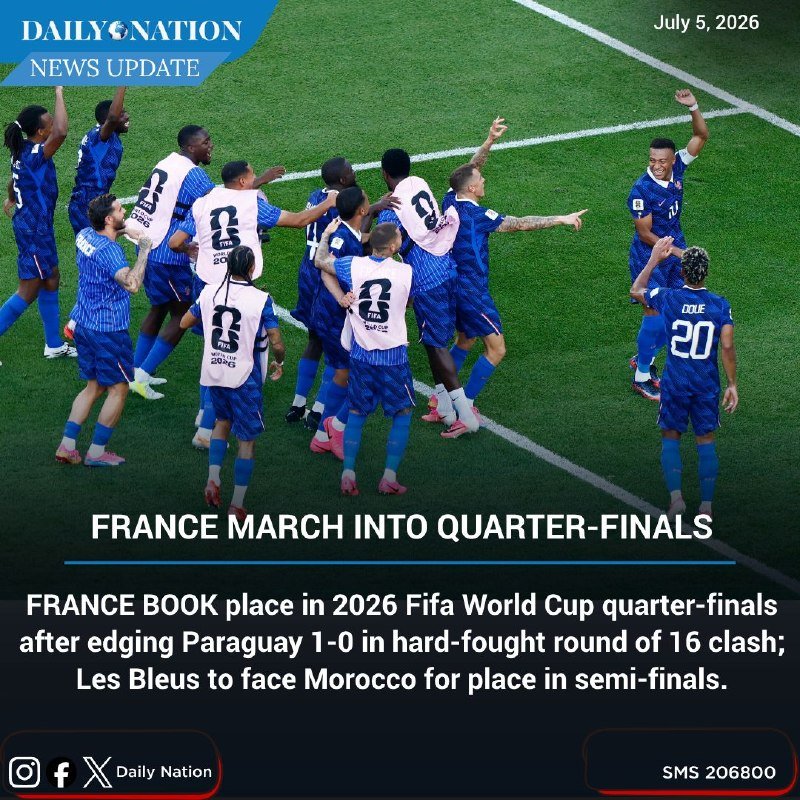
On 4 July 2026, a prediction market run by Polymarket put France's chances of lifting the World Cup trophy at 36% — the highest single-team probability recorded by the platform since the tournament began. Hours earlier, the same account had confirmed France had reached a fourth consecutive World Cup quarterfinal. On a separate evening, the platform logged Egypt's first-ever knockout-stage win, a quieter kind of history the algorithms processed without commentary. The numbers are doing more work than the commentary around them.
This is no longer a story about gambling. It is a story about who gets to authorise the meaning of a tournament in real time — and on whose infrastructure that meaning is rendered legible to millions of viewers who have never placed a dollar on a contract.
The odds have left the bookmaker
Polymarket's 36% France figure sits on a public order book. Anyone with a wallet can watch the implied probability tick up or down as the round-of-16 concludes, as lineups leak, as weather reports land. The price is, in effect, a collective guess with money behind it. By contrast, the kind of expert polling that used to set the agenda — the Las Vegas line, the Reuters odds roundup, the Sunday newspaper tipster — has been pushed to the margins of fan attention.
Two things follow. First, the consensus number is no longer curated by a newsroom. It is curated by an order book. Second, the people who care most about that number — sharp traders, crypto-natives, the Telegram-group arbitrageurs who arbitrage the spread between Polymarket and a sportsbook in Curaçao — have an outsize voice in shaping what "the market thinks," even though the market does not, in any formal sense, think.
The narrative is the asset
France's quarterfinal run is itself a 2026 storyline with weight. A fourth straight last-eight appearance is a structural achievement — Les Bleus have now made the quarters in 2018, 2022, and 2026, the kind of run that turns a national federation into a system rather than a team. Polymarket's official account treated the milestone as a breaking-news event, posting it alongside the implied-probability update.
This collapsing of news and price is the structural shift. When an outlet with the reach of a national broadcaster treats a probability update as a story, it has effectively outsourced part of its editorial framing to a trading venue. The platform's brand sits inside the news cycle; the news cycle sits inside the platform's order book. Neither is neutral about the other.
Egypt, the Socceroos, and the cost of the wrong bracket
Two contrasting cases from the same dataset sharpen the picture. On 3 July, Polymarket flagged Egypt's first-ever World Cup knockout-stage win — a historic result for African football that, on traditional metrics, would have commanded hours of studio analysis. On the prediction-market side, the win registered as a price move on Egypt's futures, then disappeared into the feed. Meanwhile, in Australia, SBS News published a guide for parents on 5 July titled "World Cup woes: How to help a child deal with distress about the Socceroos' exit" — a piece of fan-care journalism that exists precisely because the Australian team went home earlier than expected.
Both moments illustrate the same asymmetry. Prediction markets privilege the teams that are still in. Egypt's historic win matters to the price feed because it changes the bracket; the Socceroos' exit matters to parenting columnists because a generation of children watched it happen. Neither framing is wrong. But only one of them is reinforced, minute by minute, by an algorithm trained on liquidity.
The structural question
What this publication is watching is not a corruption of sport but a re-platforming of it. Football has always been narrated — by broadcasters, by federations, by the press box. The new layer is that the narration is increasingly co-produced with markets that price narrative as if it were a commodity. Polymarket's 36% France call is not a prediction; it is a position. Treating it as a forecast, the way a reader might treat a meteorologist's hurricane cone, elides the fact that the number is built from bets that can be withdrawn, coordinated, or pumped.
The honest read is that prediction markets add genuine information — sharp money often beats punditry — but they also add a new kind of distortion. The teams that command liquidity get the most accurate prices; the teams that don't get narrative silence even when they make history. Egypt's first knockout win deserves more than a price tick. The Socceroos' young fans deserve more than a coping column.
Stakes, six weeks out
If Polymarket-style venues continue to absorb the editorial oxygen around major tournaments, the implicit contract between broadcasters and audiences changes. Networks will be tempted to read the odds on air, the way they used to read the league table. Federations will be tempted to read their own reputation through the implied probability of progression. And fans — particularly the youngest ones, the SBS reader's children — will inherit a sport whose meaning has been partially pre-priced before they ever see a goal.
France may yet win this tournament. The 36% will move with every goal. But the more durable story of 2026 is that the scoreboard now has a parallel ledger, and the parallel ledger is increasingly the one people quote.
This piece foregrounds the prediction-market framing because the available reporting centres on it; mainstream wire coverage of the actual quarterfinals and Egypt's milestone was not in the source set, so the structural argument leans on Polymarket's own posts and the SBS parenting piece as the documented record.