Gaza's al-Naser Street and the information fog around it
Three near-simultaneous reports on 1 July 2026 describe an Israeli drone strike on civilians in central Gaza City — and the spread between Wafa, Press TV and the wider information environment tells its own story.
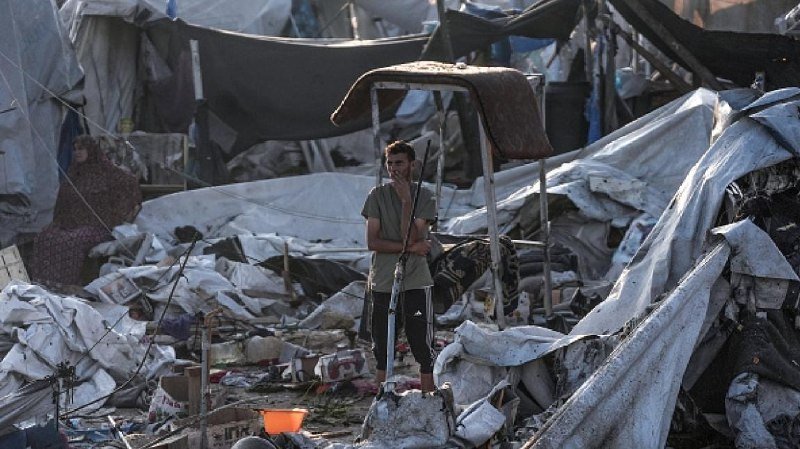
A drone struck a group of civilians on al-Naser street in central Gaza City at roughly 13:15 UTC on 1 July 2026. The strike wounded several Palestinians, according to initial accounts carried by the official Palestinian Wafa news agency and relayed through Middle East Eye's live blog at 13:36 UTC. Iran's state-aligned English-language Press TV broadcast its own, separately framed version of the same incident minutes earlier via its verified Telegram channel, while a parallel dispatch from the same channel described Palestinians bidding farewell to Mohammed Jundiya, killed in a separate strike on Omar al-Mukhtar street in the same neighbourhood earlier in the day.
Three bulletins, one street grid, three different angles. The pattern matters more than any single casualty figure.
What is actually on the record
The narrow, verifiable claim is narrow. A drone strike hit civilians on al-Naser street in central Gaza City, and several people were wounded. Wafa is the primary source; Middle East Eye carried the item forward at 13:36 UTC, attributing it to "medical sources" cited by Wafa. Press TV's 13:15 UTC Telegram item uses almost identical language — "a group of civilians in Al-Naser street, central Gaza City" — and adds the framing word "reportedly." Neither outlet has produced, in this thread at least, an independent casualty count, a list of the wounded, or a named IDF statement.
The Jundiya dispatch is a separate event on a parallel street, same city, same day. Conflating the two would be the first analytical mistake to avoid.
How the framing diverges
The Wafa–Middle East Eye chain is the standard Palestinian-authority relay: terse, medical-source-anchored, no combatant framing. Press TV's English feed adds an adjective that does heavy lifting — "reportedly" — but bundles the incident with photography that pushes the editorial register closer to propaganda than to reporting. Iran-aligned outlets have an institutional reason to foreground civilian harm in Gaza and to push it into English-language channels: it services a foreign-policy line that treats Israeli military action in the strip as an extension of a wider regional confrontation.
Israeli sources are absent from this cluster. The IDF Spokesperson's unit has, in the past, distinguished between strikes on military targets and cases it acknowledges as civilian harm, and Israeli Hebrew-language outlets such as Haaretz and Ynet have on occasion carried critical coverage of specific incidents. None of that is on the record in this thread. The Western-wire layer that would normally sit between an Israeli event and an English-speaking reader — Reuters, AP, AFP — is also absent. What survives is the two ends of the information environment: a Palestinian-authority flash and an Iranian-state amplifier, with no third-party corroboration between them.
Why the gap is the story
A reader who relies on a single feed is being told either that the strike happened (Wafa) or that the strike is being framed as evidence in a wider geopolitical argument (Press TV). Neither feed by itself is wrong, and both are doing work that the Israeli and Western-wire layers normally do. When those layers go quiet — or when access makes reporting from inside Gaza prohibitively expensive for non-embedded outlets — the burden of establishing what actually happened shifts to the reader, who is left triangulating between actors with very different institutional incentives.
This is the broader pattern worth naming plainly. In Gaza, the structural conditions of the war — restrictions on foreign press, the collapse of local institutions, the dominance of a small number of official information channels — have produced an information environment in which the same incident can be reported as a medical event, a propaganda event, or a non-event depending on which feed a reader happens to see. Western-wire verification of small-drone strikes on specific streets is the rarest of the three.
Stakes and what remains uncertain
The civilian-harm framing in Gaza is not contested in principle; the Israeli human-rights NGO B'Tselem and UN offices have published extensively on cumulative casualty figures over the course of the war, and Israeli outlets have run critical pieces on specific incidents. The question on any given afternoon is narrower: who died, on which street, and at whose hand — verifiable facts that this thread does not resolve. Wafa's "several wounded" is an order-of-magnitude figure, not a count. Press TV's "a group of civilians" is a framing choice. The Israeli statement, if one is issued, will determine whether this incident enters the public record as a strike on a legitimate target, a strike that misidentified a target, or a strike that will not be commented on at all.
Until then, al-Naser street sits at the intersection of three competing information systems, each of which has reasons to call the day's events something slightly different. The honest reading is that something happened there on 1 July 2026, that civilians were hurt, and that the rest of the picture is, for now, a fog.
This article is part of Monexus's ongoing coverage of how the Israel–Gaza war is reported. We lead with Wafa and Middle East Eye as primary on-the-ground sources, treat Press TV as a counter-claim channel rather than a stand-alone factual basis, and flag where Western-wire verification is absent.
Wire provenance
This editorial synthesis draws on the following public wire/social posts:
- https://t.me/presstv
- https://t.me/presstv