Venezuela's earthquake toll climbs to 235 — and the relief frame hides the deeper problem
The death toll from the earthquake that struck Venezuela has climbed to 235, with more than 4,300 injured. The disaster is exposing the gap between Caracas's limited state capacity and the scale of relief a country in its position actually needs.
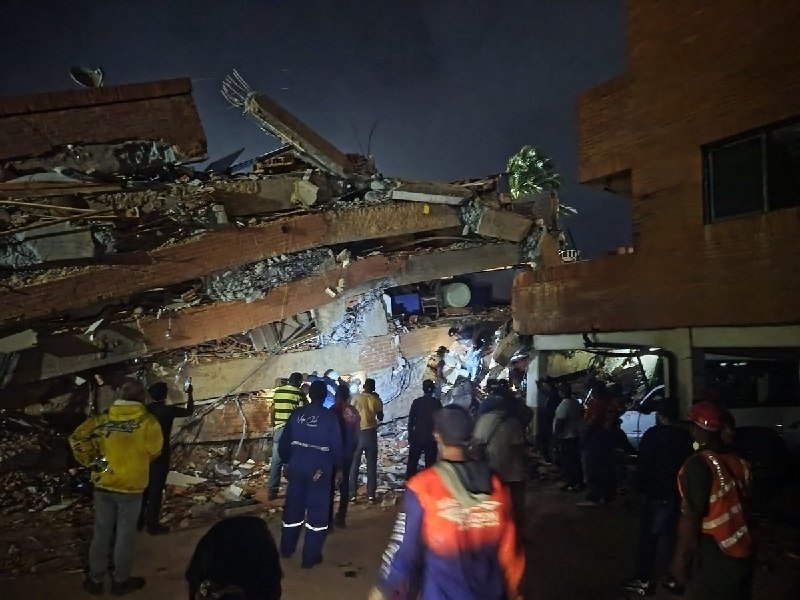
The Venezuelan Ministry of Health raised the official death toll from the country's earthquake to 235 on 26 June 2026, with figures compiled through the early hours of the morning reporting more than 4,300 people injured. The quake, measuring 7.2 on the Richter scale and centred in northern Venezuela, has produced casualty counts that are still moving as search-and-rescue teams reach previously cut-off communities. Three consecutive updates from the ministry — issued through the early UTC window — converged on the same 235 figure, suggesting that the immediate triage count has stabilised even as the secondary-care burden grows.
The earthquake is a disaster. It is also a stress test of something the relief-and-donation frame tends to flatten: the question of which states in the Western Hemisphere retain the institutional capacity to absorb a shock of this scale on their own, and which cannot.
A state built for announcements, not absorption
Venezuela enters this crisis with a public-health infrastructure that international observers have, for years, described as severely degraded. The ministry's ability to issue prompt numerical updates is real, and matters — in disasters, a credible count is the precondition for credible relief. But the distance between announcing 235 dead and burying them, housing the displaced, and keeping the 4,300 injured alive through the next seventy-two hours is the distance Caracas has to close with limited state capacity, sanctions-era fiscal compression, and an oil sector whose revenues do not behave as they once did.
The early framing in wire reporting has leaned humanitarian — casualty counts, foreign-aid offers, expressions of solidarity from neighbours. That framing is not wrong. It is also incomplete. A country whose health system has lost roughly half its pre-2014 medical personnel, according to multiple independent assessments over the past decade, does not process a mass-casualty event the way a country with intact systems does. The same 235 that reads as a sobering figure in a wire bulletin reads as a stress indicator inside the country.
The counter-narrative the wires are not running
There is a second story here that is harder to fit on a front page. It is the question of what the relief architecture around a sanctioned state actually looks like in 2026. Venezuela has been under comprehensive US sanctions for years; secondary sanctions have, in practice, narrowed the universe of banks, insurers, and logistics firms willing to handle even clearly humanitarian cargo. Several governments and multilateral bodies have built exceptions, carve-outs, and general licences to keep humanitarian flows moving. The question worth asking is whether those mechanisms work at the speed and scale that an event like this demands.
This publication is not arguing that sanctions caused the earthquake. We are arguing that the conversation around how this disaster gets handled is more interesting — and more honest — if it includes the operating environment in which Caracas has to source generators, field-hospital kits, and cold-chain medicine. The relief frame, by design, holds the affected population in the foreground and the political economy in the background. Sometimes the background is the story.
The structural pattern
Latin America has lived through a sequence of these moments over the past decade — earthquakes in Mexico and Ecuador, hurricanes in the Caribbean, the collapse of public services in multiple jurisdictions. The pattern is consistent. Initial coverage focuses on the natural event and the human toll. Within forty-eight hours, the coverage begins to disaggregate: which roads are open, which hospitals are functional, which ministries can disburse, which foreign partners are credible. The state-capacity question, which is the actual determinant of how many of the injured survive the second week, surfaces late and gets less column-inch than the dramatic first-day imagery.
What we are watching in Venezuela this week is that pattern running on schedule. The 7.2-magnitude event is the news. The institutional question — how a country that has lost a large share of its trained medical workforce, and operates under extensive external financial restrictions, runs a 72-hour mass-casualty response — is the slower, less photogenic story underneath.
What remains contested
The headline figure of 235 is the ministry's count as of the early UTC hours of 26 June. That count will rise. It always does in events of this magnitude, particularly when rural municipalities are cut off by road damage. The other figure worth watching is the displacement number, which the ministry has not yet published at the same granularity — and which will determine whether the relief architecture scales appropriately or whether it arrives in Caracas and stalls there.
The honest summary: a country has been hit hard, the state is reporting credibly and promptly, and the international response will say a great deal about whether the systems built around sanctioned economies actually work when tested. The next seventy-two hours matter more than the previous seventy-two hours did.
This piece focuses on the state-capacity question that the relief-and-donation frame tends to push to the background, while staying inside the bounds of what the available reporting can verify.
Wire provenance
This editorial synthesis draws on the following public wire/social posts:
- https://t.me/JahanTasnim
- https://t.me/alalamarabic
- https://t.me/alalamarabic