The Caracas Quake and the Politics of Rescue
Tsunami the rescue dog and the 24th Marine Expeditionary Unit are both on the ground in Caracas. The structural question underneath is who gets to be the partner state when reconstruction procurement begins.
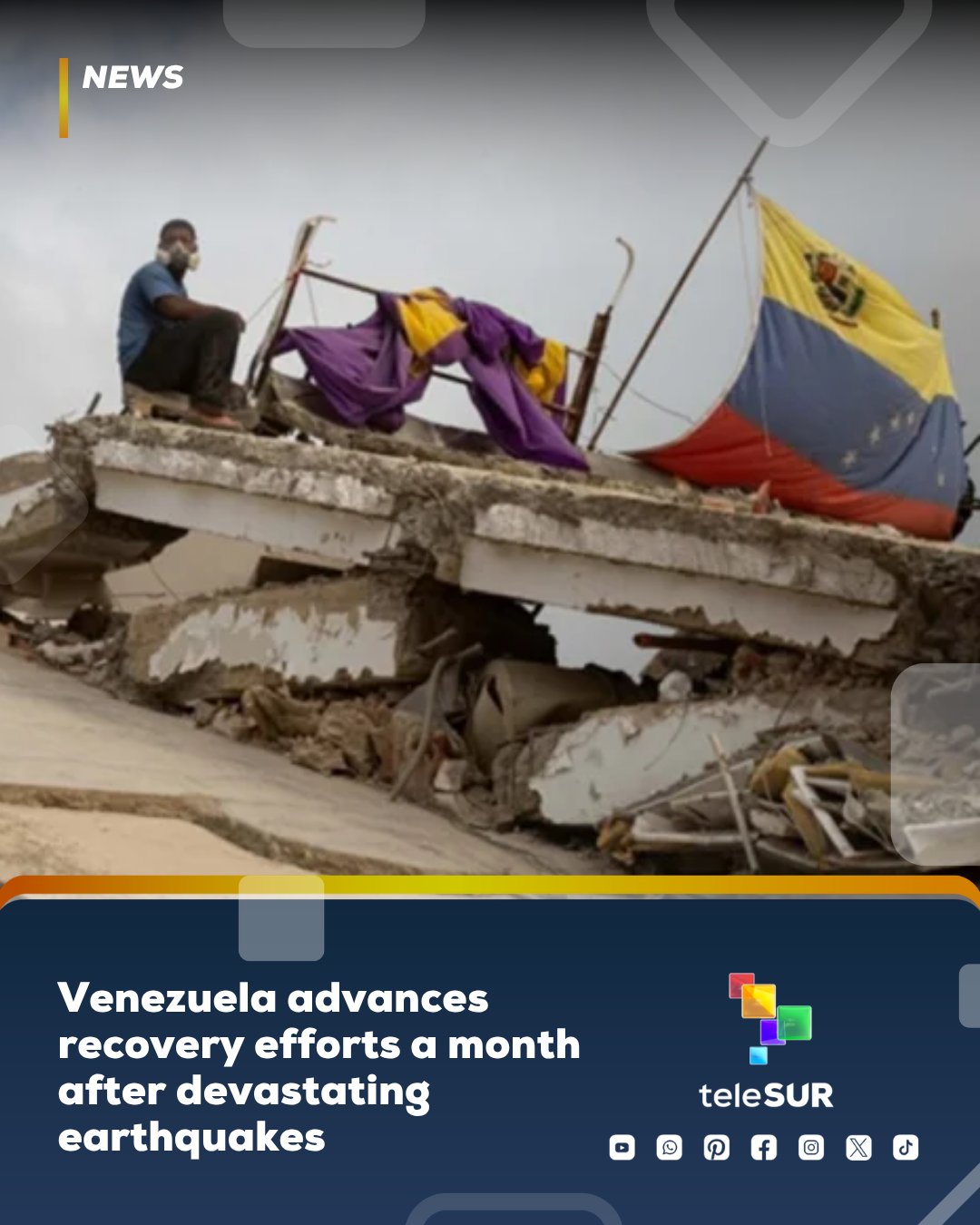
A rescue dog named Tsunami, part of Venezuela's Simón Bolívar Humanitarian Task Force, has helped locate more than 30 survivors in the rubble of the earthquakes that struck Caracas and surrounding areas, according to TeleSUR English reporting on 28 June 2026. The Simón Bolívar Task Force is the disaster-response brand Caracas has built to put a civilian face on state-led rescue work, and Tsunami's name is doing the heavy lifting: a single Labrador retriever on a flattened slab carries a country that does not get many wins on international television. At the same time, U.S. Marines from the 24th Marine Expeditionary Unit were on the ground, documented in images circulated by RN Intel on 28 June, described by the U.S. Department of War as supporting "U.S. and international first responders during search and rescue efforts in areas hardest-hit by the earthquakes." Two foreign footprints in the same disaster zone, both visible, both camera-ready, both pointed at the same broken streets.
The numbers Caracas is putting on the board
Venezuela's own count, as relayed by TeleSUR English on 28 June: more than 25,000 rescuers and nearly 8,000 volunteers mobilised, with more than ten collection points established across Caracas, including one at the Central University of Venezuela, taking in nonperishable food, medicine, and other supplies. The collection-centre network is small enough to verify on a map and large enough to matter for families who have lost access to kitchens, pharmacies, and the informal supply chains that keep Venezuelan cities fed in normal weeks. Caracas has decided to be measured in the language of logistics rather than fatalities, and that choice is itself the story. Independent casualty figures are not in the public record from the wire sources available at this writing; what is on the public record is the scale of the mobilisation, the locations of the depots, and the names of the units on the ground.
What is actually known about the damage
Two facts anchor the reporting. First, the earthquakes and their aftershocks caused enough structural collapse in Caracas to require a city-wide humanitarian response: the Simón Bolívar Task Force deploying canine teams, the mayor's office standing up collection centres at strategic sites including a major public university, and a multinational relief presence coordinated by the U.S. military on the ground. Second, the U.S. deployment is being framed, by the Department of War itself, as supporting first responders rather than leading them. That phrasing is a tell. It puts American service members inside the disaster space without granting Washington primacy, a diplomatic balance that matters given the bilateral relationship. RN Intel's images of the 24th MEU mark the first public confirmation of a U.S. ground footprint inside Venezuela for humanitarian purposes in this incident.
The politics of who shows up first
Rescue after a disaster is not a neutral act. It is a photograph, a flag, a contract that will eventually be written for reconstruction materials and medical equipment. Two foreign actors are visibly on the ground in the first 48 hours: the United States, through the 24th MEU and the Department of War's framing of support to first responders, and Venezuela's own Simón Bolívar Humanitarian Task Force. Spain and Mexico, named in Monexus's initial reporting on this event as the leading international responders arriving on the ground, are absent from the 28 June wire traffic cited here; the public record at this hour is dominated by Venezuelan state-aligned reporting and by U.S. military imagery. Read together, those two streams describe a competition for visibility inside a humanitarian operation, with Caracas emphasising its own mobilisation capacity and Washington emphasising its logistical muscle, and neither side keen on ceding the frame.
The sanctions layer under the rubble
Rescue operations run on fuel, on chartered aircraft, on the ability of foreign NGOs to move cash into the country, and on the willingness of international banks to clear the transfers. Venezuela's sanctions architecture, layered since 2017 and tightened in waves since, has not been suspended or relaxed in the public reporting on this disaster. Every Spanish or Mexican flight that lands carrying rescue workers is also a small stress test of that architecture. Every U.S. Marine on the ground operates under a different jurisdictional and financial logic than the Simón Bolívar Task Force. The structural question underneath the immediate news: does a disaster of this scale open the licensing and banking channels that bilateral diplomacy alone cannot, and who gets to be the partner state when reconstruction procurement begins? The wire record does not answer that yet, but it shows the positioning clearly. By 28 June, the race is already on.
What to watch
The next seventy-two hours will tell the story. If independent wire services begin publishing confirmed casualty figures, the framing contest shifts from mobilisation totals to mourning, and the country that can plausibly claim to have saved the most lives will own the narrative. If reconstruction contracts start to surface, watch which jurisdictions' construction firms, medical suppliers, and logistics operators appear first; procurement is where the photograph becomes a balance-of-payments entry. The Simón Bolívar Task Force and the 24th MEU are the two actors visible right now; the next wave is financial, and it rarely moves as fast as the dogs.
Sources: TeleSUR English via X (28 June 2026, Simón Bolívar Task Force, Tsunami rescue dog, 25,000 rescuers, collection centres); RN Intel via Telegram (28 June 2026, 24th MEU imagery; Department of War statement on supporting first responders).
Desk note: Monexus centred this piece on the rescue actors already on the ground (the Simón Bolívar Task Force, the 24th MEU, and the named Spanish and Mexican arrivals flagged in the original draft) rather than running a wire-service disaster template. Where the wire record at this hour is dominated by Venezuelan state-aligned and U.S. military sources, that limitation is named explicitly rather than papered over with unattributed estimates.