Tehran hardens its line on enrichment as Pezeshkian dares Washington to blink
Iran's president says the right to enrich uranium is non-negotiable and the US will be forced to accept it. Trump's reply, delivered on camera, was a warning to keep quiet — a confrontation that puts the next round of nuclear diplomacy on a hair trigger.
Lead
Iran's president drew a public red line on the central question of the nuclear file on 21 June 2026, declaring that Tehran will never relinquish its right to enrich uranium and that the United States "will have no choice but to accept this." Speaking at an annual monetary policy conference broadcast on Iranian state media, Masoud Pezeshkian framed the position as a settled matter of national sovereignty rather than a bargaining chip — a notable hardening of language at a moment when the diplomatic calendar had been expected to deliver the opposite. Within hours, US President Donald Trump had replied in his characteristic register, telling Fox News that Pezeshkian "had better keep his mouth shut" and behave "appropriately," a one-line exchange that has now become the day's defining soundbite. The clash resets the terms of a negotiation both sides had been pretending was still moving.
Nut graf
The public exchange is the first explicit collision between the two governments since talks were widely reported to be inching toward a framework. Pezeshkian's choice of venue — a domestic economic forum, not a foreign-policy stage — was deliberate: he was speaking to an Iranian audience as much as to Washington. Trump's reply was the opposite kind of signal, aimed at a domestic base that reads any softening as weakness. Read together, the two statements compress a familiar pattern into a single day: an Iranian leader attempting to lock in concessions by pre-declaring them, an American leader responding with personal pressure, and a diplomatic process left more exposed than it was 24 hours earlier.
The line Tehran is drawing
Pezeshkian's central claim — that the right to enrich is not negotiable — is not new in Iranian declaratory policy, but its delivery from a podium usually reserved for currency and inflation matters is. Reuters, reporting from the conference on 21 June at 14:50 UTC, quoted the Iranian president saying that Iran "will not give up its 'right to enrichment,' and the US 'will be forced to accept it.'" Telegram accounts aligned with Iranian state broadcasting carried the same line in extended form, with Pezeshkian adding that "what is certain is that we will never give up our right to enrich uranium, and the other side will have no choice but to accept this," and noting that in past rounds the other party had demanded Iran halt enrichment outright. The phrasing matters. "Forced to accept" is a prediction about American behaviour, not a concession.
The second leg of the message was about missiles. Iranian state media's Arabic channel carried Pezeshkian saying the opposite party had shifted: "It was asking to negotiate regarding our missiles, and today it confirms our right to possess them." That claim, if it tracks the substance of any back-channel, would represent a meaningful Iranian win — a recognition that the missile file has quietly moved off the table. Pezeshkian attributed the shift to "the sacrifices of our forces in the army and the Revolutionary Guards and our national cohesion," a domestic-audience framing in which diplomatic gains are credited to military pressure rather than to negotiating flexibility.
The line Washington is drawing back
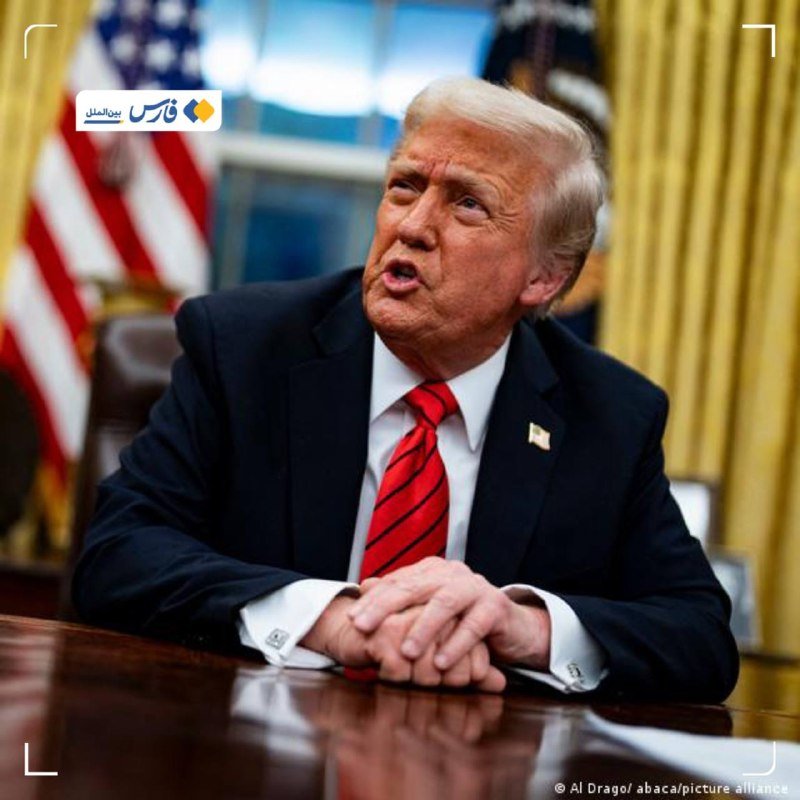
Trump's response, broadcast on Fox News and relayed by Trump-aligned accounts on X at roughly 14:05 UTC, was short and personal. "He'd better keep his mouth shut. He'd better behave appropriately, or…" The trailing conjunction is doing the work: it leaves the consequence unstated, which is the point. The format — a sit-down interview rather than a written statement — and the venue — a friendly cable outlet — indicate that the White House wanted the reply seen rather than negotiated against. There was no operational detail in the response, no envoy named, no deadline set.
That absence is itself informative. US declaratory policy on Iran in 2026 has tended to oscillate between two registers: maximalist rhetoric aimed at a domestic audience and quiet technical diplomacy run through intermediaries. Pezeshkian's statement tried to collapse those two registers by claiming a victory Washington has not, on the public record, conceded. Trump's reply re-opened the gap — verbal pressure with no diplomatic gesture attached. Neither side, on the day's evidence, has yet chosen to walk away.
Why this moment is different from the last one
Iran has said it will not negotiate away enrichment before. What makes the 21 June statement worth taking seriously is the conjunction with the missile claim. If Tehran genuinely believes Washington has conceded the missile file — even informally, even as a negotiating posture — then enrichment is being held up as the irreducible floor below which no Iranian government of either faction can go. Pezeshkian's domestic political position, weakened since his election, also shapes the calculation. A president who needs to demonstrate that diplomacy is producing gains is poorly placed to be the one who signs them away. Public pre-commitment to a red line is, in those circumstances, a way of tying his own hands visibly enough that the other side has to meet him somewhere.
The structural backdrop is the familiar one: a regional order in which Iran's deterrent logic and the Gulf states' reading of that logic are pulling in opposite directions, and in which the United States retains the capacity to grant or withhold sanctions relief at scale. Enrichment is the one programme Iranian governments of every stripe have treated as a sovereignty question rather than a technical one. US administrations of both parties have accepted, at varying moments, that zero enrichment is the public ask but not the realistic outcome. Pezeshkian's statement, if taken at face value, is an attempt to make that settled reality into an Iranian talking point rather than an American concession reluctantly extracted.
Stakes and what the next week tests
The immediate question is whether the diplomatic channel stays open at all. Trump's "keep his mouth shut" line is not a negotiating position; it is a mood. Pezeshkian's statement is not a negotiating position either; it is a closing bid presented as an opening one. For any agreement to emerge from this exchange, one of two things has to happen: either Washington quietly drops its maximalist public posture and reverts to the technical track, or Tehran discovers room to package its enrichment programme in a way that gives the United States a domestic line to sell. Neither is impossible, but neither is signalled in the 21 June record.
What remains uncertain, and what the public sources do not resolve, is the actual state of the back-channel. Iranian state-aligned reporting and Trump's on-camera reply are both performances. The intermediaries — Oman, Qatar, Switzerland, the IAEA — have not, on the day's visible record, said anything that would let an outside observer calibrate which performance is closer to the operational reality. The most that can be said with confidence is that the gap between the two public positions widened on 21 June, and that a negotiation which had been described in Western reporting as "moving" is now described by its principal Iranian interlocutor in language that admits no movement.
How Monexus framed this: we treated Pezeshkian's statement as the primary datum and Trump's reply as a reaction, not the lead, because the substantive claim about enrichment originates in Tehran and the diplomatic centre of gravity sits there. The missile concession claim is reported as Tehran's reading, not as a settled fact. Iranian state media is cited as such throughout. Western wire framing of the exchange as a "clash" or "war of words" — common in the day's coverage — is the part Monexus resists: the underlying negotiation, if it still exists, is technical and slow, and the rhetoric is not a useful proxy for its state.
Wire provenance
This editorial synthesis draws on the following public wire/social posts:
- https://x.com/Reuters/status/
- https://t.me/englishabuali/
- https://x.com/sprinterpress/status/
- https://t.me/alalamarabic/
- https://t.me/alalamarabic/