Israel holds southern Lebanon positions after Hezbollah tank-crew strike, declaring a conditional ceasefire
Israeli forces hold southern Lebanon positions nine days after a Hezbollah FPV strike on a Merkava tank, while a US-brokered conditional ceasefire is floated publicly and Iran prices the cost of any Israeli withdrawal.
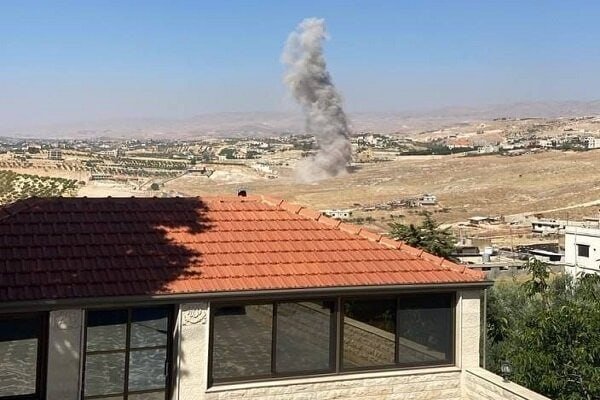
On the night of 12 June, a Hezbollah fibre-optic FPV drone threaded itself into the eastern outskirts of Yahmar al-Shaqif and detonated against an IDF Merkava Mk. 4M tank. The group released the footage nine days later, on 21 June, in the visual register of a propaganda event: slow-motion, captioned, timestamped. By that same evening, the Israeli government had framed the strike as evidence of an emerging threat to senior commanders, and was signalling through its preferred broadcasters that it would hold the ground it now occupies in southern Lebanon. A conditional ceasefire, brokered in its outline by Washington and Geneva, was simultaneously being floated in public by an unnamed American official speaking from Switzerland.
What is unfolding on the southern Lebanon border is not a war in any conventional sense of manoeuvre and breakthrough. It is an armed truce administered through overlapping red lines, contested footage, and a messaging war that runs faster than the shooting. Israeli forces remain dug in along positions they have held since operations expanded earlier this year. Hezbollah continues to claim targeted strikes. A senior Iranian Quds Force commander has publicly warned those forces will be "kicked out" of southern Lebanon. The two statements, delivered within hours of each other on 21 June, are not aimed at each other; they are aimed at the same external audience, which is now negotiating the terms under which the line might hold.
What the Israeli framing actually says
The Israeli messaging on 21 June travelled the channels the government itself chooses when it wants the message received intact. Hebrew-language outlets including Walla, Channel 12 and Channel 13 carried the line that Hezbollah has "once again created a system of monitoring and gathering" on Israeli command echelons, a framing that recasts a tactical strike on an armoured vehicle as an operational threat to senior officers. The argument, taken at face value, is that the Israeli Defence Forces cannot withdraw from positions that have become intelligence-rich without exposing those officers to targeting. The argument, read against the public footage, is that a single tank hit in nine days of footage has been elevated into a reason to stay.
It is worth noting that the Israeli public case for continued occupation is being made in the same news cycle in which Prime Minister Benjamin Netanyahu publicly stated that Israel intends to hold territory in Gaza, Lebanon and Syria "as long as necessary," a phrase that has no operational definition and maximal political utility. A Lebanese displaced resident quoted in southern Lebanon on 21 June put the inversion plainly: "Nabatieh is a disaster-stricken city but that's bearable compared to their [Israeli forces] presence on our land." That is the human ledger behind the broadcasters' abstractions.
The propaganda layer both sides now run
Hezbollah's 21 June video release is the kind of event both sides have learned to stage. Dated 12 June, it shows the FPV drone's terminal approach and the strike on the Merkava. The production values are deliberately cinematic; the date stamp is the message. By releasing it nine days after the strike, the group maximises the political half-life of a tactical event and forces Israeli media into a reactive posture. Israeli commanders' quoted concern about command-level targeting, sourced through Hebrew media, then becomes the second half of the same conversation.
The structural point: armed truces in southern Lebanon are now sustained less by fire than by the disciplined release of imagery. Each side reads the other's footage for what it permits and what it forbids. A tank hit is a tactical event and a political instrument in the same frame. The line between combatant signalling and combat has effectively dissolved.
The American layer, and what "conditional" means
The conditional ceasefire is being negotiated in public. Vice President JD Vance, speaking at the opening of US-Iran technical talks, framed Iran as "a driver of regional instability" but said Washington now sees "a future where everybody can work together to promote peace and prosperity." That language, paired with an unnamed American official's 21 June remarks from Switzerland confirming that mechanisms to "reduce the pace of the conflict and implement a ceasefire in southern Lebanon" had been worked on, places the conditionality in Washington rather than in Beirut or Tel Aviv. The pace-setting lever is American; the implementation lever is Israeli; the leverage lever is Iranian.
Iran's parallel messaging on 21 June was unsentimental. Quds Force commander Esmail Qaani warned that Israeli occupiers "will be kicked out of southern Lebanon." Mohsen Rezaei, advisor to the Supreme Leader, argued that under the Islamabad memorandum of understanding the United States is "responsible for Israeli aggression against Lebanon." These are not statements designed to de-escalate; they are statements designed to price the ceasefire. Tehran is signalling to Washington that any arrangement that leaves Israeli forces in place, even conditionally, will be read in Beirut and the Shia street as abandonment.
The ground underneath the messaging
The territory in question is not abstract. Southern Lebanese towns including Nabatieh are described by residents returning to inspect damage as "disaster-stricken." On the same weekend the ceasefire language was being floated, NPR reported the death of Mona Khalil, a leading Lebanese conservationist credited with building a movement to protect sea turtle nesting grounds on the southern coast, killed in an Israeli airstrike on her beachside home two weeks earlier. Her death is the kind of fact that complicates both sides' preferred frames: it is a single human life, weighted against the strategic language of commanders and presidents, and it is exactly the kind of fact that disappears in the messaging cycle.
Hezbollah, the Syrian transitional government, and the Israeli government are now operating in a triangular diplomatic space in which each holds something the others need. Syria's President Ahmad al-Shara clarified on 21 June that Trump's remarks about a possible Syrian entry into Lebanon to disarm Hezbollah had been "misunderstood," a public correction that protects Damascus from being drawn into a fight it did not choose. The Syrian readout is itself a message: that the regional architecture being negotiated is bigger than the southern Lebanon file, and that no party will be surprised into a posture by a stray White House remark.
What the conditional ceasefire actually contains
A conditional ceasefire, in this context, is not a document. It is a price. Israel is signalling that the price of withdrawal is a verified end to the command-targeting threat Hezbollah's footage is now designed to demonstrate. Hezbollah is signalling that the price of restraint is a timeline on that withdrawal, anchored in a framework Iran can claim authorship of. The United States is signalling that the price of both is an Iran file that includes the Strait of Hormuz, the nuclear question, and the broader regional alignment Vance publicly opened on 21 June.
The line that holds in southern Lebanon over the coming weeks will be the line that resolves, even partially, that triangle. The footage war will run in parallel; it is now the medium through which the negotiation is conducted.
Sources
- https://t.me/intelslava, Hezbollah video release, Merkava strike, Yahmar al-Shaqif, 21 June 2026
- https://t.me/rnintel, Israeli command-targeting framing, Walla citation, 21 June 2026
- https://t.me/wfwitness, Israeli framing through Hebrew broadcasters, 21 June 2026
- https://t.me/thecradlemedia, Regional framing of southern Lebanon file, 21 June 2026
- https://t.me/presstv, Qaani warning, Rezaei Islamabad MoU statement, 21 June 2026
- https://t.me/alalamfa, Quds Force warning, 21 June 2026
- https://t.me/alalamarabic, US official Switzerland remarks on ceasefire mechanisms, 21 June 2026
- https://x.com/middleeasteye, Vance US-Iran remarks, Nabatieh resident quote, 21 June 2026
- https://www.npr.org, Mona Khalil obituary and airstrike context, 21 June 2026
- https://t.me/englishabuali, al-Shara clarification on Trump remarks, 21 June 2026
- https://t.me/megatron_ron, Netanyahu "as long as necessary" statement, 21 June 2026
Desk note: Monexus carried the Israeli framing through the broadcasters the Israeli government itself chose for the message (Channel 12, Channel 13, Walla) and treated Hezbollah's video release as a propaganda event of the kind both sides now routinely stage. Where the public thread relies on second-hand transmission of Israeli statements through Iranian or Russian channels, the article flags the chain explicitly rather than presenting it as primary. The structural argument, an armed truce sustained by disciplined imagery and priced by overlapping red lines, is drawn from the read-outs themselves.