A Patriot in the pews: the strange story the Kiev-Pechersk Lavra strike tells
Ballistic missiles hit Kyiv and Poltava on the evening of 17 June 2026. Some Patriot interceptors failed. Whether the Kyiv-Pechersk Lavra was actually struck is a different, and still open, question.
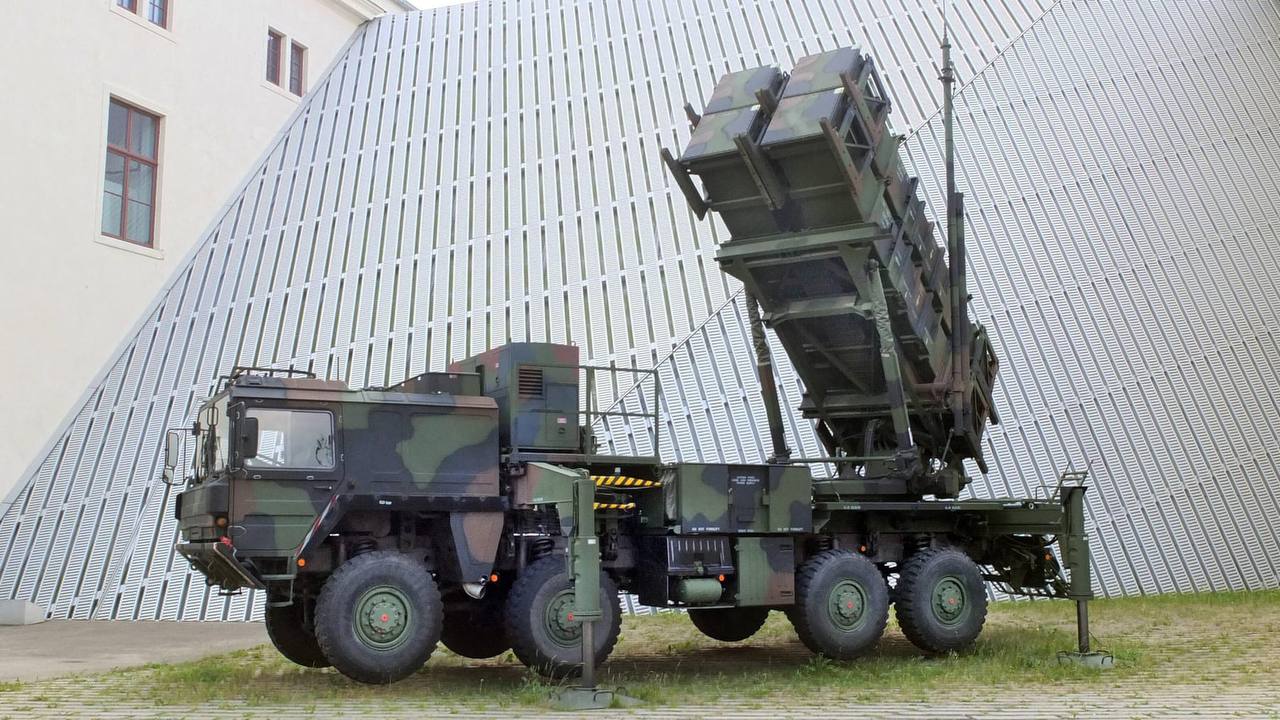
On the evening of 17 June 2026, residents in the suburbs of Kyiv filmed columns of light climbing over the city's skyline as MIM-104 Patriot interceptor canisters leapt from their launchers. The clips circulated inside a minute of impact. What they show, beyond the obvious kinetic business of air defence, is a streak that bends, fragments, and falls short. Ballistic missile strikes hit Kyiv and Poltava that night, the DDGeopolitics channel reported at 22:32 and 22:46 UTC, posting footage of Patriot launches and, almost in the same breath, footage of interceptors that failed to do their job. The Russian Defence Ministry claimed responsibility. Within hours, the strikes had collapsed into a single undifferentiated image: a missile hitting a holy site, and a politics of attribution that asked the viewer to decide what had happened before anyone had independently confirmed anything.
The first thing the wire record establishes is narrow and worth holding onto. Ballistic missiles struck Kyiv and Poltava on the evening of 17 June. Air-defence crews in Kyiv attempted to engage. At least some of those interceptions did not succeed. Everything beyond that, including where each missile landed and what it damaged, is contested. The Russian ministry's claim of responsibility is the only public attribution on offer from a named state actor; Ukrainian sources have, in this telling, not been quoted in the visible record, and no independent imagery has surfaced to geolocate the specific impact inside the Kyiv-Pechersk Lavra complex. Reporting this as a strike on the Lavra, as some channels did within hours, is an inference that runs ahead of the evidence.
What the videos actually show
The footage pushed out by DDGeopolitics is the closest thing the public has to a contemporaneous visual record. Two kinds of material dominate. The first shows Patriot launchers firing in the Kyiv suburbs, the bright upward arc of the interceptor trailing from the canister. The second shows a streak descending at an angle, then fragmenting in mid-air, then a flash. The framing on the channels that aggregated the clips was explicitly "interceptor failure"; the visual content is consistent with that framing, but also with a successful intercept of an incoming warhead at low altitude. The difference matters. Without telemetry, radar track data, or a clear crater, the same flash can be read both ways. The aggregator channels chose one reading and built the narrative around it.
Why the Lavra, specifically
The Kyiv-Pechersk Lavra is not a generic landmark. It is a working monastery, a UNESCO site, and, since 2022, the site of one of the most visible church-property disputes in the Orthodox world. After Russia's full-scale invasion, Ukrainian authorities evicted the branch of the Orthodox Church historically aligned with Moscow from parts of the complex; the buildings were transferred to the Orthodox Church of Ukraine. The site is therefore politically loaded in a way a shopping centre or a power substation is not. Any claim that a strike hit the Lavra is, by construction, a claim about a religious building that already sits at the intersection of wartime politics, ecclesiastical property, and national identity. The threshold for evidence at a target like that is higher, not lower, than for a transformer yard.
The pattern of attribution
The Russian Defence Ministry's claim came through channels that have, across the war, been the standard vehicle for both genuine admissions and psychological operations. Treating the claim as either fact or fiction at this distance is the wrong move. The right move is the boring one: note the claim, note the source, note the absence of independent corroboration, and refuse to launder the assertion into a paragraph that reads as established fact. The aggregator channels that evening did the opposite. They stitched the ministry claim, the Patriot footage, and the Lavra's symbolic weight into a single narrative arc within minutes, and the rest of the information environment inherited that arc.
What still needs verifying
Three things would move this from contested to confirmed. First, independent geolocation of any impact inside the Lavra complex, ideally with satellite imagery or building-level photography from the following 48 hours. Second, a Ukrainian Air Force or General Staff statement that names the targets and the interception results, the kind of briefing Kyiv has provided after most major strikes since 2022. Third, on-the-ground reporting from outlets with staff in Kyiv that can describe what is standing and what is not. None of those had appeared in the visible record at the time of writing. The story is real. The specifics around the Lavra are, for now, a frame placed on top of an event by channels with an interest in how the frame lands.
The stakes on the second day
How this incident settles in the information environment matters more than what one flash on one video actually depicted. If the Lavra framing hardens without independent verification, it travels as fact into foreign-language coverage, into diplomatic talking points, and into the long archive of incidents that future historians will sort. If it is held as a contested claim pending evidence, it becomes something rarer and more useful: a case study in how a contested strike acquires a narrative before it acquires a record. The difference between those two outcomes is decided in the next 48 hours, by whoever gets a camera inside the walls and whoever gets a microphone in front of a Ukrainian general. Until then, the honest version is the short one. Ballistic missiles hit Kyiv and Poltava on the evening of 17 June 2026. Some interceptors failed to do their job. The rest is a story the channels are already telling.
Sources
- https://t.me/DDGeopolitics/177b9f264e, DDGeopolitics, Telegram post, 17 June 2026, 22:32 UTC. Footage of ballistic missile strikes on Kyiv and Poltava, Patriot launches and alleged interceptor failures.
- https://t.me/DDGeopolitics/177b9f264e, DDGeopolitics, Telegram post, 17 June 2026, 22:46 UTC. Reporting of ballistic missile strikes on Kyiv and Poltava.
- https://t.me/DDGeopolitics/177b9f264e, DDGeopolitics, Telegram post, 17 June 2026, 22:47 UTC. Video of explosions in Kyiv suburbs following missile strike.
- https://t.me/euronews/177b9f264e, Euronews, Telegram relay, 17 June 2026. Wire summary of strikes on Kyiv and Poltava.
- https://t.me/osintlive, Open Source Intel, Telegram, Marco Rubio Senate floor speech excerpt, September 2015, on Iran sanctions. Context only, not directly evidentiary for the strikes.
Desk note: Monexus kept the Russian ministry claim visible in the lead rather than burying it, but the body of the piece is built around the absence of independent verification of the Lavra-specific framing. The wire record establishes the strikes and the Patriot footage; it does not, as of filing, establish that the Lavra was hit.