David Hockney at 88, still painting: a century spent remaking the picture
David Hockney turns 88 still painting daily in his Normandy studio, a living rebuke to the art world's instinct for sealing careers before the work is finished.
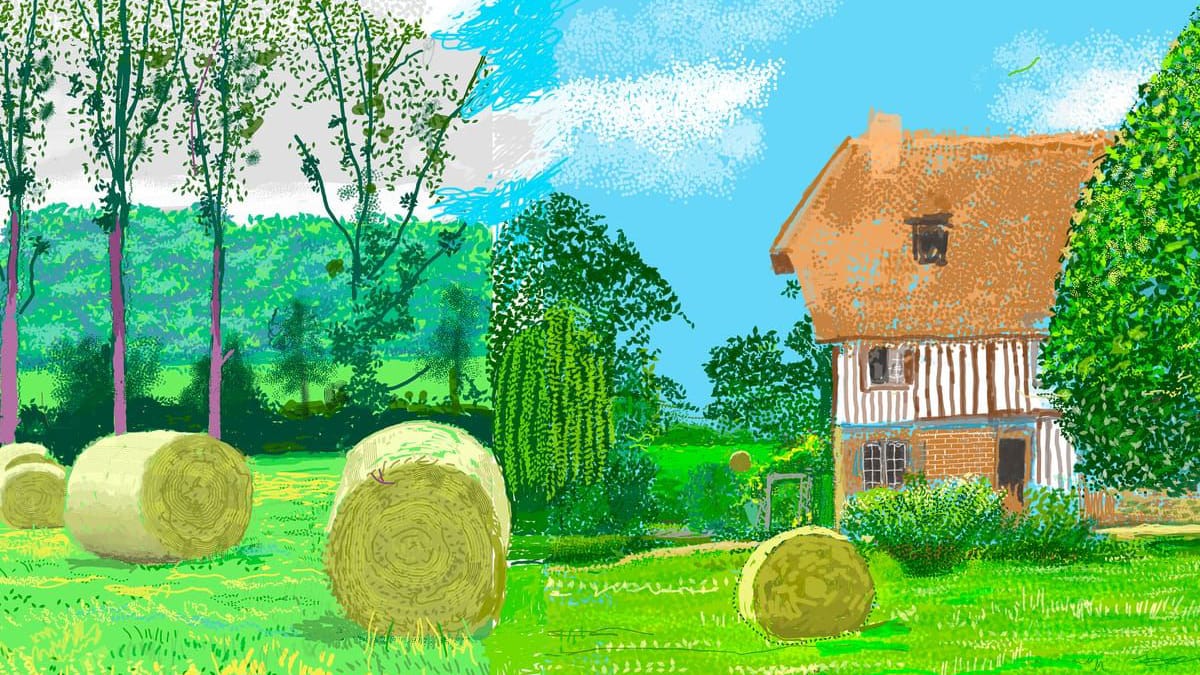
David Hockney turned 88 this week, and the most striking thing about the milestone is how little retirement it has occasioned. The Bradford-born painter who moved to Los Angeles in 1964 and reshaped twentieth-century figuration is still, by his own accounting and by his gallery's, in front of a canvas almost every morning. France 24's 12 June 2026 cultural obituary-roundup noted his birthday alongside the centenary of Marilyn Monroe, an unkind pairing that nonetheless captures something accurate: Hockney is now the last living member of a small group of British artists who, between roughly 1960 and 1980, made pop art feel less like American importation and more like a London vernacular.
His continued productivity is not a footnote. At a moment when the international art market is treating his earlier pools and double portraits as blue-chip collateral, Hockney's late output has become a kind of living laboratory for what an artist's late career can still mean in a culture that worships the deceased master. The Tate, which holds the world's deepest public collection of his work and mounted the major 2017 retrospective, lists him on its artist page as active into the present day. That matters because the institutional language of "living national treasure" is usually applied to someone resting on the laurels of a sealed body of work. Hockney's catalogue is not sealed.
The picture he keeps repainting
What Hockney is doing in his late work is not a polite variation on his earlier themes. Beginning with the 2007 Yosemite paintings and accelerating through the iPad and digital works of the 2010s, and the 2022 Lumière d'Arras cycle displayed in his native northern France, he has been working a problem he has named repeatedly in interviews: how to put the duration of looking, the actual minutes a viewer spends in front of a tree or a face, into a single static image. The technique is not new for him; the pool paintings of the late 1960s already embedded time-of-day into the surface of the water. But the late cycles are bigger, slower, and built from observational sessions that can run to many sittings.
The result is a body of work that resists the auction house's preferred framing of Hockney as a fixed-period modernist. A 1971 double portrait of two friends in Los Angeles can be sold and resold as a trophy asset, because the moment it documents is over. A 2024 Normandy landscape, painted by an 86-year-old who is still getting up before dawn to look at it, cannot be trophy-asset-ised in the same way because it is not yet complete as a project. The market has not decided what to do with that.
Why this birthday lands differently
Eighty-eighth birthdays rarely make news. The reason this one registers is the arithmetic of generation. Hockney is now older than Francis Bacon was when he died. He is older than Lucian Freud was at his death. He has outlived every member of the School of London cohort he is loosely associated with. The institutional reflex in such moments is to begin assembling the authorised version of the life, the catalogue raisonné language, the museum-floor biography.
Hockney's own relationship to that process is famously uncooperative. He has refused the conventional positioning of a painter who is "wrapping up." His studio in Normandy, documented extensively in the lead-up to the 2023 Lumière d'Arras exhibition at the Musée de l'Orangerie, operates as a working factory floor rather than a memorial site. Visitors describe easels in use, canvases stacked wet, an artist who reschedules interviews around the light. France 24's brief 12 June mention placed him in a round-up of centenaries and farewells; that framing is exactly what he has spent two decades declining.
The market question underneath the art question
The deeper question this birthday surfaces is not artistic but financial. Hockney's auction record, set during the post-2017 surge that followed his Tate retrospective, has stabilised at a level that makes him one of the few living artists whose work behaves like an estate asset while the artist is still alive. Sotheby's and Christie's routinely consign his prints and early California canvases into evening sales. When the artist is simultaneously producing new work at scale, the pricing logic for the older pieces becomes incoherent: how do you value the 1972 portrait against the 2024 portrait when the artist is still painting and may, by his own preference, revise the older work conceptually through the newer?
This is the structural puzzle collectors, gallerists and museum acquisition committees are quietly chewing on as the candles get lit. The Tate's continued programming around the living artist (acquisitions, loans, the institutional infrastructure of an active relationship) is the public face of a calculation that is happening privately at a much larger scale.
What an 88-year-old painter actually represents
There is a more straightforward reason to mark the birthday beyond market mechanics. Hockney's late productivity is an argument, made daily by the evidence of the canvas, against the now-default cultural assumption that serious art is a young person's game. The prestige art world runs on a discover-then-canonise rhythm in which a figure is excavated in their twenties or thirties, sealed by their forties, and mourned in their sixties. Hockney's curve inverts every segment of that timeline.
He is also, perhaps uniquely among his British contemporaries, an artist who has refused the British establishment's preferred reading of him. The Royal Academy elected him, the Queen (and later the King) honoured him, the Tate built a wing around his work. None of that has softened his public scepticism toward the London art world's instinct for periodising artists before the artists are done. The Normandy years have been conducted in large part outside the London orbit, in a French cultural bureaucracy and a French landscape, on his own terms.
The open question for the next decade
The honest analytical position at 88 is that the work is unfinished and the reception is still arriving. The Tate's institutional commitment, the auction market's quiet recalibration, the French state's continuing willingness to mount his work in its most-celebrated museum, and the artist's own daily refusal to stop: these are the four data points. Any verdict on the late period requires more late period.
What can be said is that Hockney has engineered something rare: a career arc in which the late work is taken seriously by the same institutions that already own the early work, and in which the artist himself remains the primary obstacle to the tidy closing narrative. The next significant birthday, 90, will arrive in 2027. On present evidence, the studio will be the loudest thing about it.
Sources
- France 24, "Farewell to David Hockney and Marilyn Monroe at 100" (12 June 2026), https://www.france24.com/en/culture/
- Wikipedia, "David Hockney", https://en.wikipedia.org/wiki/David_Hockney
- Tate, "David Hockney", https://www.tate.org.uk/art/artists/david-hockney-1292
Desk note: The wire provided only a brief birthday mention in a culture round-up; Monexus has treated the milestone as an analytical occasion, reading the late-career productivity against the institutional and market reflexes that usually close such careers early.