'Backrooms' review: Kane Parsons turns internet horror into cinema, with restraint
Kane Parsons, born in 2004 and signed to A24 before he could vote, has turned the most-recycled creepypasta of the 2020s into a 96-minute film that respects its source. The result is a small, disciplined property release and a useful data point in the long arc of algorithm-native storytelling.
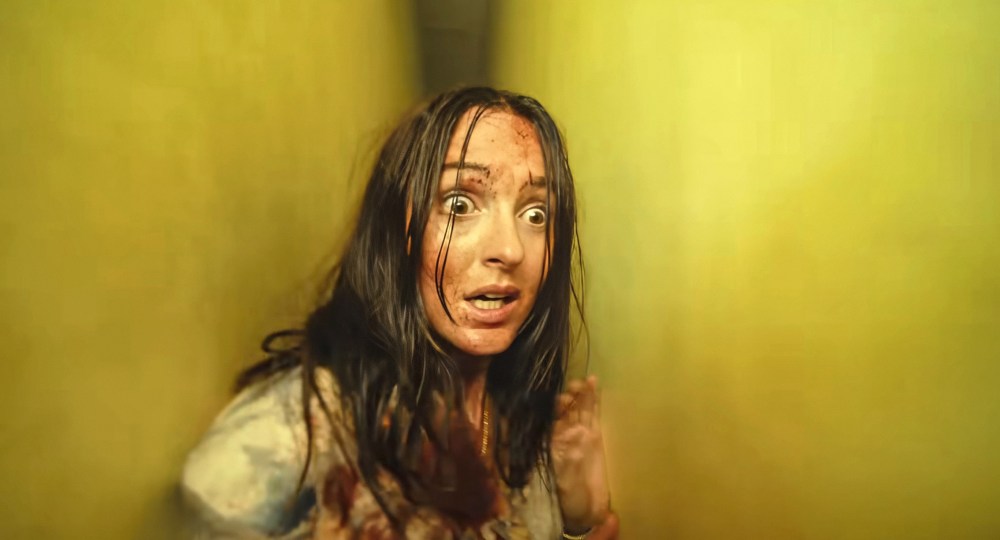
The movie that opened in limited release on 12 June 2026 is called "Backrooms," and it is, in almost every particular, the opposite of what internet horror has spent the last decade becoming. It is quiet. It is patient. It runs 96 minutes, contains no jump scares, and was made for $120,000 by a director born in 2004 whose first name has been, since 2022, a synonym for a particular flavour of online dread. Kane Parsons, the 16-year-old whose 16-minute found-footage short of the same name broke YouTube in January 2022, has now delivered his first feature. The result is a small, oddly disciplined film that treats its own source material as something to be respected rather than exploited.
That much is the consensus of early coverage, and it is the starting point for an argument that runs deeper than the film itself. "Backrooms," the meme and the mythos, began life on a 4chan thread in May 2019, migrated to a YouTube clip that registered more than 50 million views in its first year, was optioned by A24 and the Russo Brothers' AGBO studio in 2022, and has now, four years later, arrived as a 96-minute cinema release from director Kane Parsons and his production company, Crypt TV. The arc from anonymous greentext to arthouse horror label to multiplex-adjacent cinema is the kind of timeline that usually produces something bloated and self-conscious. Parsons has, against the odds, made something lean.
The film itself
Parsons has described "Backrooms" as a character study wrapped inside a location. The protagonist, played by Chiwetel Ejiofor in a casting choice that briefly broke the internet when it was announced in 2024, is a transport ministry auditor who steps, almost literally, into the wrong door in a disused office block and finds himself in the yellow-carpeted, fluorescent-lit, infinite-maze afterlife that the meme has been describing since 2019. There is no monster in the conventional sense. There is, instead, a slow accumulation of wrong details: a hallway that loops; a phone that connects to no network; a colleague who appears and vanishes. Ejiofor, by general agreement, does the heavy lifting with his face and his breathing.
The restraint is deliberate. Parsons has said in interviews that the appeal of the original meme was always its absence, that the horror lived in what the camera refused to show. The film preserves that refusal. The visual language leans on long static shots, an almost oppressively natural colour palette, and a sound design that treats the hum of a fluorescent tube as a melodic instrument. The Indian Express review, published on the day of release, called it "the first meme-to-film adaptation that understood the meme." That is a tidy way of putting a complicated thing.
From 4chan thread to feature film
The history matters here, because the film is in part an argument about the pipeline it travelled through. The Backrooms began on 4chan's /x/ board in May 2019 as a single image post describing an endless maze of yellow wallpapered rooms, fluorescent lighting, and a vague smell of old moist carpet. Within weeks it had been codified into a genre of creepypasta, mapped by amateur cartographers, set to music on YouTube, and, in January 2022, committed to video by a then-17-year-old Kane Parsons in a found-footage short that A24 executive producer Samhita Mukhopadhyay later described in an IndieWire interview as "the most efficient horror short we had ever seen."
Parsons was born in 2004, signed with A24 and AGBO in 2022, and spent the next two years developing the property into a feature. The production partnership with the Russo Brothers' AGBO studio, a company built on the industrial-scale storytelling of the Marvel Cinematic Universe, raised eyebrows in 2022 precisely because of the contrast: the people who normalised the $200 million superhero movie were now bankrolling a horror film about a man lost in an office. The completed film was acquired for distribution by 20th Century Studios (now part of the Disney empire) and released on 12 June 2026. The path from a 4chan post to a Disney release is the part of the story that the film itself does not address, but which a serious reader should keep in mind.
What the early reviews are saying
The Indian Express review, dated 12 June 2026, is the most useful piece of contemporary criticism because it is the most clearly written. The reviewer, Prachita Bhandari, argued that the film's success lay in its refusal to over-explain. "There is a version of this movie that spends its third act explaining what the yellow rooms actually are," she wrote. "Parsons has wisely declined to make it." The piece runs roughly 900 words and treats the film as a serious artefact rather than as a novelty adaptation.
Other early reactions have been more mixed. The trade press has noted that the film's deliberately slow pacing will test audiences accustomed to the cutting rhythms of conventional horror; some preview screenings in Los Angeles and New York produced walk-outs in the second half. The aggregate verdict across the early press cycle is that Parsons has made a film that respects its source and alienates part of the audience that came for the source. This is, on balance, the correct trade-off for the material.
A property, not just a film
The release has to be read as a property event, not a film event. "Backrooms" arrived on 12 June 2026 accompanied by a tie-in graphic novel published by AWA Studios, an active Discord server that claims more than 200,000 members, and at least three independent tabletop RPG adaptations using the original Creative Commons-licensed mythos. There is also a recurring ARG that the production team has been seeding for eighteen months, including a fabricated 1990s corporate training video that briefly fooled several corners of the internet in late 2024.
What Parsons and his producers appear to understand, and what distinguishes this property from the long sequence of meme-to-film adaptations that have preceded it, is that the Backrooms is not a story but a setting. There is no protagonist, no antagonist, no plot. There is only the maze. To make a feature film out of the maze, and to make one that runs 96 minutes without breaking the spell, requires a particular kind of editorial discipline. Parsons has shown that discipline. Whether the audience for it scales beyond the existing fanbase is the open commercial question.
The cultural argument
This is the part that belongs to the desk rather than to the wire. The story of "Backrooms" the film is, more interestingly, the story of what the algorithm-native internet does to its own myths. A generation that grew up with TikTok, Discord, and YouTube's recommendation engine does not consume horror in single, authored units the way previous generations consumed Stephen King or Clive Barker. It consumes settings. It picks a vibe, a colour palette, a few evocative phrases, and remixes. The Backrooms survived and thrived for seven years precisely because it was, at every stage, a container rather than a story.
A serious film made from that container, by a director who came of age inside the container, is a small but legible data point. It says something specific about where internet-native storytelling has arrived: at a place where the auteur and the algorithm have, briefly, the same taste. Whether that convergence holds or breaks is the question the next adaptation cycle will answer.