US strikes on southern Iran reopen a ceasefire Washington and Tehran had barely let settle
With an Iran-US memorandum reportedly hours from signing on 12 June 2026, US strikes hit southern Iran and an Iranian missile struck Ramat David. The same foreign ministry that declared a deal 'closer than ever' also confirmed Hormuz blasts. The ceasefire is being negotiated under fire, literally.
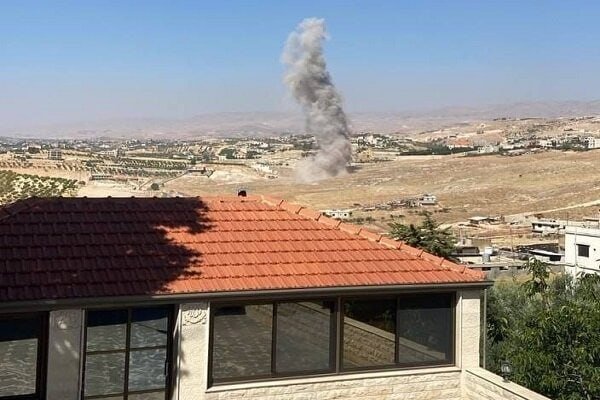
Two explosions were reported within an hour on the evening of 12 June 2026 near Sirik Port and Qeshm Island on Iran's southern coast. Iranian state broadcaster IRIB attributed the blasts to the IRGC enforcing a blockade in the Strait of Hormuz, framing them as the sounds of an active maritime cordon rather than incoming fire. Within forty minutes of those reports, the United States had resumed air operations against targets in the same coastal belt, collapsing a ceasefire that officials in both Washington and Tehran, hours earlier, had insisted was close to being sealed.
The contradiction is now the story. The White House and the Foreign Ministry in Tehran are publicly negotiating a 14-point memorandum of understanding, mediated through Islamabad, that both sides describe as closer to completion than any framework in the war to date. Yet the same evening, Iranian-launched missiles struck Ramat David Airbase in northern Israel, destroying a storage facility and likely damaging the IAF's 157th Electronic Warfare Squadron, while US strikes returned fire to southern Iran. The diplomatic track and the military track are running on parallel rails, and the closer the deal gets, the louder the bangs along the shore.
What is actually on the table
The draft memorandum, as circulated by Iran's Mehr News Agency and catalogued by regional monitors on 12 June, runs to fourteen points. They include a permanent and immediate cessation of hostilities on all fronts, including Lebanon; a US commitment to non-interference in Iran's internal affairs; the unfreezing of Iranian state assets held abroad, which Araghchi described as a non-negotiable condition ("none of our assets can be frozen again"); and a reconstruction track for damage inflicted during the war. Foreign Minister Abbas Araghchi told Iranian state television that the "Islamabad Memorandum has never been so close to completion", while warning journalists off speculating about its contents until the final text is published.
Two structural items sit above the standard confidence-building language. The first is the status of the Strait of Hormuz. Araghchi, in an interview with state-aligned outlets, was blunt: "The management of the Strait of Hormuz will not return to its pre-war state. The services provided in the future will no longer be free of charge." That phrasing, in plain English, amounts to a Tehran tollbooth on roughly a fifth of the world's seaborne oil. The second is Lebanon. Hussein al-Haj Hassan, a Hezbollah-aligned member of the Lebanese parliament, stated on 12 June that "Iran has informed us that Lebanon is part of the agreement, and Israel will withdraw from Lebanese territory," a claim that, if it survives contact with the final text, would link a US-Iran deal directly to the northern front.
The Gulf's quiet cash
What the memorandum will not say in print, but the reporting around it now makes visible, is the price tag already accruing on the margins. The Washington Post, as relayed by Middle East Eye on 12 June, reported that Qatar held secret talks with Tehran during the Israeli-US war and offered to help disrupt global energy markets if Iran spared the Ras Laffan gas complex, a quiet assurance that hydrocarbon infrastructure inside the Gulf would not become a target. A separate Middle East Eye report described the UAE paying Iran billions of dollars to halt strikes, with IRGC officials staying at the UAE national security advisor's guest house to cut the de-escalation.
These are not within the four corners of any 14-point document. They are the ductwork around it. The New York Times, as quoted by regional press on the same evening, framed the pressure more bluntly: "The world is rapidly depleting its oil reserves, and this is increasing the pressure on Trump to reach an agreement." Strategic petroleum stocks are not an abstraction in mid-June. They are the clock that runs underneath the negotiations.
Washington, holding fire, then not
President Trump's posture on 12 June was visibly aimed at closing the deal. He retweeted an Araghchi quote endorsing the emerging framework. AFP reported that Switzerland had formally offered to host a signing ceremony, with Bern's foreign ministry stating the country was "fully prepared." Araghchi, for his part, said the agreement "could be signed in the coming days, remotely," an unusual formulation that points to the legal difficulties of getting the principals, an American president and an Iranian foreign minister under sanctions, into the same room.
And yet within that same window, US strikes hit southern Iran again. The sequence is hard to read as coincidence. Iranian coastal cities were hit while Iranian state media was still publicly insisting that explosions near Sirik and Qeshm were the IRGC's own enforcement of a Hormuz cordon. The US appears to have calculated that a strike in the south, even with a deal in its final draft, sends a price signal: the diplomatic window is open, but it is not unconditional. Whether that calculus survives the morning of 13 June is the question the next twenty-four hours will answer.
What Tehran wants the world to notice
Iran's signalling on 12 June was unusually transparent by the standards of a wartime foreign ministry. The Pezeshkian message to Putin on Russia Day, publicly released in the same hour as the strikes, frames Moscow as a longstanding partner and a post-war reconstruction counterweight. Araghchi's interview language about Hormuz ("under the sovereignty of Iran and Oman," with no international regime) was calibrated for two audiences: a domestic one that wants to hear sovereignty restored, and a Western one that needs to hear that transit fees, not blockades, will be the instrument of choice.
The Hezbollah-linked claim on Lebanon, if true in the final text, would be the most far-reaching item in the package. It would mean a US-Iran memorandum reaches into Israeli-Lebanese territorial questions currently being negotiated, or fought over, on a separate track. Whether Tel Aviv has signed off on language that commits Israel to withdrawal is not in the public record on 12 June. The silence from Jerusalem, as the evening closed, was itself a data point.
The next forty-eight hours
Three calendars now overlap. The diplomatic calendar runs to a remote signing "in the coming days", pending Bern's hosting offer and final text agreement. The military calendar runs to whether the southern strikes of 12 June were a one-off pressure pulse or the start of a renewed escalation cycle, with Hormuz traffic watching both. The political calendar runs to whether Hezbollah's claimed gains on Lebanon survive Israeli review, or are quietly walked back before the ink dries.
For the moment, the story is the gap. A memorandum that is, in Araghchi's words, closer than it has ever been is being negotiated over the sound of explosions its authors insist are someone else's. That gap, between the signature being drafted in Islamabad and the bang still echoing near Sirik, is the working definition of this ceasefire.
Sources
- Telegram, englishabuali (2026-06-12T20:57). https://t.me/englishabuali/
- Telegram, DDGeopolitics (2026-06-12T19:44; 19:45; 20:45). https://t.me/DDGeopolitics/
- Telegram, megatron_ron (2026-06-12T19:44). https://t.me/megatron_ron/
- Telegram, GeoPWatch (2026-06-12T20:46; 20:52; 20:58). https://t.me/GeoPWatch/
- Telegram, ClashReport (2026-06-12T20:27; 20:41). https://t.me/ClashReport/
- X (Twitter), sprinter_press (2026-06-12T20:39; 20:43; 20:45; 20:46). https://x.com/sprinterpress
- X (Twitter), Middle East Eye (2026-06-12T19:39; 20:43). https://x.com/MiddleEastEye
- Al Jazeera, Breaking News (2026-06-12T20:44). https://www.aljazeera.com/news/
Desk note
Monexus read the 14-point draft and the surrounding wire traffic together, rather than as parallel stories. Wire coverage on 12 June tended to separate the "deal is close" line from the "US struck southern Iran" line; we ran them in the same frame because, on the public record at 2058 UTC, the same office in Tehran was claiming both that a Hormuz deal was imminent and that the explosions in the south were its own.