DRC Ebola Outbreak Surpasses 160 Deaths as Uganda Halts Flights
The DRC's eleventh Ebola outbreak has killed 160 and produced more than 900 suspected cases; Uganda's flight suspension is the clearest sign yet that the regional system sees the operating environment, not the virus, as the binding constraint.
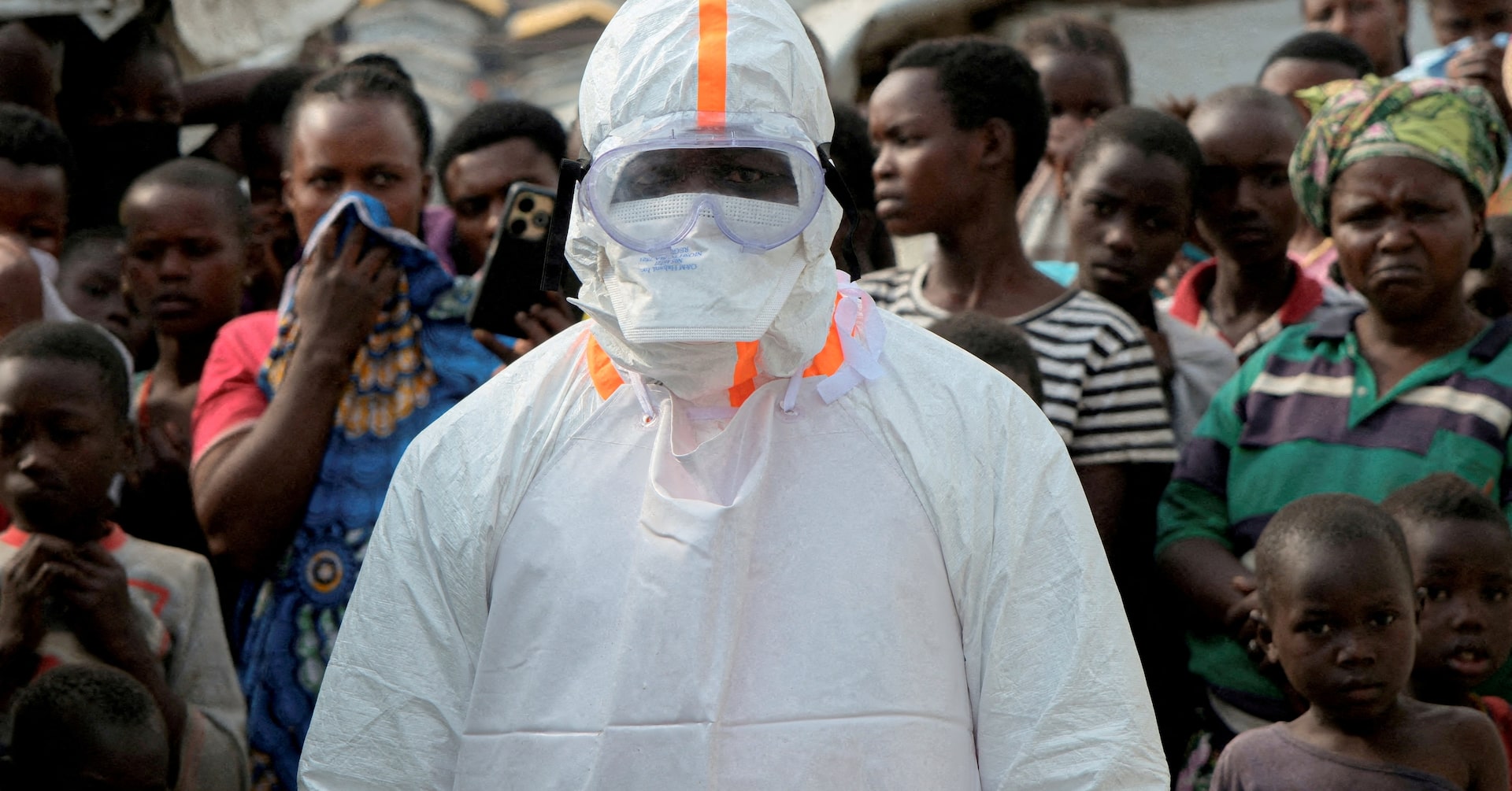
On 22 May 2026 the Democratic Republic of the Congo crossed another grim threshold in its eleventh recorded Ebola outbreak: 160 people dead, more than 900 suspected infections, and a Ugandan civil-aviation directive pulling the kind of regional passenger traffic that, in previous epidemics, has carried the virus across borders before anyone notices. The numbers, confirmed by WHO director-general Tedros Adhanom Ghebreyesus and relayed through Reuters, describe an outbreak that is no longer contained to a single province, no longer a story about a remote health zone, and no longer something a regional air-traffic regulator could shrug off.
That last fact matters. Uganda's decision to suspend flights into the eastern DRC is not a humanitarian gesture. It is an admission by a neighbouring capital that the international response, four months in, has not built the kind of perimeter previous Ebola operations have been built around. Frontline responders in Bulambuli and the surrounding eastern DRC health zones describe a familiar problem under new strain: limited isolation capacity, slow genomic sequencing of new cases, and a community-engagement gap that has followed this outbreak since the index case was confirmed in late January.
The numbers, and what the curve looks like
The WHO's 900-plus suspected-case figure, announced by Tedros on the weekend of 23 May and reported the same day by Reuters, sits well above the official confirmed-and-probable count that the DRC's Ministry of Public Health publishes weekly. The gap between the two is itself a reading on the state of surveillance. Suspected cases are people who meet a clinical case definition: fever, bleeding, organ failure, contact history. In a functioning outbreak response, the gap narrows as laboratories catch up. In this response, the gap is widening.
The Congolese health ministry's most recent published tally, carried by Al Jazeera English on 24 May, places the official death toll at more than 160 since the first cases were declared on 15 January. Case-fatality rates in previous Zaire-strain outbreaks have run between 60 and 70 percent where supportive care is unavailable. The DRC's outbreak is running inside that band. Thevirus itself, identified early as the Zaire ebolavirus, is the same strain targeted by the Ervebo vaccine deployed in the 2018-2020 eastern DRC outbreak that killed nearly 2,300 people. Cold-chain logistics, not vaccine science, are the constraint.
Capacity, not biology, is the binding constraint
What distinguishes this outbreak from previous responses is not the pathogen. It is the operating environment. Eastern DRC has been a contested theatre for at least three decades, with multiple armed groups active across North Kivu, South Kivu and Ituri, and a health-system backbone that was already weak before the latest round of conflict displacement. Treatment centres that can isolate infectious patients, run intravenous rehydration and discharge a recovered patient safely are scarce and frequently overrun.
WHO and Médecins Sans Frontières have rotated response teams in and out since February, but the rotation cycle has been visibly uneven. Al Jazeera's reporting from Kinshasa flags what responders have been saying privately: the international community treats Ebola in DRC as a recurring disaster narrative, dispatches surge teams for the photo opportunity, and withdraws before community trust is built. The 2026 outbreak is testing that theory in real time.
Vaccination has reached frontline health workers and contacts of confirmed cases, but coverage data has lagged behind the case curve. The Ervebo vaccine is highly effective when used in ring-vaccination protocols, but ring vaccination depends on contact tracers being able to move through communities, identify contacts, and follow up daily for 21 days. That work requires local staff, transport, and a community that answers the door.
Community trust is the operational chokepoint
In previous eastern DRC outbreaks, refusal of medical care and attacks on health workers emerged within weeks of index-case confirmation. The pattern has repeated in 2026. Community reluctance to bring sick relatives to treatment centres pushes patients deeper into family care at home, where transmission is hardest to interrupt. Burial practices, particularly around the handling of bodies, remain a sensitive point in rural eastern DRC, where the dead are typically prepared at home.
The DRC's Institut National de Recherche Biomédicale has spent years training local health workers in safe-and-dignified burial protocols. The work matters; it is also the kind of work that is invisible to the global press cycle and impossible to scale in a single month. Where the international response has emphasised laboratory capacity and case-count updates, the slower, more patient engagement work has lagged.
That is the lens this publication has chosen for the 2026 outbreak. The narrative is not about an unfolding international emergency in the abstract sense. It is about a response architecture that has repeatedly underestimated how hard the last mile is in eastern DRC, and about what that looks like in operational terms once a neighbour state is grounding flights.
Uganda's flight suspension, and what regional health governance actually does
Uganda's civil-aviation authority issued a directive on 22 May suspending passenger traffic into affected eastern DRC provinces and tightening screening at Entebbe International Airport. The move came a day after Uganda's Ministry of Health confirmed that three cross-border truck drivers had been isolated with suspected Ebola symptoms at the Mutukula border crossing. None of the three cases has yet been confirmed.
The flight suspension is a regional health-governance signal. Under the International Health Regulations, states have the right to impose travel and trade restrictions during public-health emergencies, but the same regulations explicitly discourage measures that are disproportionate to the public-health risk and that interrupt the flow of medical supplies and personnel. Uganda's move is closer to the latter category than the former. It will not stop an outbreak that is already seeded across multiple health zones; it will complicate the rotation of response staff and the delivery of laboratory samples to reference centres.
What the directive signals, more than anything, is that the burden of containment is being pushed outward from the DRC to its neighbours. Rwanda, Burundi, Tanzania and the Republic of Congo have all announced enhanced border screening in the past fortnight. None of them have yet imposed flight suspensions. Whether they follow Uganda's lead will be the first operational question for the WHO's Africa regional office in the week ahead.
The stakes if the curve keeps bending
The outbreak is at week 17. Previous large Ebola outbreaks in the DRC have run, conservatively, between six months and two-and-a-half years. The 2018-2020 outbreak, the largest in the country's history, was not declared over until June 2020, nearly two years after the index case. By that benchmark, the 2026 outbreak is at its first major inflection point. The community-engagement infrastructure is not in place at the level required to interrupt transmission at the current case rate. The laboratory surveillance backlog continues to widen. The neighbouring state system has begun to react.
There are two paths from here. The first is the path the 2018-2020 outbreak took: a slow grinding curve, hundreds of frontline deaths, mass vaccination, eventual fade. The second is a faster turnaround through intensified contact tracing, mass vaccination of health workers in all affected health zones, and the kind of local-community partnerships that have not yet been funded at scale for 2026. Whether the second path is taken will depend on decisions made in Geneva and Kinshasa in the next two to three weeks, before the next suspected-case surge makes the question moot.
That is the operational story to watch. Not the death count itself, grim as it is, but whether the response architecture finally catches up with the operating environment.
Sources: WHO figure of 900+ suspected cases, reported by Reuters, 23 May 2026 → https://t.me/aljazeeraglobal/29452 ; DRC ministry confirmed toll and outbreak update, Al Jazeera English, 22-24 May 2026 → https://t.me/alalamfa/29452 ; Al Jazeera Arabic regional coverage, 22 May 2026 → https://t.me/alalamarabic/29451 ; regional aviation and health response, Al Jazeera Arabic → https://t.me/alalamarabic/29450 ; Euronews wire coverage, 22 May 2026 → https://t.me/euronews/29448.
Desk note: Monexus frames the 2026 DRC Ebola outbreak as a test of community-engagement infrastructure in eastern DRC rather than as an unfolding international emergency in the abstract, prioritising the operational gap between surveillance capacity and ground-level trust.