The Silence After the Siren: How Ukraine Learned to Normalize the Unendurable
A Mykolaiv Telegram sequence of alerts and all-clears, carried by no major wire, exposes the structural gap between the cadence of an invasion that has become a daily metronome and the news apparatus built for events.
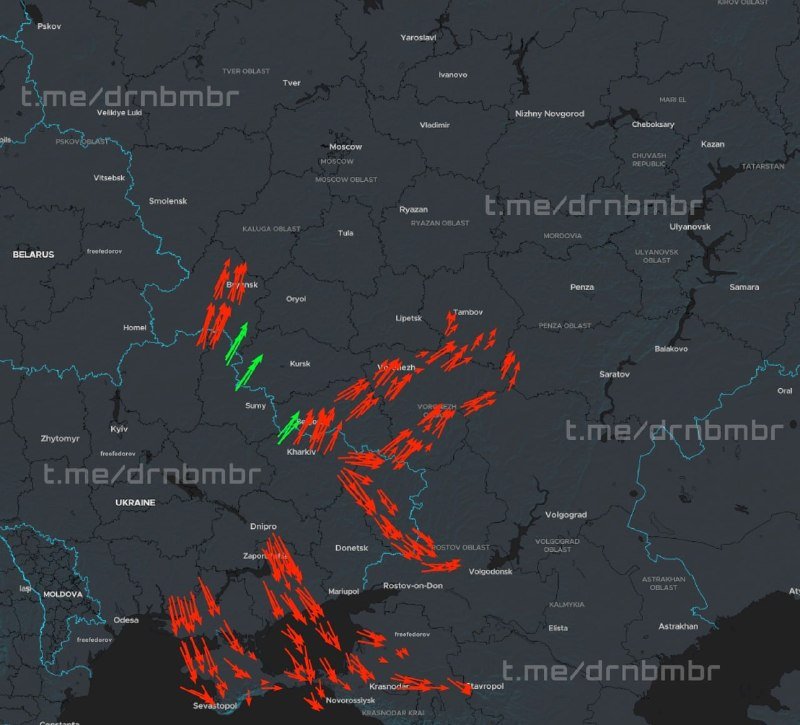
On the night of 2 May 2026, the Mykolaiv Oblast State Administration's Telegram channel posted the kind of sequence Western wire services rarely carry as a story of its own: an air-raid alert issued, an all-clear delivered, then another alert, then another all-clear, then another alert, compressed into a few hours of mundane municipal administration. Wire desks typically fold that granularity into overnight roundups or background paragraphs on overnight developments. Monexus is republishing the Telegram sequence because the rhythm itself is the news. The alerts were not a singular event. They were an evening, repeated across the country, the same way it has been repeated for more than three years.
The pattern does not need interpretation. It has its own ledger: a residential building damaged in Kharkiv, a maternity hospital in Sumy operating from its basement, an apartment block in Kyiv with the windows blown out on a Tuesday morning. The Kyiv Independent, Ukrainska Pravda and the Kyiv Post publish the day's toll as a matter of routine. Reuters and AP move the wire. International outlets reprint the photographs and the captions. Then the news cycle rotates forward and the buildings become background again, replaced by the next building, the next morning, the next set of names read at the next vigil. Coverage has not stopped. It has simply stopped registering as exceptional.
The wire and the alert cycle
What the Mykolaiv Telegram sequence makes visible is the granularity that wire formatting usually compresses. A single alert-to-all-clear cycle, lasting anywhere from twenty minutes to several hours, is too small a unit for a wire lede. The human cost of those intervals, the people carrying children into corridors and then carrying them back to bed, the doctors resuming surgery after pausing for the all-clear, the baker deciding whether to fire the oven before dawn, does not survive the cut from a regional Telegram channel to an international news desk. The result is that the lived texture of the war is filtered out of the reporting even as the war itself remains nominally covered. The wire carries the strike. The Telegram carries the night.
This is not a complaint about negligence. It is a description of a structural mismatch between the cadence of an invasion that has settled into a daily metronome of strikes, alerts and resumptions, and the news apparatus designed to surface the discontinuous, the novel, the breaking. A society that learns to function between alerts does not produce the kind of event that warrants a wire alert of its own. It produces a pattern. Patterns are harder to sell than events, and harder still to fundraise around.
The grammar of normalisation
The word "normalisation" has earned a bad name, but the process it names is real and it is happening. It refers to the slow migration of the unendurable from the category of emergency into the category of background. It does not mean the population has stopped feeling the shock. It means the routines of ordinary life have been re-engineered to absorb it. Ukrainian media has documented this in granular form. Ukrainian railway workers now run evacuation trains on schedules that assume the track may be cut at any moment. Ukrainian hospitals have begun treating mass-casualty triage as a standing capability rather than a disaster response. Ukrainian school administrations publish calendars that mark air-raid drills as recurrent items rather than extraordinary ones. Each of these adaptations is sensible. Each of them is also, taken together, a quiet concession that the war has become the operating environment rather than the interruption to it.
Reporting that frames this as resilience alone is incomplete. Resilience describes what a society does. Normalisation describes what the rest of the world's attention does. Foreign press cycles still move on Ukrainian strikes, on Zelenskyy's diplomatic moves, on the rare and dramatic Russian failures. They move on less reliably on the Tuesday that looks like the Monday that looked like the Sunday before it. A pattern is not a story; a pattern is an editorial problem, and editorial problems tend to be solved by silence rather than by redesign.
What the silence registers
The cost of the silence is not disinformation. It is not a coherent denial or a coordinated cover-up. It is the quieter thing that happens when a stream of small shocks stops generating the kind of surprise that an audience treats as news. In the literature of conflict reporting, the vocabulary for this is well established even if the framings are not: saturation, fatigue, the paradox of the chronic emergency. In practice, what it means is that a residential building in Kharkiv damaged by a glide bomb on a Wednesday afternoon in May 2026 will receive a wire mention, a handful of paragraph-depth follow-ups in regional outlets, and almost no sustained attention from international broadcasters once the footage has been pushed through the second-day news cycle. By the weekend, the next building is the story.
None of this is novel. War reporters have long observed that the deadliest phase of any conflict for civilian attention is the one in which the fighting has become predictable. What is specific to the current phase of Russia's full-scale invasion is the volume. There are more alerts, more buildings, more names, more evenings that look like the Mykolaiv sequence than at any previous point in the war. The signal-to-noise ratio of any individual alert has fallen. So has the political bandwidth of the foreign audiences whose pressure is, in practice, what determines whether the air-defence deliveries arrive on schedule.
What Kyiv is asking for, and what Kyiv is not
President Zelenskyy's declaration of a "regime of silence" for the night of 5–6 May, framed as a reciprocal arrangement with Moscow, is best read in this context. It is, on its face, a tactical proposal. It is also, in the longer arc, an attempt to reclaim the discreteness that the alert cycle has eroded. A silence regime produces an event. An event produces a wire. A wire produces an international conversation. If the proposal holds for even a few hours, it interrupts the pattern. If it collapses, the collapse is itself the story. Either way, the war becomes, briefly, discontinuous again.
The deeper wager is whether the international audience will treat the next round of strikes as a fresh crisis or as a recurrence. The Ukrainian government has spent more than three years refusing to let the war become routine. The Telegram sequence from Mykolaiv is, in a small way, evidence of the same effort at the level of municipal administration. The question for readers outside the country is whether the silence after the siren still registers as silence, or whether it has already been absorbed into the ambient noise of a conflict that the global attention economy is, slowly, learning to filter.
That is the thing to watch in the weeks ahead: not whether any single alert cycle is carried by the wires, but whether the cycles themselves are still treated as a story. The siren is still loud in Mykolaiv. The question is whether the rest of the world has remembered how to hear it.