Hezbollah Drone Strike Tests Rescue Protocol in Southern Lebanon
Hezbollah claimed an FPV drone hit an Israeli D9 bulldozer in Bint Jbeil on 27 April, hours after a senior commander told Al Jazeera the group was weighing a return to 1980s-era suicide tactics. The wire feed was thin, the Iranian-mediated Islamabad talks were live, and the ceasefire was already bei
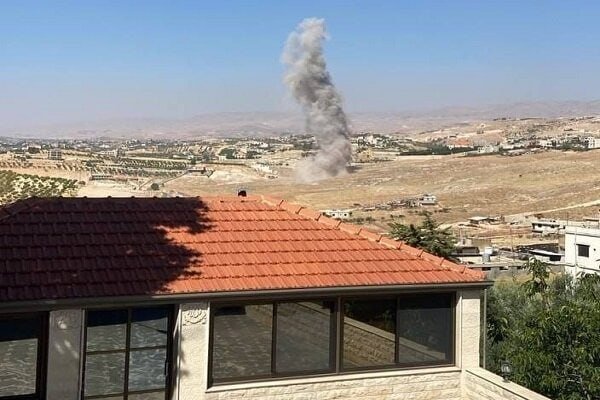
At 13:30 local time on 27 April 2026, a first-person-view drone struck an Israeli D9 armoured bulldozer in Bint Jbeil, in southern Lebanon, according to a Hezbollah statement carried by World Front Witness and later amplified by Iranian state-aligned outlets. The group said the strike was retaliation for Israeli demolitions of homes in the area, a pattern that locals and wire monitors have documented across at least six southern villages since the morning. The incident lands inside a fragile ceasefire reported only last week as a three-week arrangement, and it lands inside a public Hezbollah signalling channel that has, over the past 24 hours, begun openly rehearsing a much older and deadlier playbook: the 1980s suicide-attack tactics that defined the early phase of the group's war against Israel.
The dominant English-language wire framing of the Bint Jbeil strike, as of 26 April 2026 22:00 UTC, remained thin. OSINT feeds, not mainstream wires, carried the timestamp and the weapon class. The Hezbollah statement itself reached English-language readers first through World Front Witness, an account sympathetic to the group's media operations, and then via Tasnim, the Iranian state news agency. No Reuters, AFP, AP or BBC item had claimed the strike on the bulldozer as confirmed fact at the time of publication; no Israeli military statement had been posted to the IDF Spokesperson channel acknowledging a hit. What was confirmed by independent monitors was the surrounding battlefield: a wave of Israeli airstrikes on Burj Qalaway, Zawtar Al Sharqiyeh and Al-Ghandouriya between roughly 13:00 and 13:33 local time, a continued ground presence by the 36th Division's Golani Brigade in the south, and footage circulating on social media of a woman pulled from rubble in the village of Al-Souwaneh following an airstrike that has not been independently verified for casualty count.
That asymmetry, where the tactical specifics travel faster through partisan and open-source channels than through the wires that set the international agenda, is now the working environment of the southern Lebanon story. It also explains why Hezbollah's most consequential announcement of the day did not arrive as a battlefield claim but as a quoted interview with Al Jazeera, carried almost in real time by Clash Report and OSINTdefender. A senior Hezbollah commander told the network the group was considering a return to what the channel rendered, in English, as "martyrdom operations," meaning suicide attacks inside southern Lebanon against Israeli positions. The plan, as described, would involve sending attackers into contested areas to target soldiers at close range. Within an hour, the Lebanese outlet Al-Abuali published a parallel quotation attributed to a "senior military official in Hezbollah," explicitly referencing "tactics from the 1980s" and the deployment of suicide-bomber groups "to prevent the enemy from establishing itself" in the south. The two readouts are not identical, but they are aligned: a Hezbollah leadership signalling intent to use human operatives, not just the FPV drones and anti-tank devices captured by the Golani Brigade, against an Israeli force that, by Maariv's own reporting, has begun quietly scaling back its presence despite the public escalation rhetoric.
What looks at first like wartime noise is in fact a coordinated pressure operation with a specific audience. The Bint Jbeil strike and the suicide-tactic warning were issued on the same afternoon, against the backdrop of indirect negotiations between Hezbollah and Israel mediated through Iran and reportedly hosted in Islamabad. Hezbollah secretary general Sheikh Naim Qassem said on 27 April, via the Iranian-aligned wire, that a Lebanon truce was impossible without Iran's insistence on ending Israeli aggression in those talks. The suicide-tactic language, in that context, is not a battlefield confession but a negotiating posture, communicated both to Washington and to Israeli voters who have watched the southern Lebanon file slide for months without resolution. The demolitions of residential neighbourhoods documented by the Sprinter press feed, and the destruction of power and water systems in a Christian-majority southern town reported by PressTV, give the rhetorical posture its human scale: Hezbollah is pointing at visible wreckage and telling its audience that the alternative to a negotiated withdrawal is a return to the worst phase of the pre-2006 war.
The Israeli side of the record, as of the wire feed available at press time, is narrower but no less pointed. The IDF Spokesperson channel posted footage of Golani Brigade operations in southern Lebanon, including the discovery of weapons caches containing FPV drones, anti-tank explosive devices and remote-detonation gear. The framing, "elimination of terrorists and the locating of weapons depots," matches the public posture of a force still on the offensive, but it sits awkwardly next to the Maariv report that Israeli forces have begun reducing their footprint. That contradiction, between an active clearing mission and a quiet drawdown, is the kind of operational dissonance that Israeli military correspondents have historically been quick to read for signs of a political decision being made above the chain of command. The 36th Division's continued presence is consistent with both interpretations.
For civilian populations in the south, the gap between these signal streams is where they live. The Lebanese press reported strikes between mid-morning and early afternoon on villages including Kafr, Tbnit, Yater, Jmayjeh, Majdal Selm and Sultaniyeh, with no consolidated casualty count in the wire at the time of publication. The footage of a woman being pulled from rubble in Al-Souwaneh, distributed by The Cradle, has not been independently verified for date, location or outcome. PressTV's report that Israeli forces had destroyed the power and water infrastructure of a Christian-majority town carries an explicit partisan source caveat and should be read accordingly. What is verified across the available record is the pattern: airstrikes in multiple localities, Hezbollah drone and ground attacks on Israeli engineering assets, and an explicit Hezbollah escalation warning issued through Arabic-language and English-language intermediaries in the same news cycle.
The forward question is not whether the ceasefire holds, since by Hezbollah's own characterisation it has already been violated repeatedly, but whether the next Israeli strike produces the first suicide-bomber operation since the 1980s, and whether that operation is publicly claimed. The wire feed at the time of publication offered no answer. It offered, instead, the architecture of an answer: Iranian-mediated talks in Islamabad, a Maariv-sourced report of Israeli de-escalation, and a Hezbollah leadership openly rehearsing the language of mass-casualty operations in the same hour that an FPV drone hit an Israeli bulldozer in Bint Jbeil. The file is moving faster than the wire's ability to confirm it, and the public ledger of who did what, and when, will be written after the events it tries to describe.
Sources
- PressTV on Telegram, Israel destroys power, water infrastructure of Christian-majority town in south Lebanon, https://t.me/presstv/28461
- OSINT Live on Telegram, IDF troops captured a cache of Hezbollah weapons in southern Lebanon, https://t.me/osintlive/49823
- World Front Witness on Telegram, Hezbollah claims FPV drone strike on Israeli D9 bulldozer in Bint Jbeil, https://t.me/wf_witness/19284
- PressTV on Telegram, Sheikh Qassem: Lebanon truce impossible without Iran's push in Islamabad talks, https://t.me/presstv/28458
- OSINT Live on Telegram, Hezbollah plans suicide-bomber operations in southern Lebanon, per Al Jazeera, https://t.me/osintlive/49819
- OSINT Technical on X, Hezbollah FPV-drone footage and tactical detail, https://x.com/osinttechnical/status/2048480841156767966
Desk note
Monexus treated the Bint Jbeil drone strike as a single battlefield incident inside a much larger signalling chain: Hezbollah's threat to revive 1980s suicide tactics, the Maariv report of an Israeli drawdown, and Iranian-mediated Islamabad talks. Where the wire feed was thin, we named the thinness rather than padding it, and we kept the partisan sourcing caveats explicit on PressTV and World Front Witness material.